 Playable Books
Johann Joseph Fux · section 10 of 32
Fourth species in three voices: ligatures
Read and hear this section in the playable edition →Fourth lesson
On ligature
Here we must recall what was said about ligatures in two voices. Their manner of construction is not to be changed at all in three voices, but must be observed exactly. We need now only explain how the accompanying concordance is to be arranged when the third part is added. It is also important to remember what was said above: a ligature is nothing other than a delay of the following note. Hence this paradox: the same concordance must be assigned to the third part as would have been used if the ligature were omitted. The following examples will make this truth clear.
Without ligature
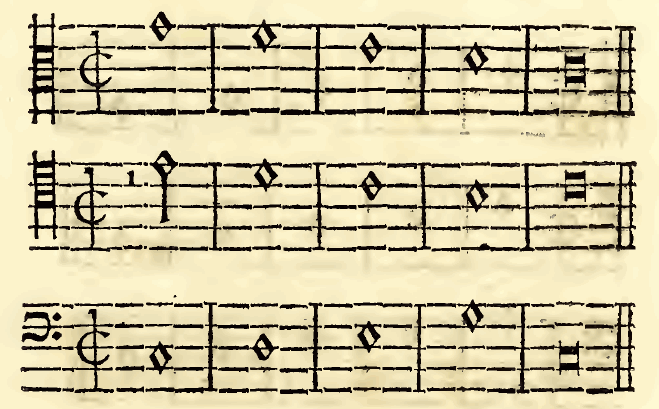
With ligature
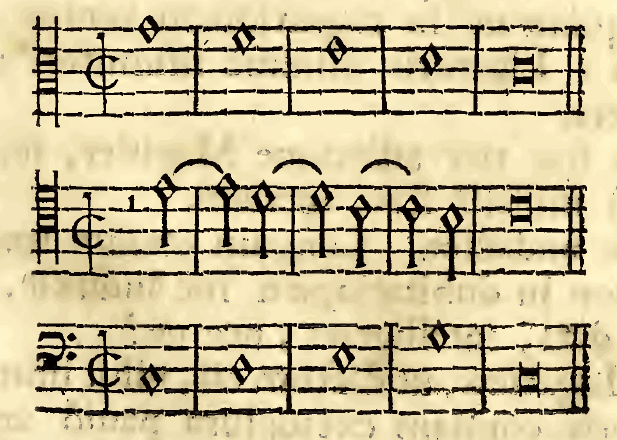
Here it is clearly seen that in both examples the third part has the same concordance, the ligature presenting no obstacle. I think the same must be understood of ligatures placed in the low, or foundational, part. For example:
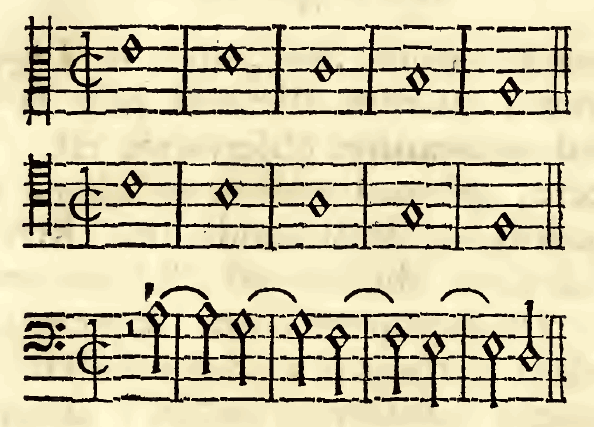
With the ligatures removed, these cases would take the following form on account of the harmonic triad, were it not prevented by another consideration, namely the immediate succession of several fifths:
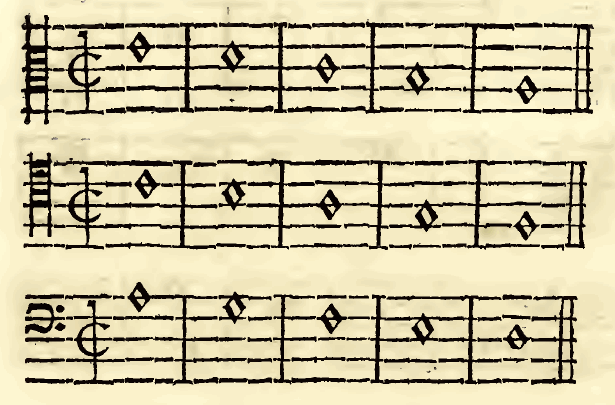
Joseph, I have placed this faulty example before your eyes for no other purpose than to bring you to understand that the disposition of the concordances is not changed at all by ligatures, but remains exactly the same.
Joseph. From this assertion of yours, Master, a doubt arises in me, which, if you do not mind, I shall disclose.
Aloysius. Speak boldly. Your long silence thus far has almost made me doubt whether you understood what I said without interruption or not.
Joseph. If ligatures change nothing, as was said, the first example with ligatures given a little earlier will be just as faulty as the second. Therefore, just as in the second example, with the ligatures removed, an immediate succession of several fifths appears, so for the same reason, if the ligatures are treated as not having been added, the first example furnished with ligatures will not be free of the same fault.
Aloysius. I am very pleased by this shrewd argument of yours, a sign of your great attentiveness. But, besides the great weight that must be given to the authority of distinguished masters of the art, who approve the first example and disapprove the second, you must know that when I said ligatures change nothing, this was to be understood only of the nature and essence of the concordances, which is the same in both examples. Otherwise, who can doubt that ligatures have the greatest force and power to make things permissible and to change them?
Joseph. My argument would be resolved by this distinction of yours, were it not opposed by the example of ligature given above in two voices, which you rejected as faulty because it was unable to make two octaves permissible. For example:
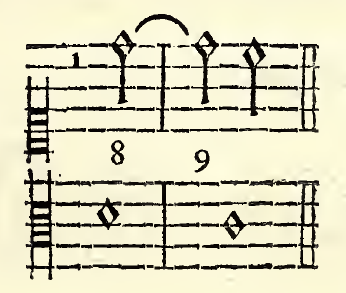
Just as the ligature in this example cannot prevent two faulty octaves from occurring, so, for exactly the same reason, in the following example it will not be able to make two fifths permissible:
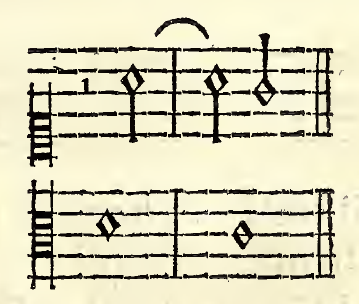
Aloysius. To resolve this by no means slight objection of yours, it helps to know that many things are forbidden in the high part, because it is more perceptible and more readily reaches the ear, which are tolerated in the low part, being somewhat obscured by its low register and not striking the hearing very strongly. For high pitch distinguishes; low pitch suppresses. Then, to arrive at a more fundamental reason and distinction, let us recall what we said elsewhere about the perfection of consonances: namely, that the fifth is a perfect consonance, the octave more perfect, and the unison the most perfect; and that the more perfect they are, the less harmony they possess. Furthermore, it is established that dissonances in themselves lack all the pleasantness and grace of harmony. Whatever is agreeable and pleasing that they offer the ear must be attributed entirely to the benefit of the following consonance into which they resolve. From this it is clear that a dissonance resolved to a fifth is more tolerable than one that happens to resolve to an octave. It is therefore not surprising that good masters reject the first example as faulty, but approve the second as conforming to the precepts of counterpoint. Finally, the more the perfect consonance into which a dissonance resolves approaches the nature of an imperfect consonance, the more readily the resolution should be excused and allowed. Now, if you are satisfied, prepare yourself for the exercise in this species of counterpoint.
Joseph. I shall do as you command.
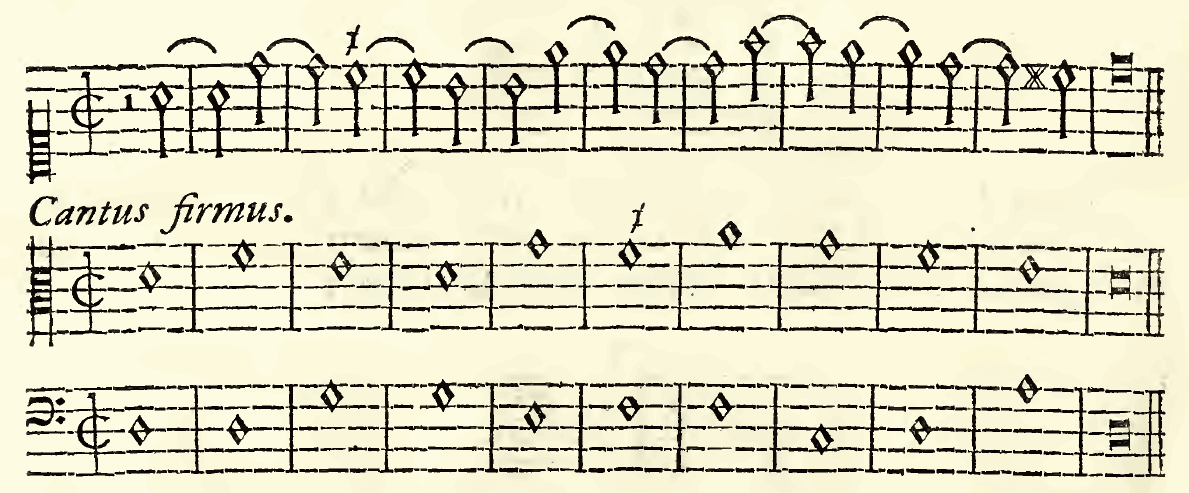
Aloysius. Why did you place a sign of error, or rather of doubt, in the soprano part of the third measure?
Joseph. I have not yet forgotten that the first part of a ligature must be a consonance. But in that place I used a dissonance, namely a fourth, partly because, owing to the necessity of placing two semibreves, I could not find another way to do it, and partly because I remember having seen examples of this kind in good masters.
Aloysius. This scruple of yours is very praiseworthy, and bears witness to your great attentiveness. But it does not matter that this case is less in accord with the strictness of the rules. For the statement that the first part of a ligature must be consonant is to be understood of cases in which the foundational part moves in every measure, not of those in which the bass remains stationary, as we commonly say, and is held in the same position. In that case a ligature consisting entirely of dissonances is not only without fault but is used with the greatest elegance, as the following example demonstrates.
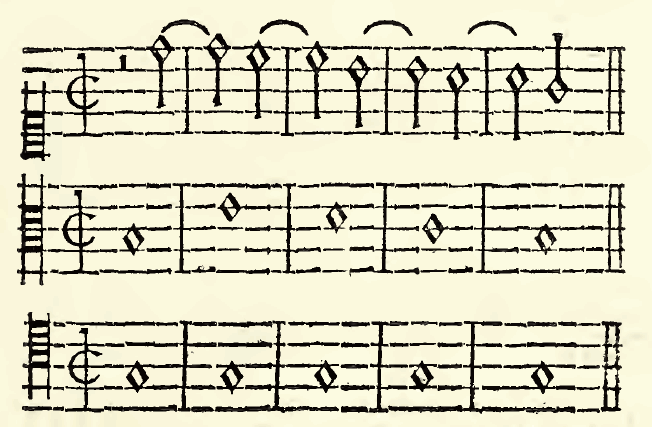
What does the other sign of doubt in the sixth measure indicate?
Joseph. I know that the seventh requires a third as its companion; but there, because of the constraint of the cantus firmus, I associated an octave with it.
Aloysius. You must remember that here we are engaged in lessons and in the study of inserting a ligature in every measure, without adhering too strictly to the requirements for the other concordances, of which we have spoken elsewhere and shall speak again. A different judgment must be made concerning free composition, where no constraint prevents each dissonance from being given its own appropriate concordance. Therefore that seventh associated with an octave must be tolerated. Now let us turn to the remaining exercises.
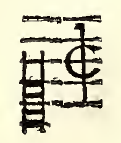
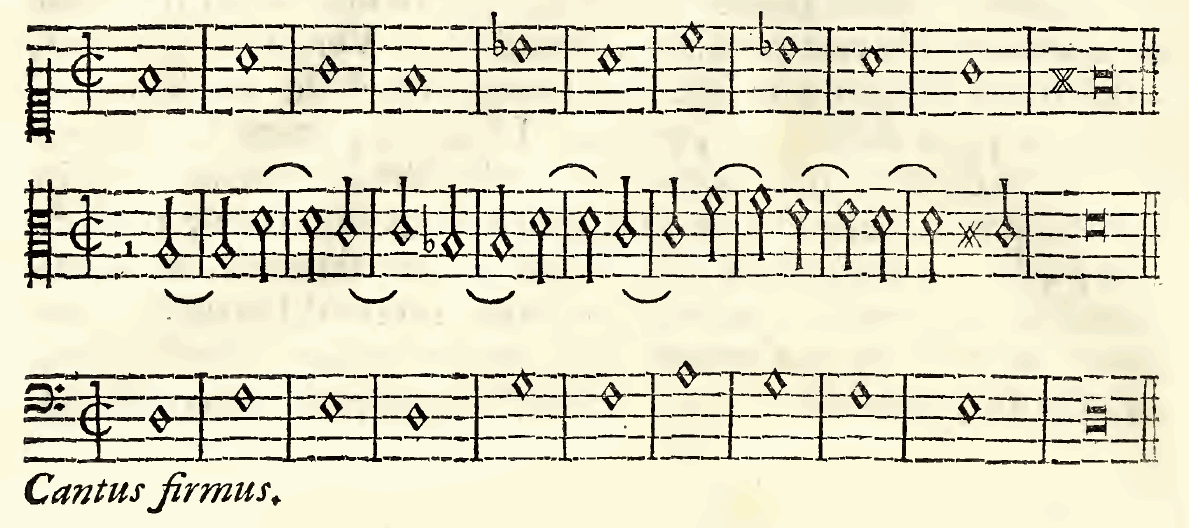
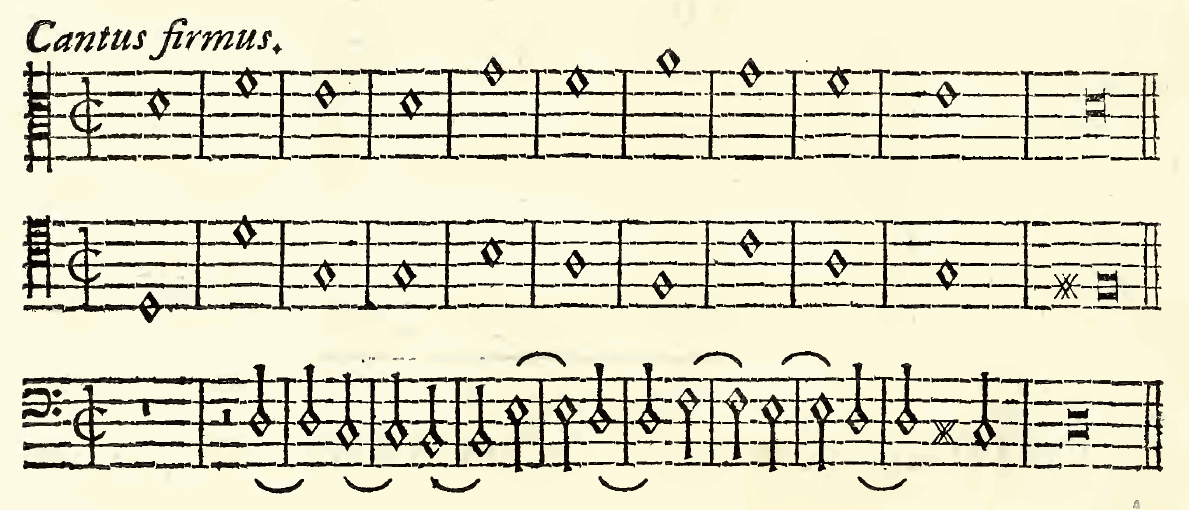
Aloysius. Why did you use a rest of one measure at the beginning of the foundational part in the last example?
Joseph. Because I could not find a way to use a ligature there, and I did not think that space should be filled with another species of counterpoint; I therefore tried to help myself by means of a rest.
Aloysius. I am not displeased by this resourcefulness of yours. Nevertheless, it could have been done in the following way.
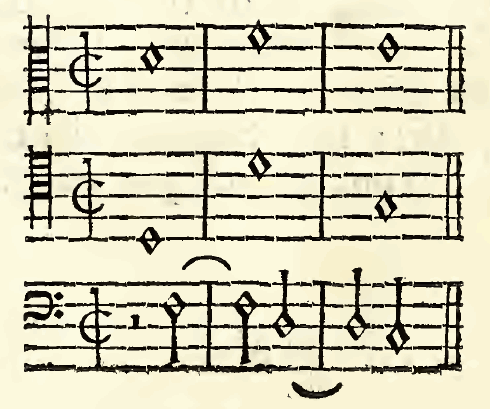
Here the tenor performs the function of the bass in the first measure. This can happen not only to the tenor but also to the alto, and even, if it were possible, to the soprano. Thus the lowest part, whatever it may be, must be taken as the foundation, and the others built upon it. Now proceed to construct examples for the two further tenors that follow in their natural order.
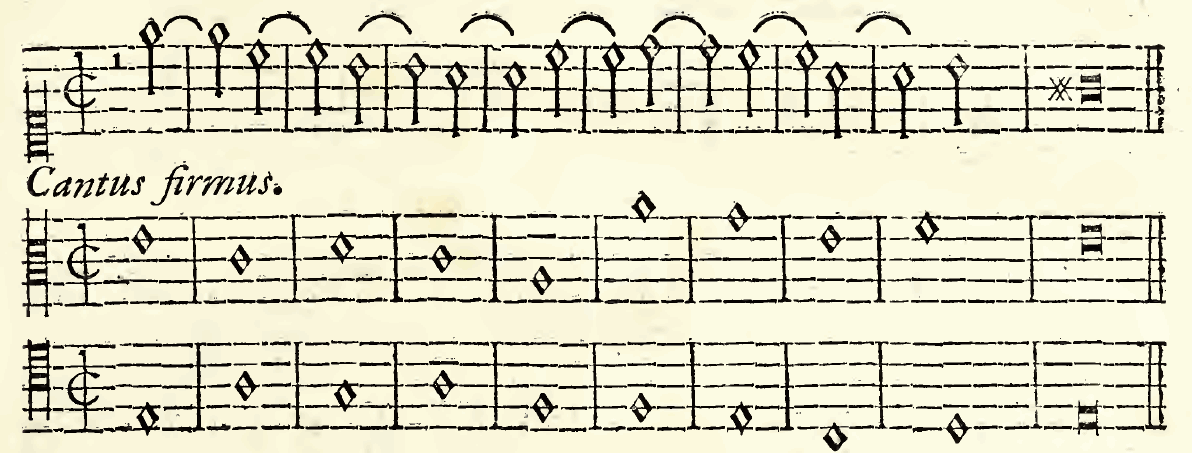
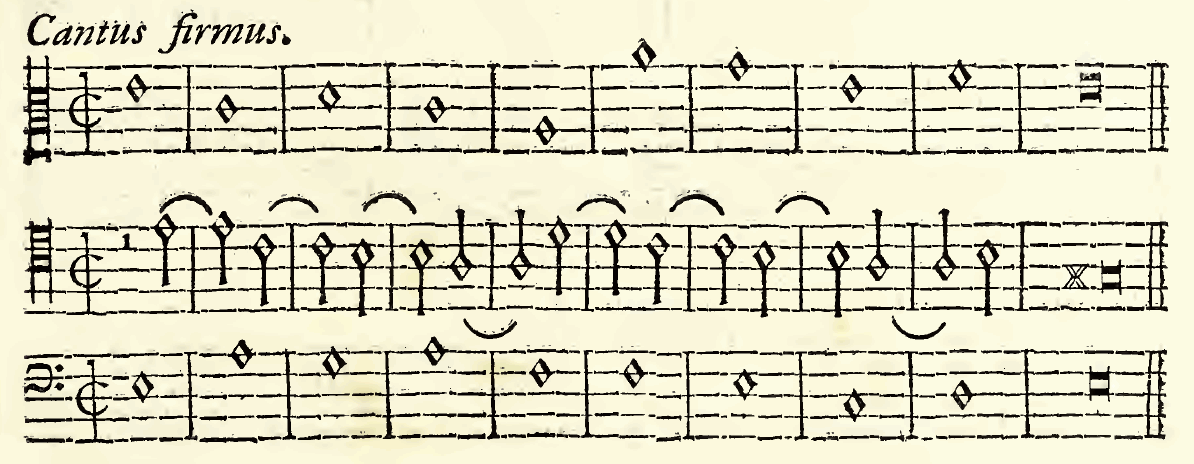
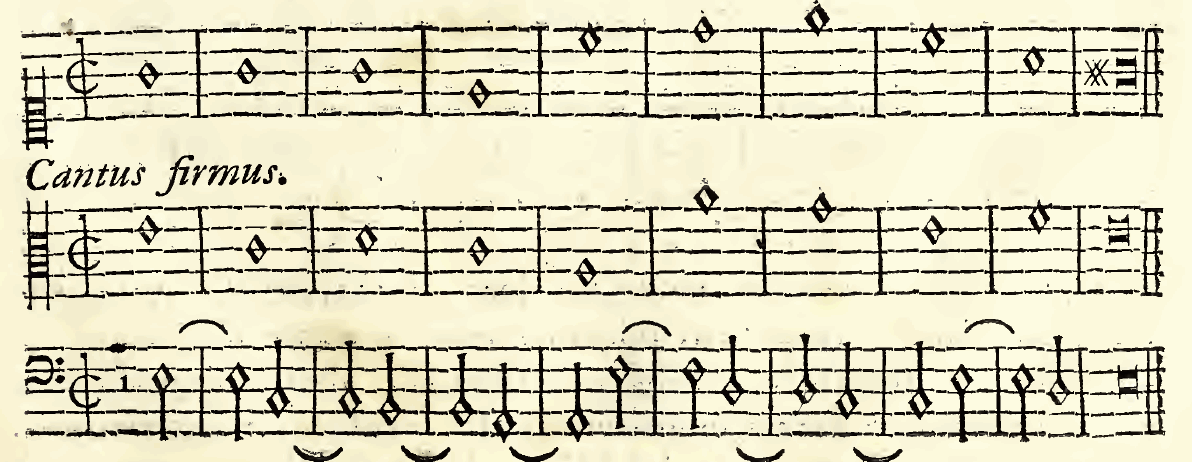
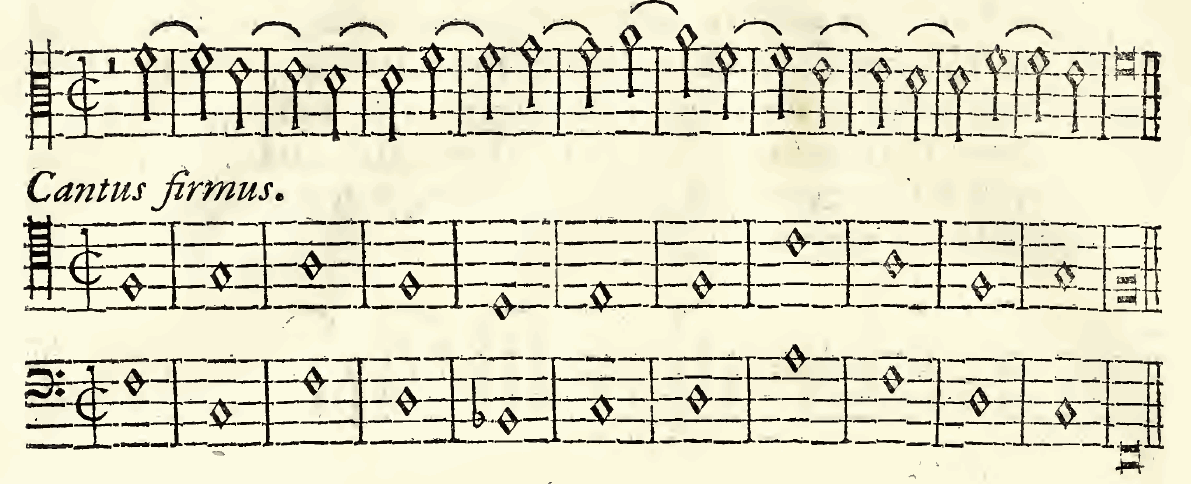
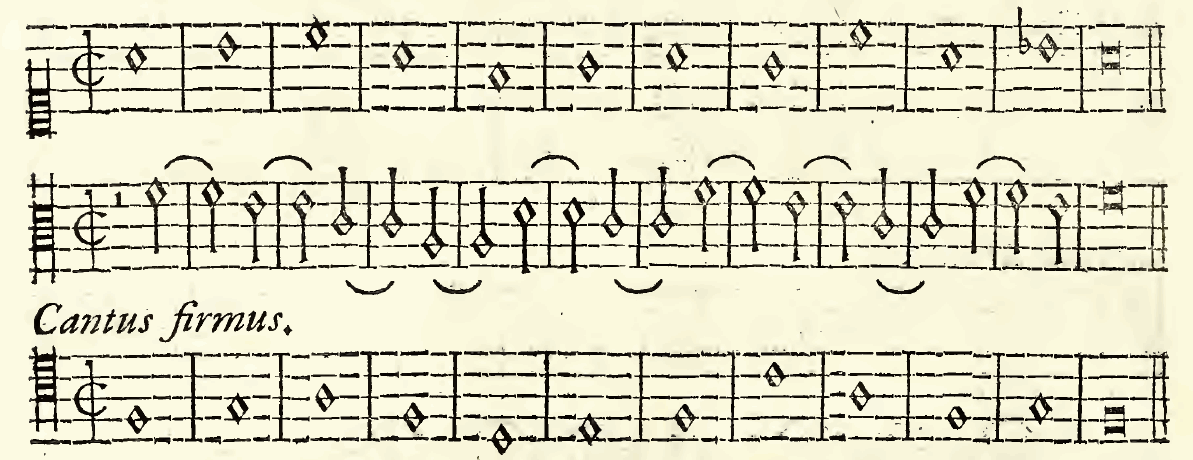
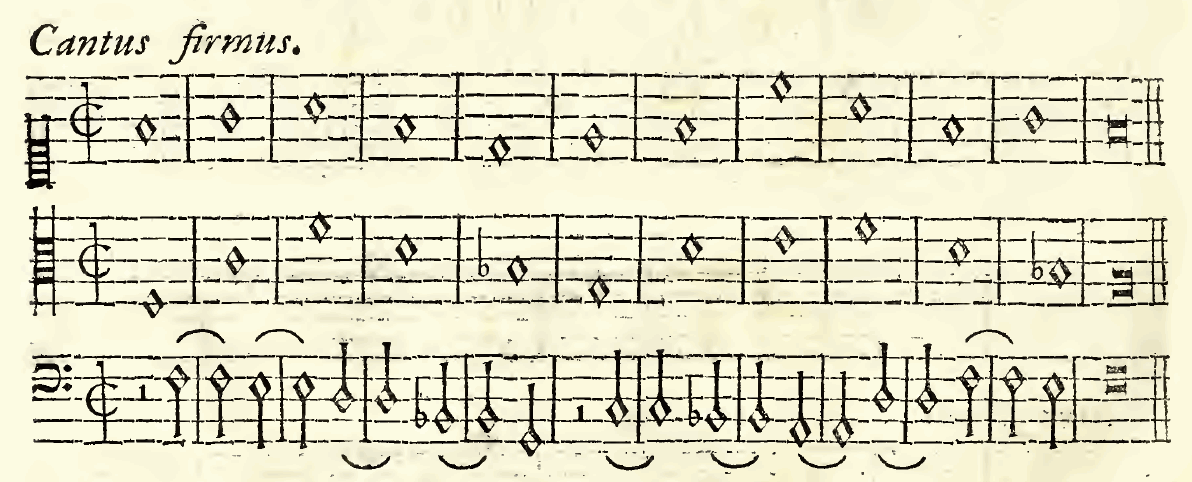
Aloysius. These exercises have been worked out with regard to harmony as far as ligatures placed with two semibreves in every measure permit; for the restriction of this species does not allow harmony complete in every respect. Moreover, as we have often said, greater consideration is given here to ligatures, which, appearing in so many different ways in this exercise, provide a complete understanding of how to construct them. I therefore most strongly commend this exercise to you as a principal ornament of composition. What could have been done better is the first measure of the exercise, which is as follows:
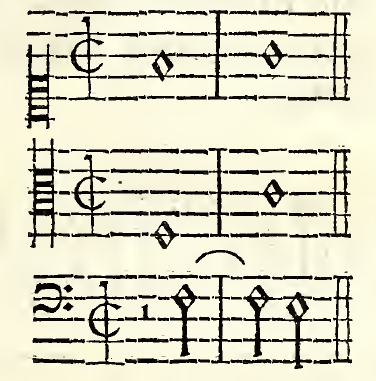
Here a hidden succession of two fifths arises between the alto and soprano, which, being readily perceived by the ear, must be avoided in three voices. This can be done by placing a rest in the alto, in this way:
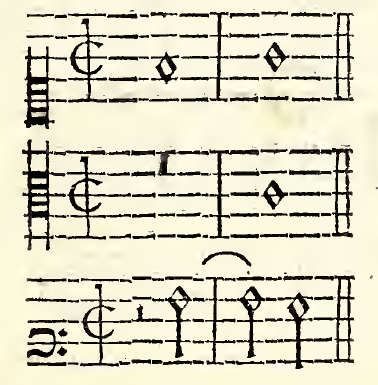
Joseph. I used a similar aid in the sixth measure of the bass in the same exercise, where otherwise I could find no means of proceeding further through the series of ligatures.
Aloysius. That was resourcefully done. For the precept about making ligatures in every measure must be understood only as applying where the opportunity exists. You will go through the remaining three modes with the same exercise.