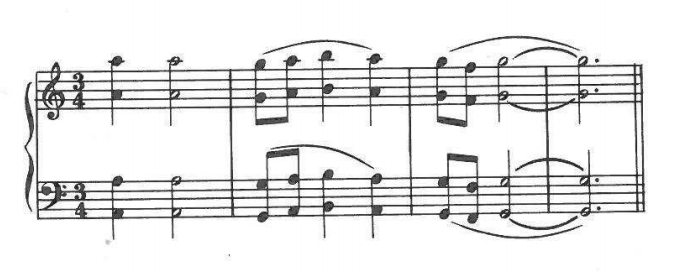
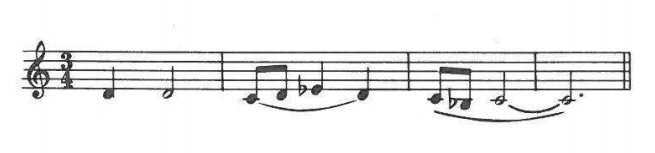
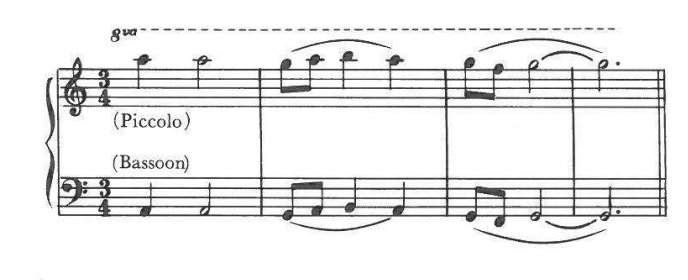
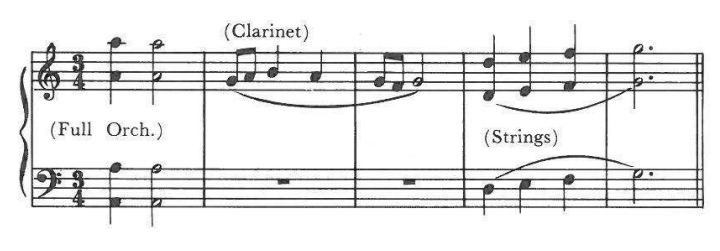
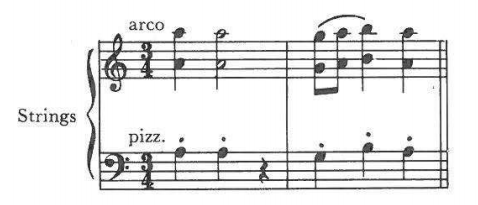
Of the eight types of texture, the simplest is the monophonic. Monophonic means "single-voiced" or "unisonal," but in the orchestra such unison can be composed of either a single line or any amount of octave doubling.
One use of monophonic texture is in the so-called "grand unison," with all instruments doubling in their natural registers (bottom of preceding page); or the instruments may be used to produce an intense and concentrated single line in middle register (such as viola, cello, horn, high bassoon, or low clarinet).
Variegation of pitch locale and articulation, and a certain effect of light and shade achieved by alternating octave doubling with single line, all contribute to a needed variety. If the experimental procedure also includes variegation of timbre, it can be seen that the possibilities for monophonic interest are far-reaching indeed.
The creative and historical importance of the monophonic texture is evidenced by the emphasis that it received in early European and Oriental music. A study of the music of India and China gives a vision of the possibilities to be explored. The student is referred to the Louisville Symphony recording And The Fallen Petals by Chou Wen-Chung. This is an outstanding example of essentially monophonic procedure, intensely variegated, especially by variety of timbre, with much use of percussion.
 Playable Books