Playable Books
Ebenezer Prout · section 3 of 50
Fugue 1 · Book I, No. 1 · BWV 846
Read and hear this section in the playable edition →

C Major (Four Voices).
Exposition
The subject of this fugue—
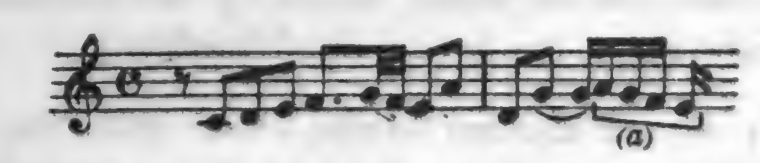
which is in the alto, extends to the first note in the third crotchet of bar 2. As it moves by step from tonic to dominant, and does not modulate, it takes a real answer, given to the treble. As the fugue contains an unusual amount of stretto, it has no regular countersubject; but, in order to give unity to the composition, the last four semiquavers of the subject, marked above with ' (a)—', are very frequently used throughout the fugue, either by direct motion, as in bars 2, 7 and 10, or by inverse movement, as in bars 4, 5 and 6.
At bar 4 must be noted an irregularity. According to rule, the third voice should enter with the subject; here, however, Bach puts the answer in the tenor, and gives the subject to the last entering voice—the bass.
Counter-Exposition
At bar 7, immediately on the close of the exposition, follows the counter-exposition, in stretto. This is led by the treble, (which, it will be seen, had the answer in the exposition), and answered at one crotchet's distance by the tenor. At bar 9 the answer is repeated by the alto.
Middle Section
The second (modulating) section of the fugue begins at bar 10. At first sight it looks as if the bass entry in this bar belonged to the counter-exposition. But the immediately following entry of the alto on D (the fifth above G) proves the bass to be now the subject in the key of G, and not (like the alto in bar 9) the answer in the key of C; if it were, the alto would have begun on C, a note lower. We have here reached the middle section of the fugue, as is further shown by the succeeding entry of the tenor (bar 12), on the dominant of A minor.
At bar 14 we see another stretto, closer than the preceding, and in which all the voices take part. It is not very common to find middle entries (as here) in the original keys of the tonic and dominant, though another instance will be seen in the third fugue of the first book; but there is generally less modulation in fugues that contain much stretto or close imitation than those of simpler construction. Note that the entry of the treble in bar 15 is incomplete; the answer is interrupted, to allow the same voice to begin a new stretto. The treble now leads (bar 16), with the subject in C, followed at one beat's distance by the alto with the answer a fourth below; at the beginning of bar 17 the tenor begins the answer on A, while the bass has the subject in D minor. Observe that the first note of the subject in the bass is here lengthened. It should also be noticed that we call these entries "subject" or "answer" when their keys bear to one another the relation of tonic and dominant; in bar 16, G being the dominant of C, the treble is subject and the alto answer; for a similar reason in the following bar the tenor is regarded as answer and the bass as subject, because A is the dominant of D. But when the entries are at irregular distances it is impossible so to regard them. As the subject appears in a complete form in all the groups of entries now under notice (bars 16 to 18), we have here an example of a stretto maestrale.
At bar 19 we have another stretto in only two voices, alto and tenor. The following stretto—treble in G, beginning on the last quaver of bar 20, tenor three crotchets later, beginning on B— illustrates what has just been said. The tenor entry being a sixth below the treble the two cannot hold to each other the relation of subject and answer; to do this it would be needful for the tenor to begin on either C or D.
Final Section
The final section of this fugue begins at bar 24. Here the tenor has the subject in C, and the alto imitates it half a bar later in F. We have here a short modulation to the subdominant key, and, for this time only, the entry in C is answer instead of subject. We have here in fact an extended plagal cadence; it will be seen that the authentic full cadence precedes it (bar 23). The whole of this final section is built over a tonic pedal.
A quite exceptional feature of this fugue, not to be found in any other number of the work, is the entire absence of episodes. Except in bar 23 and the last two, there is not one bar which does not contain either subject or answer. There is consequently less variety in this fugue than in many others of the collection; on the other hand there is none which displays more complete mastery of imitative writing, or furnishes a finer example of "the art of concealing art."
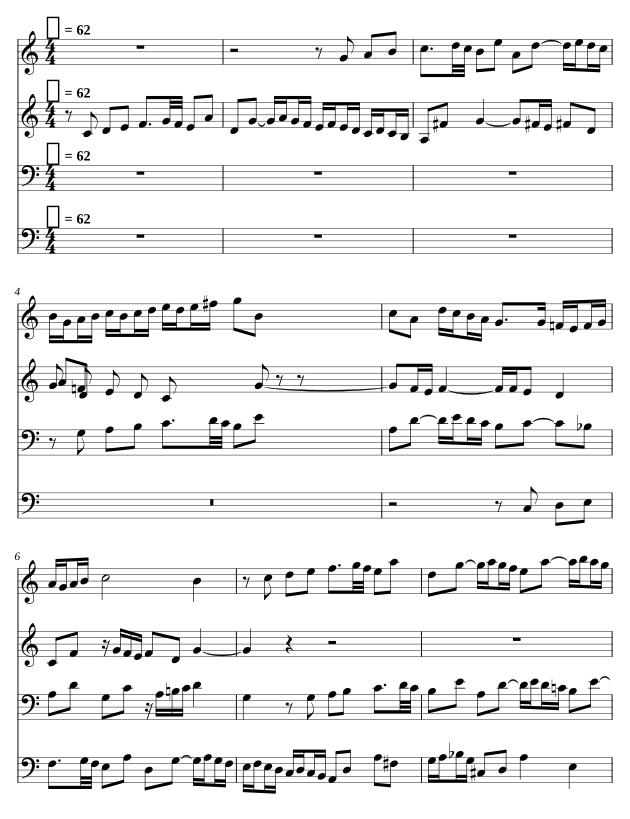
Complete fugue: Bach, Well-Tempered Clavier, Book 1, No. 1, BWV 846. The reference score and piano recording below contain the entire fugue; the smaller engravings above reproduce Prout’s selected examples.