Playable Books
Ebenezer Prout · section 4 of 50
Fugue 2 · Book I, No. 2 · BWV 847
Read and hear this section in the playable edition →

C Minor (Three Voices).
Exposition
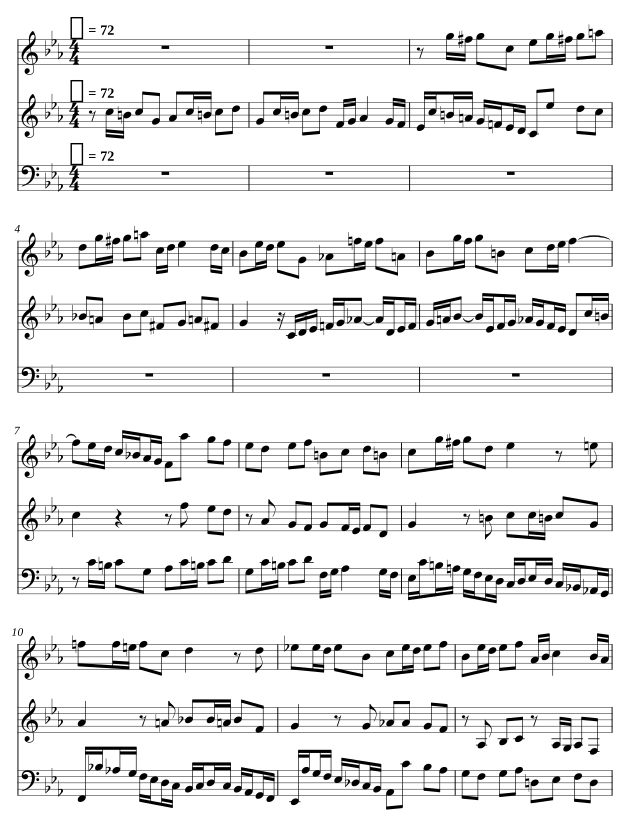
This fugue is not only much simpler but much more regular in form than No. 1. Its subject is announced in the alto:—

The leap from tonic to dominant in the first bar requires a leap from dominant to tonic in the answer, which is therefore tonal. The answer is given to the treble, while the alto continues with a countersubject, which begins on B natural, the third semiquaver of bar 3, and ends on the first note of bar 5. This countersubject accompanies the subject or answer on every appearance throughout the fugue except the final one in the coda (bar 29).
Between the end of the answer and the next entry of the subject a codetta is introduced (bars 5 to 7). The upper part is founded on a sequential treatment of the first notes of the subject, a descending sixth being substituted for a fourth. The alto, also sequential, is formed from the commencement of the countersubject taken by contrary motion. At bar 7 the bass enters with the subject, the countersubject being now taken, according to rule, by the treble—the voice that had just before given the answer. The exposition is now complete.
Middle Section
The first episode (bars 9, 10), with which the middle section of the fugue begins, consists of an imitation between the two upper parts of the opening notes (a) of the subject, accompanied by the descending scale passage with which the countersubject opens. Bar 10 is a sequential repetition of bar 9, by means of which a modulation is effected to the relative major, E flat; in this key we find at bar 11 the first middle entry. It is in the treble, and is accompanied by the countersubject in the bass. If we compare the alto of bars 11, 12 with that of bars 7, 8, we shall see that the two passages, though very similar, are not identical; we therefore do not call this middle voice of the harmony a second countersubject.
The second episode (bars 13, 14) is entirely founded on the countersubject. The treble is the bass of the first episode by contrary motion; the two lower voices in thirds accompany with a quaver figure seen in bars 3 and 4, though the figure is not exactly imitated.
The second middle entry (bar 15), in G minor, has the subject (here taking the form of the answer) in the alto, the countersubject in the treble, and the free counterpoint in the bass.
The third episode (bars 17 to 20) is very interesting and ingenious. If bars 17, 18 are compared with bars 5, 6, it will be seen that the two lower voices at bar 17 are the inversion of the codetta in double counterpoint in the twelfth; at the third crotchet of bar 18 the alto and bass are inverted in the octave. The treble adds an accompaniment in thirds.
Final Section
At bar 20 we reach the final section of the fugue. The subject (treble) is given in C minor, the countersubject being now allotted to the alto. The fourth episode (bars 22 to 26) is formed from the first one (bars 9 to 11), by inversion of the upper parts; the sequence in the bass is continued; and at bars 25, 26, we see a variation of the codetta (bars 5, 6), with the addition of a few notes in the alto.
In bar 26 is another entry of the subject in the bass. Note that the countersubject is now divided between the treble and alto voices. At bar 29 we reach the coda. Here the subject is heard for the last time over a tonic pedal. It is not accompanied by the countersubject, but additional parts are added to the harmony—a by no means unusual feature at the end of a fugue. We shall find many other examples of this procedure in the course of our analysis.
In spite of—possibly by reason of—its simplicity, this little fugue is one of the most perfect of the collection. Let the student examine it closely, and see what perfect unity of style is obtained by building up the whole piece from a few simple themes found in the opening bars.
Complete fugue: Bach, Well-Tempered Clavier, Book 1, No. 2, BWV 847. The reference score and piano recording below contain the entire fugue; the smaller engravings above reproduce Prout’s selected examples.