Playable Books
Ebenezer Prout · section 5 of 50
Fugue 3 · Book I, No. 3 · BWV 848
Read and hear this section in the playable edition →C Sharp Major (Three Voices).
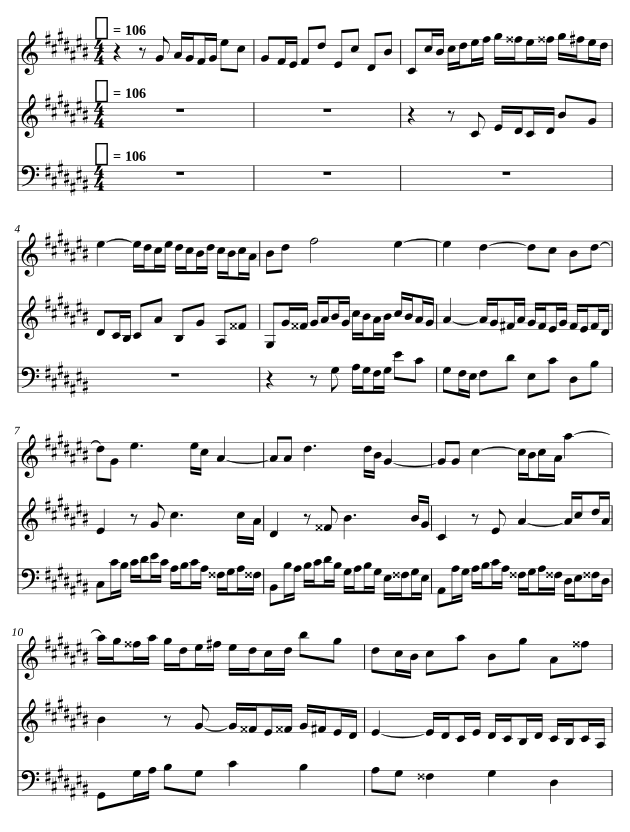
This fugue, which is considerably longer than the two preceding, is especially interesting from the variety and resource shown in the construction of its episodes.
Exposition
As the subject commences on the dominant

the answer will be tonal, and begin on the tonic. There are two countersubjects, the second of which is omitted in a few of the entries.
The subject is first heard in the treble, the answer being given to the alto while the treble continues with the first countersubject:—

When the subject enters in the bass, while the alto gives the first countersubject, the second is heard in the treble:—
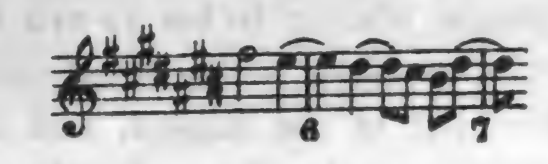
Let the student notice that the end of this second countersubject is varied on its later appearances.
The first episode (bars 7 to 10) consists of a sequence in the bass, made from the inversion of the semiquaver figure seen in the first countersubject (bar 6), and accompanied by free imitation between the treble and alto. It is followed by an additional entry of the answer in the treble, introduced (as is often the case when the subject first appears in the upper part) to allow the countersubject to be heard below it. It will be seen that the second countersubject is not present here. This additional entry is considered as forming part of the exposition.
Middle Section
The middle section of the fugue commences with the second episode (bar 12). Its relationship to the first episode is obvious. The semiquaver figure in the treble of bar 12 is taken from the first countersubject (bar 6), now in direct, not inverse, movement, and the free imitations between alto and bass are founded on the material seen in the upper voices at bars 7, 8. The first middle entry (in A sharp minor) at bar 14 is accompanied only by the first countersubject. The third episode (bars 16 to 19) is very neat. It must be noted that bar 16 is, excepting the first beat in the treble and alto, identical with bar 9; the whole episode is made from sequential continuations of the last bar of the first episode. It leads to an entry in E sharp minor (the mediant minor of C sharp); the subject is now in the alto, with the second countersubject above and the first below it.
The fourth episode (bars 21 to 24), begins with a prolongation of the preceding phrase, leading in bar 22 to a full cadence in E sharp minor. To this succeeds a sequential figure in the treble, made from the first bar of the subject, and accompanied (not sequentially) by semiquavers in alto, and, at bar 24, in bass also.
The following group of entries, answer in treble (bar 24), subject in alto (bar 26), being in the dominant and tonic keys of the fugue, look at first as if they belonged to the final section. But they are here followed by a very long episode containing so much incidental modulation that it is better to regard them as forming part of the middle section. It will be seen that both entries are accompanied by the two countersubjects. The three voices are written in triple counterpoint; if we compare the four passages (at bars 5, 19, 24, 26) in which they have been combined, it will be seen that on each new presentation a different position is given. Of the six possible combinations, four are employed.
The fifth episode—the longest of all—(bars 28 to 42) begins with a transposition of the semiquaver passage in the treble of episode 2 (bars 9, 10) into the bass; the accompanying figure being now above instead of below the semiquavers. In the next bars (30 to 34) the bass sequence of the first episode (bars 7 to 10) is transferred, with a very slight modification, to the treble; the alto and bass accompany with the figure seen in bar 29. At bars 35 to 37 the first bar of the subject is again treated sequentially in the treble, and at bars 39 to 41 in the bass, with new accompanying counterpoints.
Final Section
The final section begins at bar 42 with a complete group of entries (subject, answer, subject), which, after what has been said, will not need further comment. The sixth and last episode (bar 48) is an almost exact transposition a fifth lower of the first (bars 7 to 10). At the end of bar 57 we see a final entry of the subject (treble) in the tonic key, accompanied by the first countersubject (alto); and the fugue concludes with a short coda, additional voices being introduced (as in Fugue 2) at the last bar.
Complete fugue: Bach, Well-Tempered Clavier, Book 1, No. 3, BWV 848. The reference score and piano recording below contain the entire fugue; the smaller engravings above reproduce Prout’s selected examples.