Playable Books
Ebenezer Prout · section 6 of 50
Fugue 4 · Book I, No. 4 · BWV 849
Read and hear this section in the playable edition →C Sharp Minor (Five Voices).
The fugue is not only one of the finest but also one of the longest and most elaborate in the present work. It is sometimes spoken of as " a fugue on three subjects "; this, however, is not absolutely correct. In a fugue on three subjects, either all the subjects will be heard together at first, or each of the three will have a separate exposition, more or less regular and complete. Neither is the case in the present instance; the proper designation of the present movement is "a fugue with two countersubjects.'
Exposition:—The subject of the fugue, one of the shortest in the "Forty-eight," consists of only five notes:—
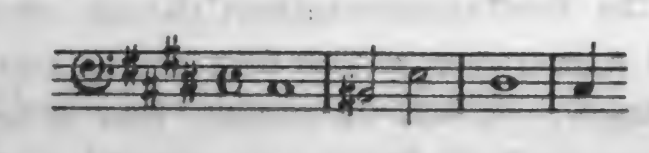
The bass leads, and the tenor replies with a real answer. No regular countersubject is introduced at this point; for though the counterpoint with which the tenor at bars 7 to 10 accompanies the entry of the subject in the alto is the same with which the bass accompanied the answer in bais 4 to 7, it will be seen that quite different counterpoints are employed at the next two entries, bars 12 and 14. At bar 10 a codetta of two bars is inserted between the third and fourth entries (compare Fugue 2, bars 5 to 7). The entry of the answer in the second treble (bar 12) is irregular, not because the first note is shortened, for it is always allowed to shorten or lengthen the first or last note of a subject but because it has the form of a tonal answer, and modulates to the key of the subdominant, F sharp minor. With the entry of the subject in the first treble (bar 14) the actual exposition is completed; but, as this fugue differs greatly from those already analyzed, we do not consider that the second section begins here. Further entries of the subject and answer will be noticed at the following points: bar 19, tenor (G sharp minor); bar 22, tenor (F sharp minor) with the first note shortened, bar 25, alto (C sharp minor); bar 29, bass (B major); bar 32, alto (E major). Observe that, though no countersubject has yet been heard, great unity is given to the first part of this fugue by the frequent—one might say the almost continuous—use of the figure of four crotchets first seen in the bass of bar 7, and employed not only by direct motion, but also by inversion (bars 17, 18, 23, 24, etc.), and even by diminution bar 26); it is seen in all twenty-six times.
Middle Section
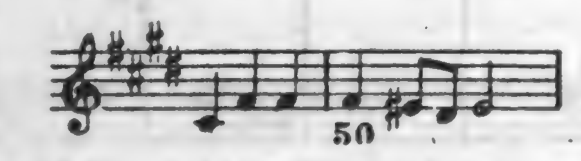
The middle section of this fugue begins at bar 35, where the first countersubject (which we shall mark as CS 1) makes its appearance in the first treble, accompanying the subject in the tenor. It will be noticed that it begins with the crotchet figure just spoken of:—

The entry of the alto with the answer (bar 38), CS 1 being again heard in the upper part, leads to the first episode (bars 41 to 44). Here the tenor gives CS 1 by inversion, with free counterpoints for first treble and alto. At bar 74 the subject in the second treble has CS 1 in the bass. At bars 47, 48, CS 1 appears in the treble; its last notes also serve as the first notes of a new entry of the subject in F sharp minor. The second treble now has CS 1; at the same time a second countersubject (CS 2) makes its first appearance in the alto.
The next entries of the subject (tenor, bar 51; second treble, bar 54) are accompanied by both CS, which are therefore written in triple counterpoint with the subject, four of the six possible positions being used in the course of the fugue (see bars 49, 52, 67 and 74), The second episode (bars 57, 58), like all that follow it, is founded on the CS without the subject. An entry of the subject (first treble) in C sharp minor (bar 59) leads to the third episode (bar 62). Here we find at bars 64, 65, CS 2 in stretto. At bar 66 is an entry of the subject in D sharp minor in the first treble. It is irregular and unusual to have two successive entries (as here, bars 59 and 66) in the same voice. The fourth episode (bars 69 to 72) leads back to the tonic key.
Final Section
The final section of this fugue begins with the bass entry in bar 73, accompanied by both CS. This is immediately followed by an entry, again in the tonic key, for first treble (bar 76) and yet another for tenor (bar 81). In the following episode (bars 84 to 88) CS 2 is again treated in stretto (tenor second treble, bass) at one bar's distance. At bar 89 we find the fourth consecutive entry of the subject in the tonic key, accompanied by CS 2, but not by CS 1. At bar 92 begins another stretto on CS 2, below which is heard CS 1, which here makes its final appearance. The reason is that from this point the subject and CS 2 are almost continuously used in close stretto, for which CS 1 is less suited. Note the stretto on the subject between the two trebles at bar 94 •—
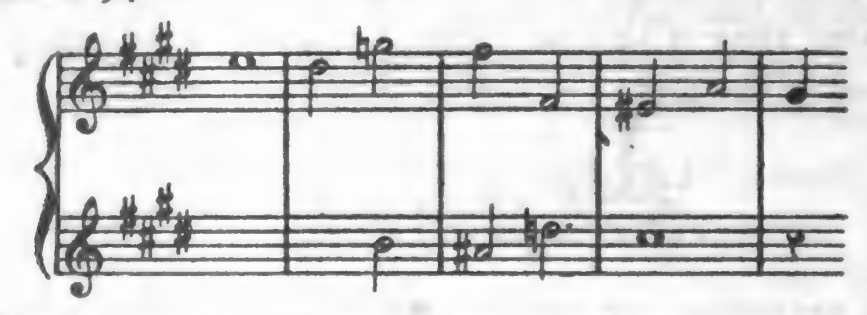
(We write the passage on two staves, to show the crossing of the parts). At the same time there is a stretto on CS 2 for alto and tenor at one bar's distance, which at bars 98, 99, is drawn still closer—to half a bar, all the voices now taking part in it. The last episode begins at bar 102, and chiefly consists of stretto of CS 2. At bar 105 begins a dominant pedal, above which in bar 107 we see the last entry of the subject in the tonic key. It is followed by a coda (bars 110 to 115), the last four bars of which are over a tonic pedal. Observe the entry of the subject (second treble) in F sharp minor, with CS 2 in the alto; we have here, as in Fugue 1, a plagal cadence, following the authentic cadence that preceded. In spite of the comparatively small amount of modulation, this fugue is remarkable for its great variety combined with perfect unity.
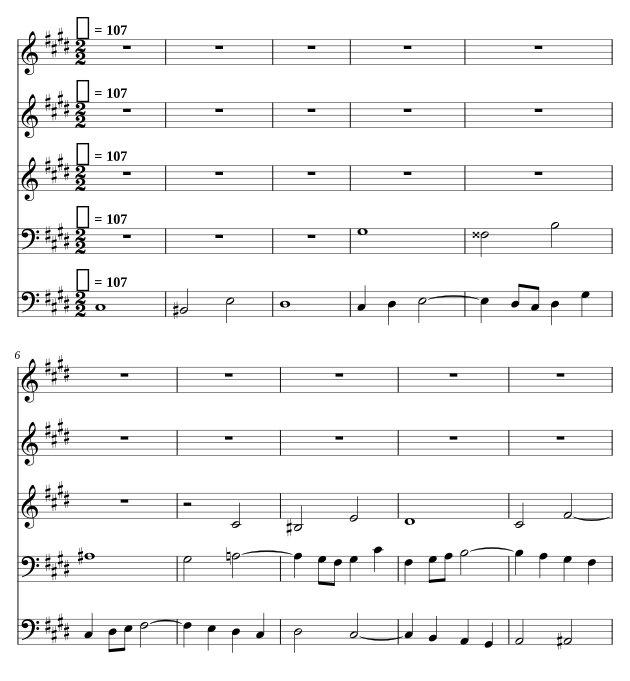
Complete fugue: Bach, Well-Tempered Clavier, Book 1, No. 4, BWV 849. The reference score and piano recording below contain the entire fugue; the smaller engravings above reproduce Prout’s selected examples.