Playable Books
Ebenezer Prout · section 7 of 50
Fugue 5 · Book I, No. 5 · BWV 850
Read and hear this section in the playable edition →D Major (Four Voices).
Exposition
This fugue needs only a short analysis. The subject only one bar in length,
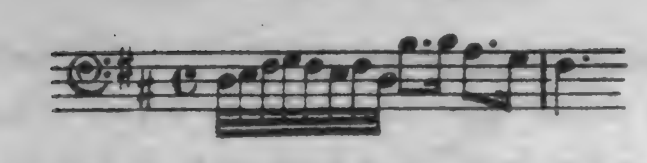
takes a real answer, and has no regular countersubject. At bar 3 is a codetta of one bar preceding the entry of the subject in the alto. Notice particularly the figure seen here in both the voices, and later in the fugue at bars 6, 7, 8, 14 and 23. The three demisemiquavers here are not triplets, as incorrectly printed in some editions. The notation here employed by Bach was common in his day, and is explained in old text-books. The dot here only adds one fourth to the length of the quaver, and the passage must be played
The exposition ends on the first beat of bar 6, and there is a partial and irregular counter-exposition in the two following bars: subject (bass) in D major; answer (treble) B minor!
Middle Section
The second section begins with the first episode (bars 9 to 11). The semiquaver figure in the treble (bar 9) is an augmentation of the last four demisemiquavers in the subject, in threefold repetition; on the last note of the phrase the commencement of the subject is heard in the bass. The passage is then sequentially repeated a note lower; after which a group of middle entries in G (bars 11 to 14)—treble (subject), alto (answer) treble (answer), tenor (subject)—-is followed by an isolated entry (bass) in E minor in bar 15 leading to a full cadence in the same key (bar 17).
The second episode (bars 17 to 21) is a free inversion and extension of the first. The semiquavers which at bar 9 were in the treble are now in the bass; the harmony, as before, is a series of chords of the sixth descending by thirds; and the sequence is continued for one bar longer. At bar 20, the beginning of the subject is heard, as if in stretto, in all the voices.
Final Section
As the complete subject of the fugue is never heard after bar 15, it is difficult to decide with certainty where the final section begins; we prefer to consider it as at bar 21, after the full close in the tonic key. Notice the reference in this bar to the commencement of the episodes, bars 9 and 17; it will be seen that bars 23, 24 are built on repetitions of the first figure of the subject, and bars 25 to 27 on repetitions of the last half of it,
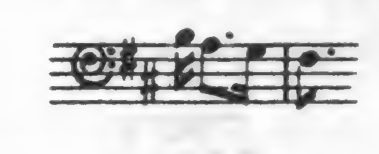
both by direct and contrary motion. The final section of this fugue is quite irregular in its construction, though the whole piece is very effective musically.
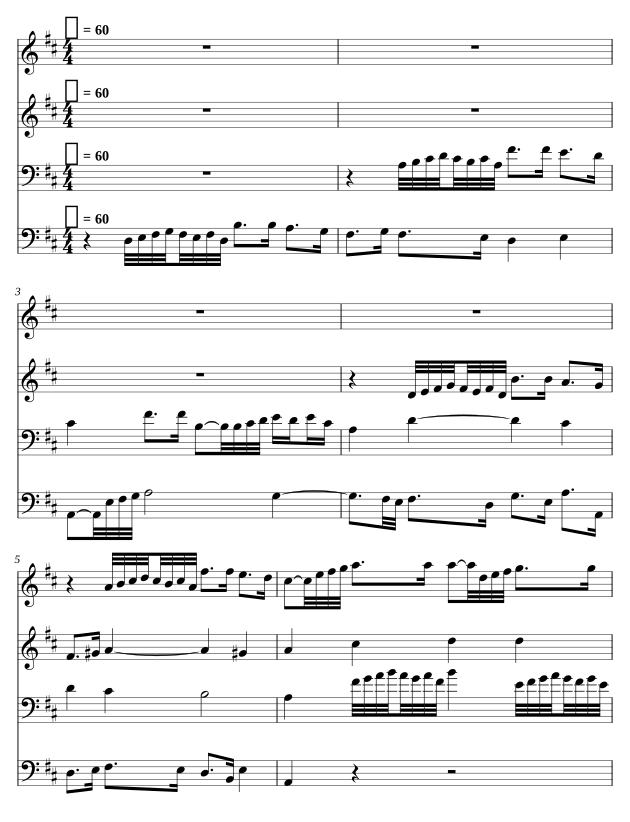
Complete fugue: Bach, Well-Tempered Clavier, Book 1, No. 5, BWV 850. The reference score and piano recording below contain the entire fugue; the smaller engravings above reproduce Prout’s selected examples.