Playable Books
Ebenezer Prout · section 8 of 50
Fugue 6 · Book I, No. 6 · BWV 851
Read and hear this section in the playable edition →D Minor (Three Voices).
This is a very interesting little fugue, by reason of the treatment of the subject by inverse movement and the adaptation of a part of the countersubject (from the second beat of bar 4) to accompany a different portion of the subject (e.g., bar 17), or its inverted form (e.g., bar 24) After the exposition the subject is frequently modified by the substitution of a major third for a minor (see bars 13, 18, 21, 34).
Exposition
The subject is given out in the treble:—
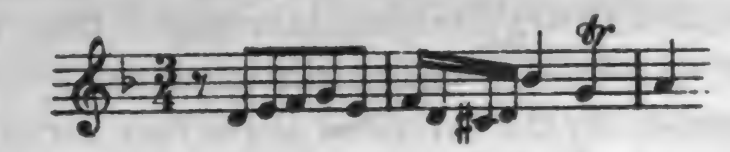
As it does not reach the dominant until the final note, and without modulating, the answer (alto) is real. It is accompanied throughout by a regular countersubject in the treble. On the entry of the subject in the bass (bars 6 to 8), this countersubject is, somewhat exceptionally, divided between the treble and alto. An irregular redundant entry of the subject in the treble, commencing on the supertonic (bars 8 to 10), gives opportunity for the countersubject to be heard below the subject.
Middle Section
The middle section is characterized less by new keys than by new treatment. In bars 13 to 16 the subject in the treble is answered in stretto by inverse movement in the alto, and it is noteworthy that from this point onwards, all the entries, excepting an isolated one at bar 34, are in stretto at one bar's distance. In bars 17 to 20 the bass leads and the alto follows, both with the subject in its direct form; in bars 21 to 25 the subject in bass (direct) is answered by treble (inverted), and this again by bass (inverted); in bars 27 to 31 the answer in treble (inverted) by subject in alto (direct) and answer in bass (inverted).
Final Section
The final entries (from bar 39, after a preparatory one in the bass at bar 34) are again at a distance of one bar, and are assigned to the bass and alto, both giving the subject, and in its direct form. At the close, a tonic pedal of two bars is accompanied by additional voices, which give a bar of the subject in its direct and inverted forms simultaneously, and in thirds.
There are four episodes, all founded on the countersubject. In the first (bars 10 to 12) the figure from bar 4 is treated sequentially in the bass, followed by a fragment of the subject • the third episode (bars 31 to 33) is a free inversion of this. In the second episode (bars 25, 26) the same figure is employed by inverse movement, accompanied by the inversion of the first bar of the subject; and in the last (bars 36 to 38) a figure derived from the first bar of countersubject (bar 3) is accompanied by the same part of the inverted subject, but now in thirds.
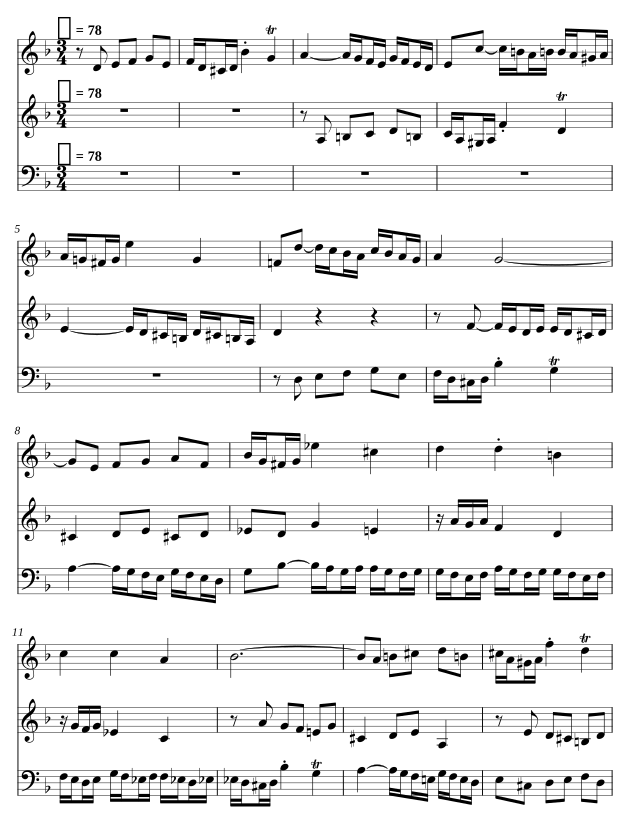
Complete fugue: Bach, Well-Tempered Clavier, Book 1, No. 6, BWV 851. The reference score and piano recording below contain the entire fugue; the smaller engravings above reproduce Prout’s selected examples.