Playable Books
Ebenezer Prout · section 9 of 50
Fugue 7 · Book I, No. 7 · BWV 852
Read and hear this section in the playable edition →E Flat Major (Three Voices).
This fugue is very simple and straightforward in construction. It contains no stretto, nor any of the rarer devices of fugal writing.
Exposition
The subject extends to the first semiquaver of the third beat in bar 2:—

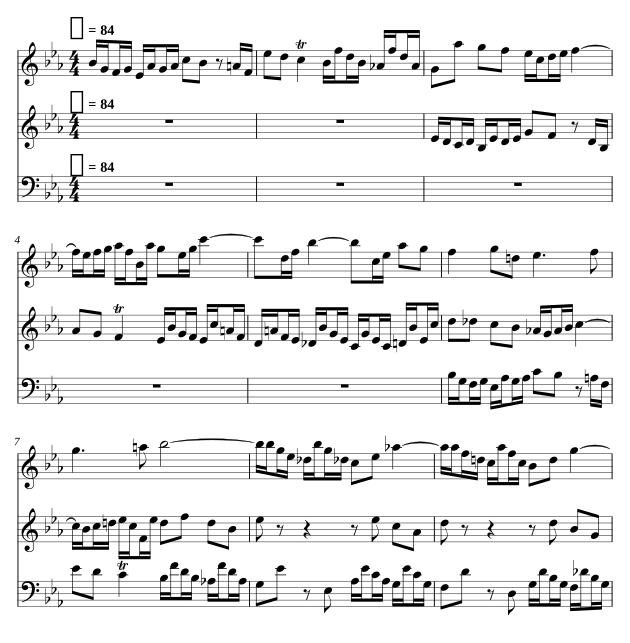
It is interesting, as containing both the elements which call for a tonal answer, namely, commencement on the dominant, and modulation into the dominant key; hence the change of the first interval in the answer, and of that at the quaver rest. The subject is in the treble, the answer in the alto (at bar 3), separated from it by a codetta of half a bar; and a longer one (a bar and a half) is introduced before the entry of the bars with the subject in bar 6. There is a regular countersubject—
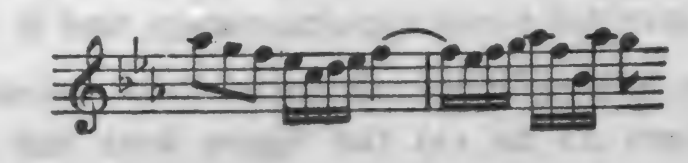
and this always accompanies the subject excepting in bar 34. At bars 11, 12 there is a redundant entry of the answer, separated from the exposition proper by the first episode (bars 7 to 10), as in Fugue 3.
Middle Section
The middle section commences with the second episode, in the second half of bar 12, and contains entries of the answer in C minor (alto, at bar 17), and the subject in C minor modulating to G minor (bass, at bar 20), to which follows the third episode, leading back to the original key.
Final Section
The final group embraces the entry of the answer in the bass in bar 26, the subject, with its first note altered, in bar 29, and—after a fourth episode—a last appearance of the answer in the alto in bar 34, with one note chromatically altered, and somewhat in the nature of a coda.
The codetta in bars 4, 5, and all the episodes are founded, more or less, on the figure of the first codetta (bar 2, second half); the third episode, however, contains greater diversity of material than the others.
Complete fugue: Bach, Well-Tempered Clavier, Book 1, No. 7, BWV 852. The reference score and piano recording below contain the entire fugue; the smaller engravings above reproduce Prout’s selected examples.