Playable Books
Ebenezer Prout · section 10 of 50
Fugue 8 · Book I, No. 8 · BWV 853
Read and hear this section in the playable edition →D Sharp Minor (Three Voices).
A fugue of highly artificial construction, full of the resource in higher contrapuntal devices of which its composer possessed such a wonderful mastery.
Exposition
The subject is announced in the alto—

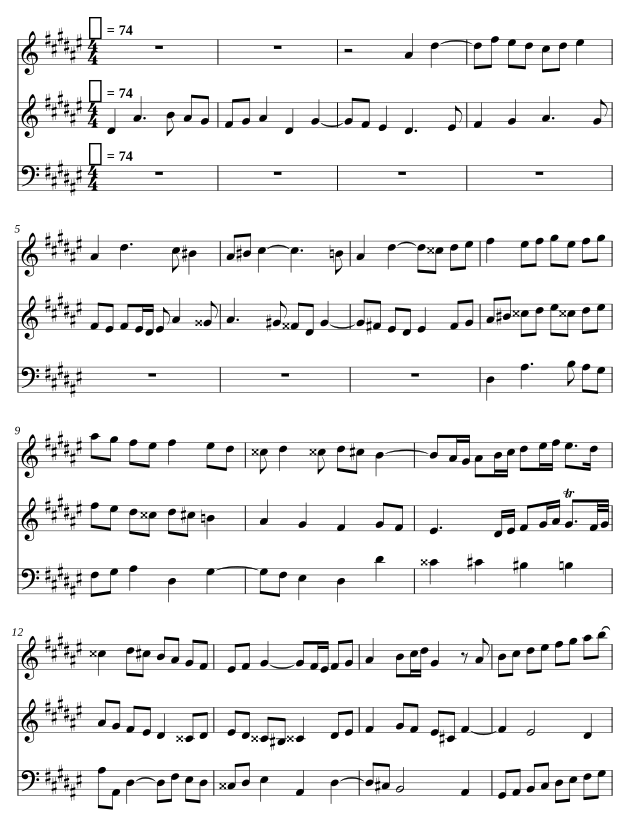
and as it begins by leaping from tonic to dominant, the answer (treble, bars 3 to 6) is tonal, leaping from dominant to tonic. There is no countersubject. A codetta of nearly two bars, suggested by the syncopated rhythm of the subject, precedes the entry of the third voice, the bass, which enters with the subject in bar 8; and a second codetta (bar 10, fourth beat, to bar 12, first beat) separates this from a redundant entry of the answer, which is, somewhat exceptionally, assigned to the same voice which just before gave the subject.
Episodes are few and unimportant, and call for no special comment (see bars 15 to 19 and 33 to 35; the others are quite fragmentary).
Middle Section
This commences with the first episode, in bar 15. In bars 19 to 22 the subject, in A sharp minor, is treated as a canon in the octave for alto and treble. In bars 24 to 26 it is employed in close stretto, the voices entering at one beat's distance, the alto in a rhythmically modified form and the bass incomplete. In bars 27 to 30 there is another canonic stretto in two parts and at two beats' distance, but now at the fifth below; and to this follows immediately the first appearance of the subject by inverse movement, given to the treble, and in the key of the relative major. A pair of entries (subject and answer) by inverse movement occurs in bars 36 to 41, in the alto and bass respectively, the latter somewhat disguised by the ornamentation of its opening note:—

Stretto is resumed at bar 44, a canon in the octave, between bass and alto, providing a companion, but by inverse movement,
to that noticed at bar 19. Two neat little canons, strict as to intervals so far as they extend, but not completing the subject, follow in bars 52, 53 and 54, 55; both are in the octave, but in the one the subject is in its direct, in the other in its inverted form.
Final Section
An isolated entry in the treble, in bar 57, marks the return to the original key. In bar 62 a new device makes its appearance, the subject (alto, from bar 61) being imitated by the bass in augmentation; and before this is completed the treble (bar 64) introduces the answer by inverse movement. A somewhat similar series of entries (bass, alto, treble), but without inverse movement, occupies bars 67 to 72, and a further entry of the answer (alto), bars 72 to 75. Finally, an entry in the treble by augmentation (bars 77 to 82) is accompanied by close, but free, stretto of the other voices without augmentation, and a coda of five bars brings the fugue to a close
It will be observed that the subject by augmentation, which is the characteristic of the final section, is given once to each voice, and that the combinations used exemplify double counterpoint in the twelfth; compare, for instance, the alto and bass of bars 62 to 64 with bars 67 (second half) to 69. The use of other than the principal keys (bars 67 to 75) is exceptional.
Complete fugue: Bach, Well-Tempered Clavier, Book 1, No. 8, BWV 853. The reference score and piano recording below contain the entire fugue; the smaller engravings above reproduce Prout’s selected examples.