Playable Books
Ebenezer Prout · section 13 of 50
Fugue 11 · Book I, No. 11 · BWV 856
Read and hear this section in the playable edition →F Major (Three Voices).
Exposition
The subject, which is announced in the alto, consists of a rhythmical phrase of four bars:—
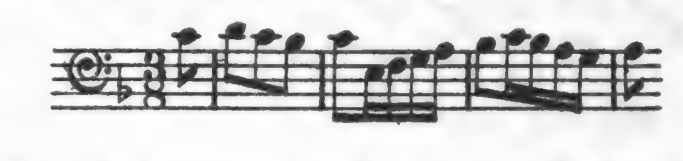
As this begins on the dominant, the answer, in the treble, is tonal. beginning on the tonic. The countersubject commences on the first semiquaver of bar 5, with the second note of the answer, After a bar of codetta, the bass enters with the subject (bar 9, third beat), the countersubject being given to the treble.
Counter-Exposition
After a short episode founded on the countersubject in the bass, with new counterpoint above it, there is a complete counter-exposition (bar 17, third beat, to bar 31, first beat). In this the order of entry is: subject in treble; answer in alto; subject in bass, with a redundant entry of subject in alto, two bars after the bass, and therefore producing the first stretto. The countersubject is transferred from alto to bass in bars 18, 19, has its first three notes in inverse movement in bar 26 (treble) and is incomplete in bars 29 to 31 (bass).
Middle Section
The middle section commences in bar 31, with a second episode, which is founded on the third bar of the subject in the upper parts, with a free bass. The appearances of the subject in this section are in stretto, and are very orderly. Bars 36 to 44 are in D minor, the stretto in the octave at two bars' distance, all the voices participating, beginning with the highest; bars 46 to 54 in G minor, the stretto at the same interval of pitch and of time, but beginning with the lowest voice. To each stretto is added a codetta of two bars ending with a perfect cadence. The third episode (bars 56 to 64) is built on similar material to the second, but quite differently treated.
Final Section
The final entries are slightly irregular. At the last semiquaver of bar 64 the subject enters in the treble, with its first note shortened and the following bar ornamented. A bar later the subject appears in the alto, making the closest stretto which the fugue contains, but its form also is varied, and it is abandoned at bar 68. On account of the stretti, neither the middle nor the final section employs the countersubject.
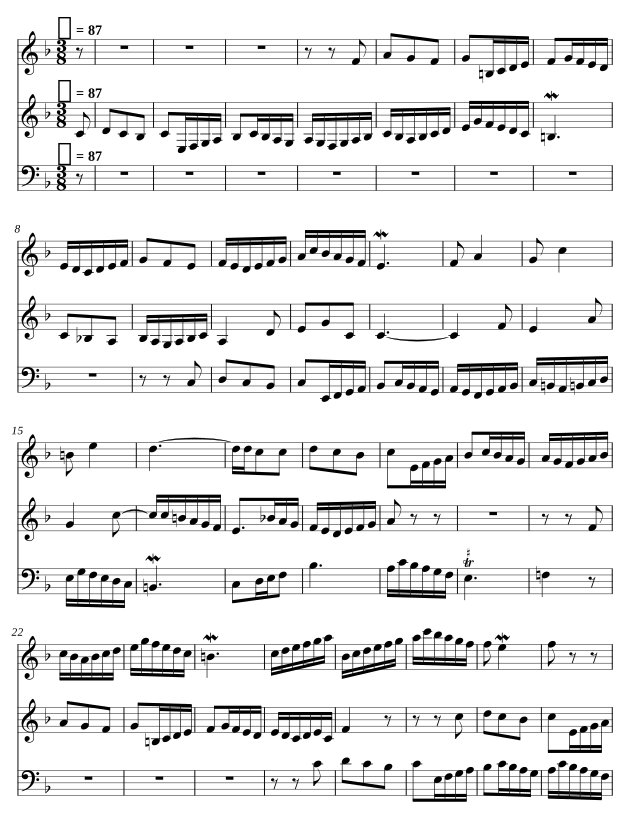
Complete fugue: Bach, Well-Tempered Clavier, Book 1, No. 11, BWV 856. The reference score and piano recording below contain the entire fugue; the smaller engravings above reproduce Prout’s selected examples.