Playable Books
Ebenezer Prout · section 14 of 50
Fugue 12 · Book I, No. 12 · BWV 857
Read and hear this section in the playable edition →F Minor (Four Voices).
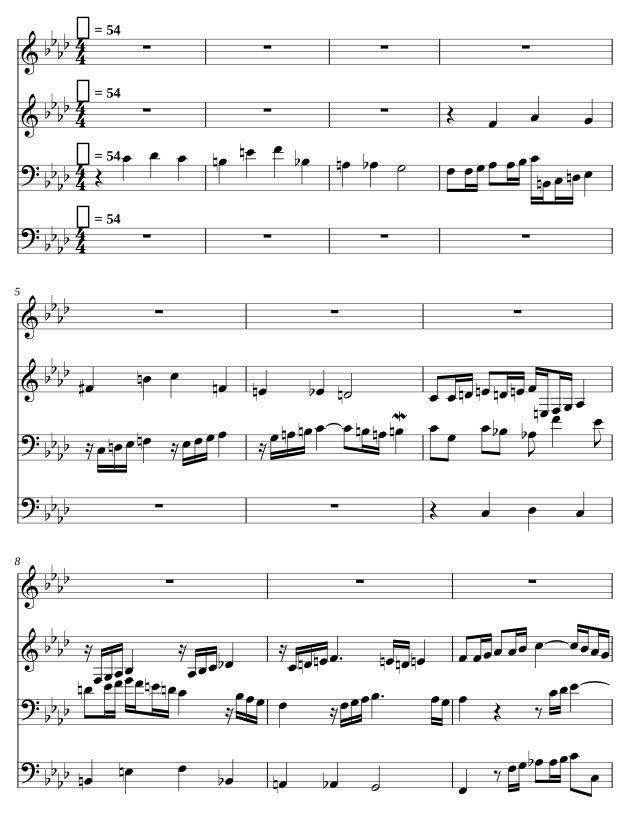
A remarkably fine fugue, rivalling No. 3 in the richness and variety of its episodes. It contains no stretto.
Exposition,—The subject

is announced in the tenor, and is given a tonal answer in the alto (bar 4), in order that the initial dominant may be replied to by the tonic; but it is noteworthy that this tonal form of answer is not heard again throughout the fugue. There is a regular countersubject, commencing on the second quaver of bar 4 and reaching to bar 7, first quaver; this accompanies every subsequent entry except that in bars 40 to 43, and even here the alto and bass give fragmentary suggestions of it. The bass enters with the subject in bar 7, and the tenor has a new counterpoint, which is so frequently used with the subject and countersubject (see bars 13 to 16, 19 to 22, 28 to 30, etc.) as almost to rank as a second countersubject; the three are worked in a triple counterpoint. A codetta of three bars (bars 10 to 12), derived from the countersubject, precedes the entry of the fourth voice, the treble, to which is exceptionally assigned the subject instead of the answer.
Counter-Exposition
As the next two entries (bar 19, tenor, and bar 27, bass) are still in the original keys, and with the answer leading, it is possible to regard them as constituting a partial and irregular counter-exposition, though they are separated by an episode.
Middle Section
Unless the above-named two entries be included, this only commences at bar 30. In any case it embraces the subject in A flat major (bar 34) and answer in E flat major (bar 40) and closes at the first beat of bar 47.
Final Section
This section consists of the answer in C minor (bar 47) and the subject in F minor (bar 53), together with the intervening episode and a three-bar coda.
The first episode (bars 16 to 19) is a free inversion of the codetta, treated sequentially. The second (bars 22 to 27) is similar to the first, with inversion of the two upper parts. In the third episode (bars 30 to 34) the first bar of the alto in the codetta is treated sequentially in the bass, imitated by the tenor, with a new counterpoint in the treble. In the fourth (bars 37 to 40) a part of the countersubject (bar 6) is worked sequentially in the treble and made the pattern for some free imitation in the alto, with a florid counterpoint in the bass. Episode 5 (bars 43 to 47) gives a new and more elaborate sequential treatment of the codetta with the addition of a fourth voice; all the other episodes are in three-part harmony. The sixth and last (bars 50 to 53) is a slight modification of the first, transposed into the dominant key.
Complete fugue: Bach, Well-Tempered Clavier, Book 1, No. 12, BWV 857. The reference score and piano recording below contain the entire fugue; the smaller engravings above reproduce Prout’s selected examples.