Playable Books
Ebenezer Prout · section 12 of 50
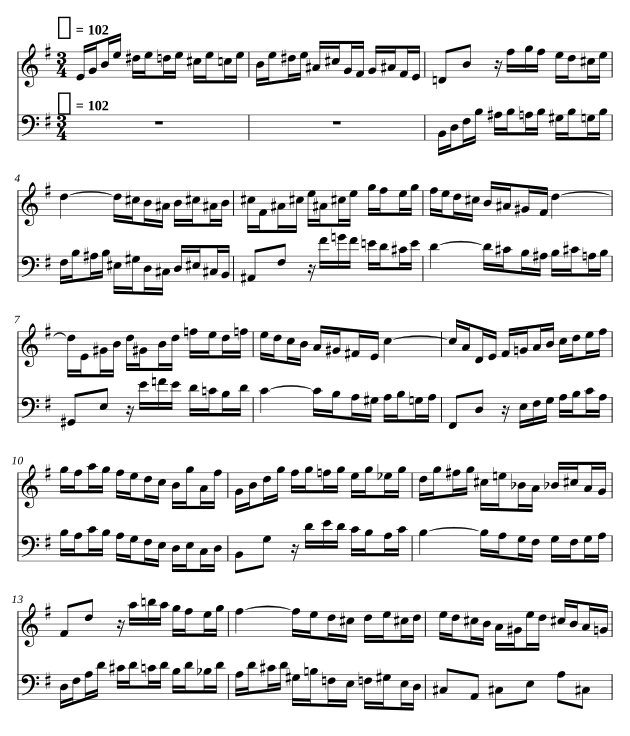
Fugue 10 · Book I, No. 10 · BWV 855
Read and hear this section in the playable edition →
E Minor (Two Voices).
The only two-part fugue in the collection, and naturally offering less scope for elaboration than those written in a larger number of parts. There is not, however, any actual feeling of thinness, the extensive use which is made of arpeggio serving to enrich the harmonic effect.
Exposition
The subject extends to the first note of the third bar:—

As it modulates into the key of the dominant, the strict rule would have demanded a tonal answer, returning to E minor. But there is no third voice to be introduced, and hence no real necessity for a return, which, indeed, Bach has not provided; he has preferred a real answer, and avoided a modulation to the unrelated key of F sharp minor by closing the answer on the leading-note of B minor. There is a regular countersubject commencing after the semiquaver rest, and terminating on the first note of bar 5.
Middle Section
Middle entries appear in the keys of G (bar 11), D (bar 13), A minor (bar 20), E minor (bar 22, as answer to the A minor entry, not as a final return to the tonic key), D minor— an unrelated key (bar 30), and again A minor (bar 32).
Final Section
The final entries are somewhat irregular, that in bar 39 being uncompleted, while that in bar 40 is still more altered, having lost the characteristic arpeggio of its commencement,
There are four episodes. The first (bars 5 to 10) is inverted to form the third (bars 24 to 29), and the second (bars 15 to 19), to form the fourth (bars 34 to 38). The occurrence of unison passages (bars 19 and 38) is extremely rare in a fugue.
Complete fugue: Bach, Well-Tempered Clavier, Book 1, No. 10, BWV 855. The reference score and piano recording below contain the entire fugue; the smaller engravings above reproduce Prout’s selected examples.