Playable Books
Ebenezer Prout · section 17 of 50
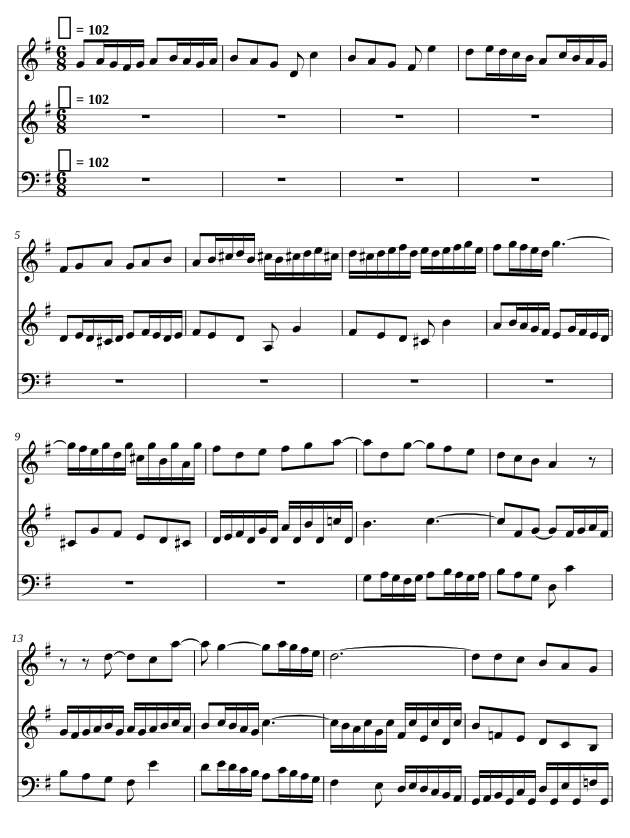
Fugue 15 · Book I, No. 15 · BWV 860
Read and hear this section in the playable edition →G Major (Three Voices).
An extremely interesting and ingenious fugue, and one in which the musical grace and charm are in no way impaired by the technical elaboration.
Exposition
The subject, announced in the treble—

remains in the tonic key throughout, and only touches the dominant incidentally in bar 3. The answer (alto, bars 5 to 9) is consequently real. The countersubject accompanies a part only of the subject (or answer), commencing at the second half of bar 6:—

The codetta (bars 9, 10) before the entry of the third voice furnishes the germ of all the episodes. The first episode (bars 15 to 19) is formed of a sequential treatment of the codetta with the addition of a third voice.
Counter-Exposition
In the counter-exposition (bars 20 to 31) both subject and countersubject are given by inverse movement, but with the last bar of the latter omitted. The order of entry is as follows: subject in alto (from bar 20) with countersubject in bass (bar 21); answer in treble (bar 24) with countersubject in alto (bar 25); subject in bass (bar 28) with countersubject in treble (bar 29).
Middle Section
The last of the entries in the counterexposition is not completed, the second episode commencing at the beginning of bar 31. Of this episode the first three bars are an inversion of bars 17 to 19; at bar 34 a scale passage is added above the figure of bar 10: the parts are then inverted with one another, and the two bars repeated in inverse movement.
In bars 38 to 45 the subject and countersubject in their direct forms, and in the key of the relative minor, are answered by inverse movement; the bass takes no part in these entries. After a third episode (bars 46 to 51; another variation of the first episode) the subject is treated as a two-part stretto in the octave, in the key of B minor, at one bar's distance, the treble leading, the bass responding, but breaking off at the end of bar 53. The fourth episode (bars 54 to 60) is a new sequential treatment of the codetta, with different counterpoint. The entries in bars 60 to 63 (alto and treble) are analogous to the preceding ones, but in D major, with the lower voice leading, and with an added counterpoint. The fifth episode (bars 64 to 69) is yet another variation of the first, with different distribution of the parts.
Final Section
At bar 69 a return is made to the key of G, the subject (inverted) being assigned to the bass, and the countersubject (likewise inverted) to the alto. The last episode (bars 73 to 76) consists of free inversion of bars 34 to 37. To this follows the last stretto, with all the entries more or less incomplete; the alto leads by inverse movement, the bass responding at one bar's distance; then the treble and alto in thirds (the latter fragmentary) resume the direct movement. A coda of five bars brings the fugue to a close. Additional voices are introduced on the tonic pedal (bars 84 to 86).
Complete fugue: Bach, Well-Tempered Clavier, Book 1, No. 15, BWV 860. The reference score and piano recording below contain the entire fugue; the smaller engravings above reproduce Prout’s selected examples.