Playable Books
Ebenezer Prout · section 20 of 50
Fugue 18 · Book I, No. 18 · BWV 863
Read and hear this section in the playable edition →G Sharp Minor (Four Voices).
Exposition
The subject is announced in the tenor:—
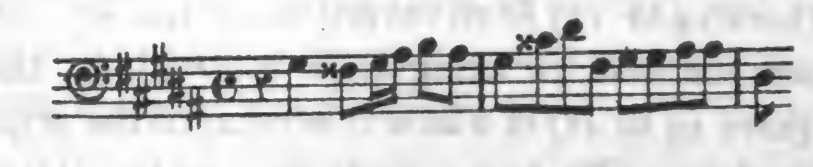
It will be observed that it makes a modulation into the dominant key, and a tonal answer will be required in order to return to the tonic. But as the new key is entered by the striking interval of he augmented fourth, which must be preserved in the answer, there is no alternative but to make the tonal change after the initial dominant, thus touching transitionally on the key of the subdominant. As in many tonal fugues, a real answer is used later (see bar 37).
There is no codetta in the exposition, the voices following at regular distances of time—tenor, alto, treble, bass. There is a regular countersubject accompanying the entire subject
Counter-Exposition
There is comparatively little variety of key in the entries in this fugue. Those in bars 11, 15, 17 and 19 though not fulfilling all the conditions of a regular counter-exposition, are all in G sharp minor or D sharp minor, and on this account may be regarded as constituting an irregular one.
Middle Section
The middle section properly begins with the episode in bar 21, for in bar 24 we get the subject modulating into the unrelated key of A sharp minor, and in bar 26 the answer in the key of B.
Final Section
The final section begins at bar 32, with the subject in the tenor in the original keys, accompanied by the countersubject in the alto, and answered, after three bars of episode, by the treble, commencing in C sharp minor and returning to G sharp minor, the alto giving a few notes only of the countersubject. At the entries in bars 17, 24 and 26 the countersubject is absent.
There are five episodes (bars 9 to 11, 13 to 15, 21 to 24, 28 to 32, 34 to 37), of which the third is constructed of new material, used again, however, in a modified form for the commencement of the fourth episode (bars 28, 29). The rest, together with the end of episode 4, are founded on the last six notes of the subject. The employment of homophony, that is, of chords proceeding note against note in place of combined melodies, is remarkable in the first episode, being extremely rare in fugal writing.
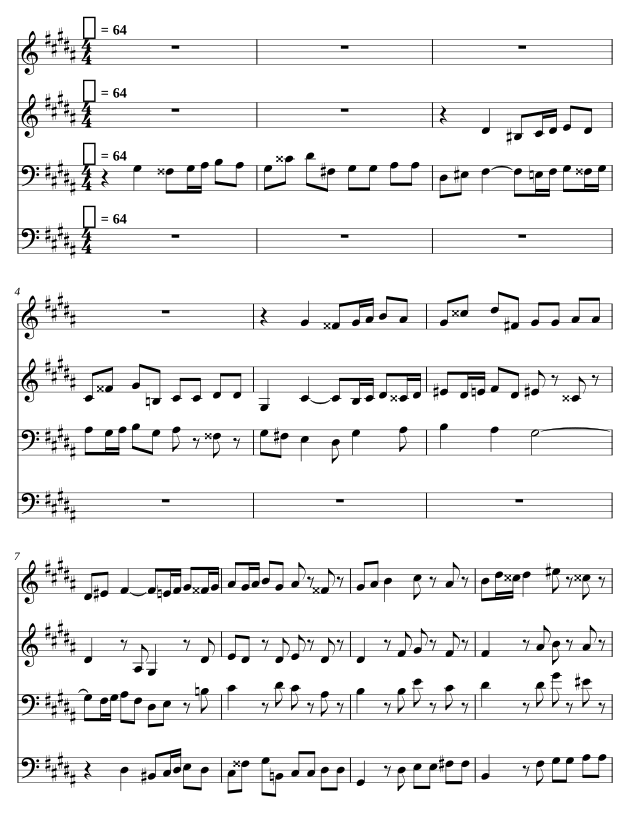
Complete fugue: Bach, Well-Tempered Clavier, Book 1, No. 18, BWV 863. The reference score and piano recording below contain the entire fugue; the smaller engravings above reproduce Prout’s selected examples.