Playable Books
Ebenezer Prout · section 21 of 50
Fugue 19 · Book I, No. 19 · BWV 864
Read and hear this section in the playable edition →A Major (Three Voices).
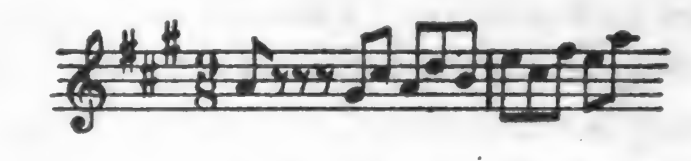
A fugue of such irregular construction that it might almost be termed a Caprice or Fantasia in fugal style. The limit of the subject is not clearly defined, but its later treatment suggests that it consists of the following:—
Exposition
The subject is announced in the treble, and answered by the alto in stretto at one bar's distance. Although the subject does not modulate, and contains no conspicuous dominant, Bach has elected to give a tonal answer, according to an idiom whereby he always prefers to regard the leading-note as the third of the dominant, and answer it by the third of the tonic, unless it be an obvious auxiliary note; compare No. 23, also, to some extent, Nos. 18 (second note) and 24 (seventh note). After a few notes of codetta, the bass enters with the subject at the beginning of bar 4. The next two entries, namely in the bass again (but with the answer) at bar 6 and in the treble (with the subject) at bar 9 might be regarded as an irregular, partial counterexposition, as they are still in the original keys.
Middle and Final Sections
From this point onwards, it is only necessary to indicate the various entries of the subject. These are:—Bar 13, in F sharp minor, in the bass; bar 16 (irregular and incomplete) in the bass, modulating into E; bars 23 to 28 a group of entries in the original keys, the subject in the bass being given a tonal answer in the treble (varied at the end) and a real answer* in the alto (its first note an octave higher than would have been regular); bars 31 to 34, two entries of the subject in the key of D, alto and bass, both irregular, the latter modulating into B minor; bar 39, in F sharp minor in bass, the initial note and rests wanting; bar 42 (presumably the "final section") in A major in the alto, the first note altered, answered at bar 44 by the bass. From this point onwards the subject is absent, the passage forming a somewhat extended coda.
As a whole, the fugue is inferior in interest to most of the series.
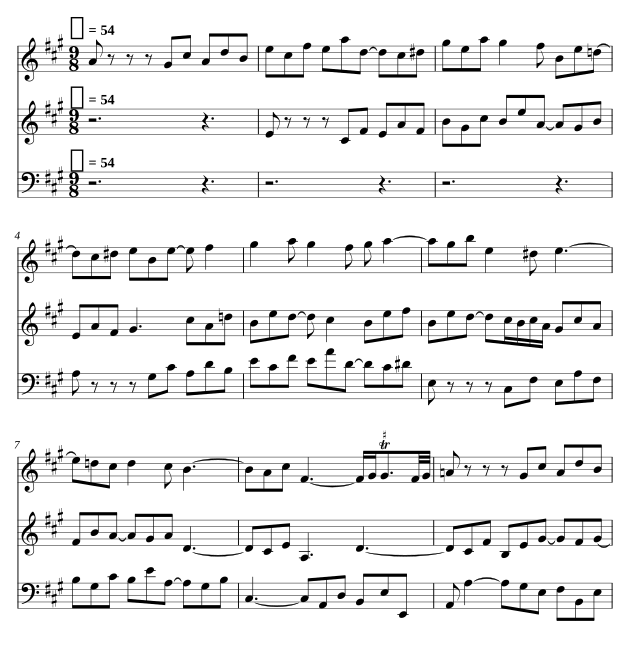
Complete fugue: Bach, Well-Tempered Clavier, Book 1, No. 19, BWV 864. The reference score and piano recording below contain the entire fugue; the smaller engravings above reproduce Prout’s selected examples.