Playable Books
Ebenezer Prout · section 22 of 50
Fugue 20 · Book I, No. 20 · BWV 865
Read and hear this section in the playable edition →A Major (Four Voices).
A long and elaborate fugue, interesting in its construction, but perhaps, not one of the most beautiful. The inversion of the subject is somewhat ungainly.
Exposition
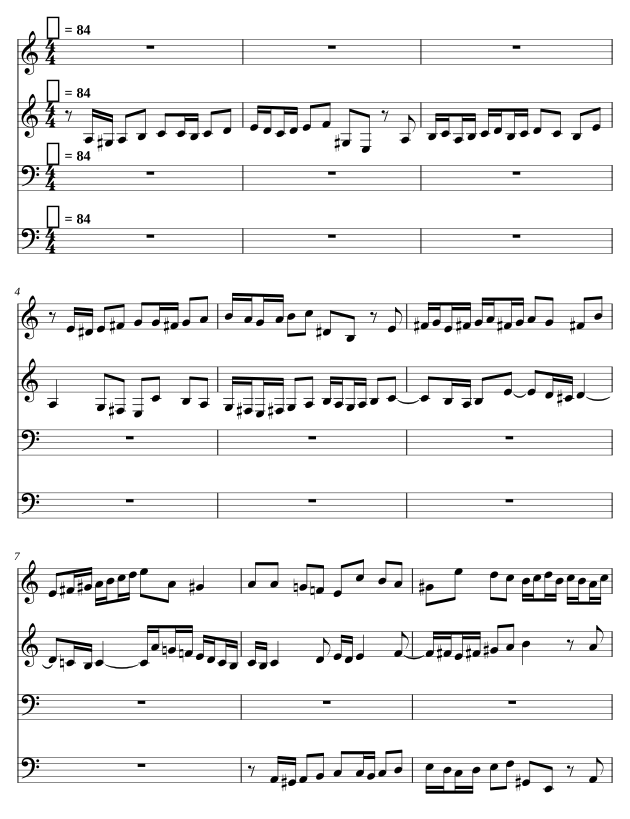
The subject is announced in the alto:—

The answer is real, and is given to the treble; there is no regular countersubject. After a bar of codetta (bar 7) the bass takes the subject, the answer in the tenor (bars 10 to 14) completing the exposition.
Middle Section
The episodes are few and unimportant. A series of entries of the subject, by inverse movement, immediately follows the exposition. That in the alto (bar 17) is fragmentary, being succeeded by the tenor in stretto at half-a-bar's distance; on the other hand an additional entry in the alto at bar 24 gives the fuller form. In all the voices the closing notes of the subject undergo a slight modification.
Canonic stretto, which is the special feature of this fugue, first makes its appearance in bars 27 and onwards. The treble and tenor give the subject, in its original key and form, in canon at half-a-bar's distance. The alto and bass (from bar 31) respond with the answer similarly treated; and in bars 36 to 40 the tenor and alto revert to the subject. After a short episode (bars 40 to 43, first quaver), treble and bass give the subject in the relative major, again at half a bar, and its closing section is further imitated by tenor (from last quaver of bar 45) and alto (from last quaver of bar 46, modified). From bar 48, similar treatment is given to the inverse form of the subject, first in alto and tenor, then (bar 53) in alto and bass; and again with the intervention of single episodical bars, in the treble and alto (from bar 57) and in the bass and tenor (bars 62, 63, incomplete).
Final Section
This would appear to begin at bar 64, in spite of some irregularity in the keys. From this point the canon is at the fifth instead of the octave; bass and tenor give the direct form, treble and alto the inverted. After the second episode (bars 71, 72), there is another canon in the octave, bass and alto, in the subdominant key, followed by three incomplete entries for the upper voices, the tenor by inverse movement, the alto and treble by direct.
The coda starts after the pause in bar 80, and contains incomplete stretti between alto and treble at the fifth, and for four voices on a tonic pedal, the bass and tenor by inverse movement, at the octave, the treble and alto in the direct form, at the fourth. Here as in several other cases, additional voices are employed for the coda.
Complete fugue: Bach, Well-Tempered Clavier, Book 1, No. 20, BWV 865. The reference score and piano recording below contain the entire fugue; the smaller engravings above reproduce Prout’s selected examples.