Playable Books
Ebenezer Prout · section 23 of 50
Fugue 21 · Book I, No. 21 · BWV 866
Read and hear this section in the playable edition →B Flat Major (Three Voices).
This beautiful little fugue is one of the most perfect in construction and artistic finish of all the collection—a veritable gem.
Exposition
The subject is as follows:—

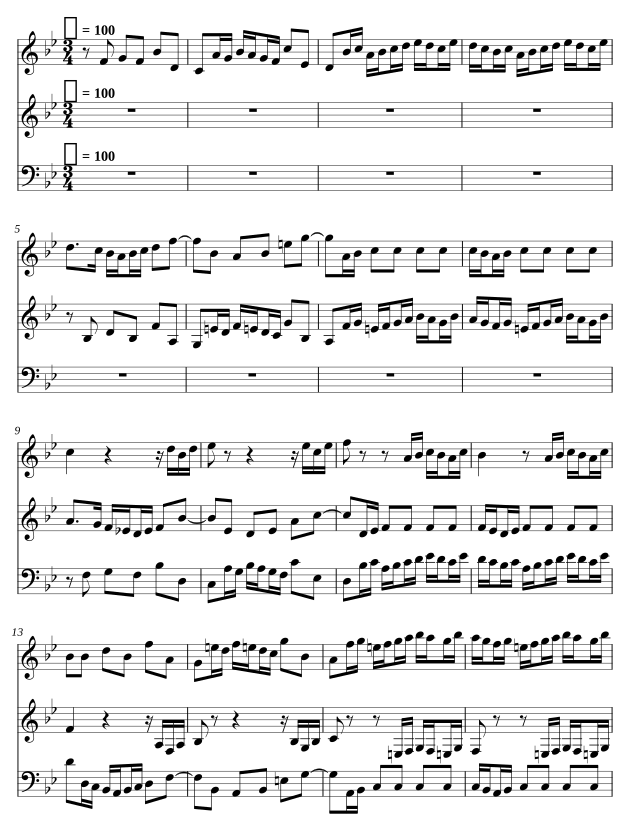
This is given out in the treble, and answered in the alto. The answer is tonal. The bass enters with the subject in bar 9, and the treble has a redundant entry, of the answer, in bar 13. There are two countersubjects, each with a marked individuality, and present with every entry from bar 9 onwards. The first (which we shall mark as CS 1) extending from bar 6, last quaver, to bar 9, will be readily recognized by its syncopations and iterated notes, the second (CS 2), bars 9 to 13, by the detached semiquaver figures and rests.
Middle Section
There are two interesting episodes. The first (bars 17 to 22) begins with a sequential continuation of bars 15 to 17, with the lower voices reversed, after which the bass is formed from a bar of the subject by inverse movement. The second episode (bars 30 to 35) is a free inversion of the first, and will repay close study.
The first group of middle entries (bars 22 to 30) begins in G minor, with the subject in the alto, CS 1 in the treble and CS 2 in the bass. The answer follows in the bass, modulating into C minor, with CS 1 in alto and CS 2 in treble. The second group commences at bar 35, in C minor, modulating to E flat. It comprises (i) an entry of answer in alto, with CS 1 in treble and CS 2 in bass; and (2) subject in treble, wholly in E flat, with CS 1 in alto and CS 2 in bass.
Final Section
The response to the last-named entry is the sole entry in the original key, and therefore the only one which can strictly be said to belong to the final section; it begins in bar 41, and has the answer in alto, CS 1 in treble, CS 2 in bass. A coda of four bars is added, founded on the same material as the episodes.
Of the six inversions of position possible in triple counterpoint, four are made use of in this fugue.
Complete fugue: Bach, Well-Tempered Clavier, Book 1, No. 21, BWV 866. The reference score and piano recording below contain the entire fugue; the smaller engravings above reproduce Prout’s selected examples.