Playable Books
Ebenezer Prout · section 25 of 50
Fugue 23 · Book I, No. 23 · BWV 868
Read and hear this section in the playable edition →B Major (Four Voices).
Exposition
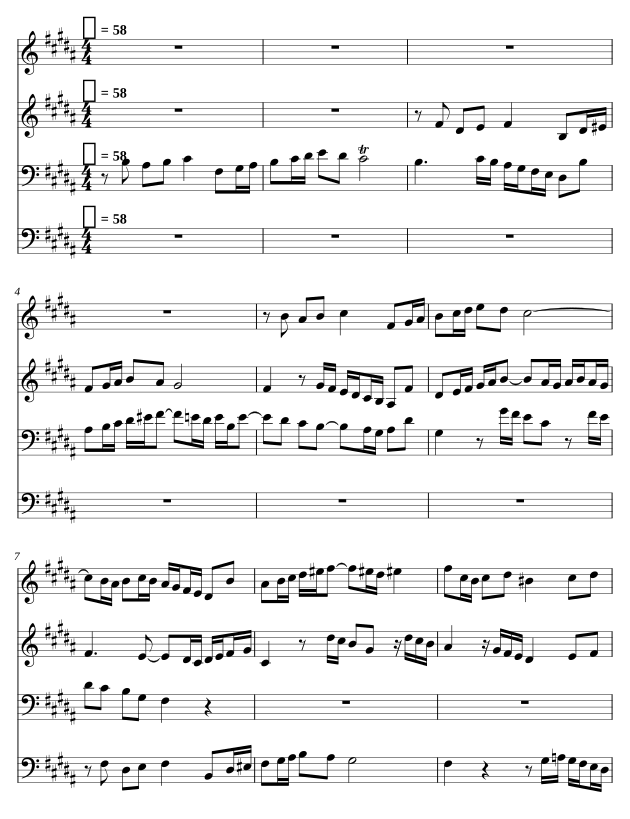
The subject of this fugue, which is in the tenor—

could have been given a real answer, but Bach has elected to regard the second, third, fourth and fifth notes in their relation to the dominant, and answer them by the corresponding intervals of the tonic, thus giving a tonal answer, somewhat as in No. 19. The answer is in the alto, accompanied by a countersubject in the tenor. A peculiarity of this fugue, however, is that the countersubject is regular throughout the exposition only, being subsequently used only once in a complete form (bars 31, 32), all other later entries being accompanied either by mere fragments of the countersubject, or by counterpoint principally derived, in rhythm, from its first seven notes. The treble enters with the subject in bar 5, and the bass with the answer in bar 7. A codetta (to bar 11) is followed by a redundant entry in the tenor in the original key.
Middle Section
The episodes (bars 13 to 16, first quaver, and 26 to 29, first quaver) are founded in part on the semiquaver figure of the countersubject, and are not very important. The subject appears in the alto in bar 16, in the key of F sharp. In bar 18 it is given in the treble, by inverse movement, in the key of B, answered in the alto in F sharp, also by inverse movement. The bass then gives it in its original form, and the tenor (from bar 24) in C sharp minor, commencing on the mediant, and slightly ornamented at the end.
Final Section
The final entries—subject in alto (bar 29) and answer in treble (bar 31) are perfectly straightforward.
Complete fugue: Bach, Well-Tempered Clavier, Book 1, No. 23, BWV 868. The reference score and piano recording below contain the entire fugue; the smaller engravings above reproduce Prout’s selected examples.