Playable Books
Ebenezer Prout · section 26 of 50
Fugue 24 · Book I, No. 24 · BWV 869
Read and hear this section in the playable edition →B Minor (Four Voices).
A worthy close to the first part of the work. The striking chromatic subject—

commencing in the tonic key closes in the dominant, and in order to return to the tonic in the answer, and at the same time to preserve the characteristic intervals and the sequence, it was necessary to make the tonal change very early. The fifth note, therefore, as well as the first, is answered by the tonic, and the whole answer from this point is a fifth below the subject. The case is analogous to that of No. 18.
Exposition
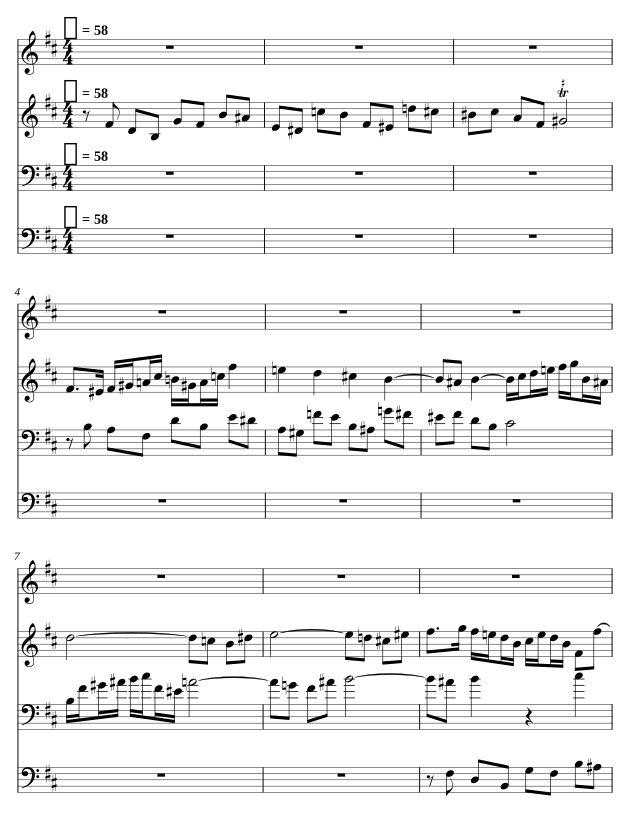
The subject is announced by the alto. The answer is in the tenor, and is accompanied by a countersubject from the fourth beat of bar 4. A codetta of two bars, in almost strict canon, derived from the countersubject, is followed by the subject in the bass (bar 9), and this, after another bar of codetta, by the answer in the treble (bar 13). The entry of the subject in bar 21 in the alto can best be described as a redundant entry, being still in the original key, and giving the treble its first opportunity of taking the countersubject. The first episode (bars 16 to 21) also clearly belongs to the first section of the fugue, as it does not quit the original keys.
Middle Section
The middle section therefore commences at bar 24, with the second episode. There are, in all, four episodes, largely founded on the same material as the codetta, the closing semiquaver figure of the countersubject. The first contains further a canon in the twelfth below (from middle of bar 17),. and contains in bar 19 a curious abortive entry of the first three notes of the subject. The second (bars 24 to 30) is a modification of the first. The third (bar 50, third beat, to bar 53) maintains the semiquaver figure throughout, and the fourth (bars 63 to 69, first quaver) is again similar to the first.
In bar 28 the subject is given to the tenor, in the new key of E minor, and at bar 34 the first stretto commences, only two voices participating. In bar 38 the subject, with its first note modified, appears in the bass, leading to a second and more complete stretto, which commences at bar 41, continues to the beginning of bar 47, and is followed by the answer in the key of D in the bass. During the stretto the countersubject is absent, excepting a fragment in the alto of bar 45; and, as frequently happens in stretti, only the last entry of the subject (here the tenor) is completed. The next series of entries (bars 53 to 63) is not in stretto, and needs little comment.
Final Section
The final section commences during the course of this series of entries, namely, with the return to the original key in bar 60. New counterpoints are here substituted for the countersubject (bars 60 to 63). The final entries (excepting the coda), are again in two-part stretto, the subject in the tenor in B minor (bar 69), being followed by the subject in the bass, beginning in E minor (bar 70) and modulating back. The coda (bars 73 to 76) includes a partial entry of the subject in the alto.
Complete fugue: Bach, Well-Tempered Clavier, Book 1, No. 24, BWV 869. The reference score and piano recording below contain the entire fugue; the smaller engravings above reproduce Prout’s selected examples.