Playable Books
Ebenezer Prout · section 27 of 50
Fugue 25 · Book II, No. 1 · BWV 870
Read and hear this section in the playable edition →C Major (Three Voices).
Exposition
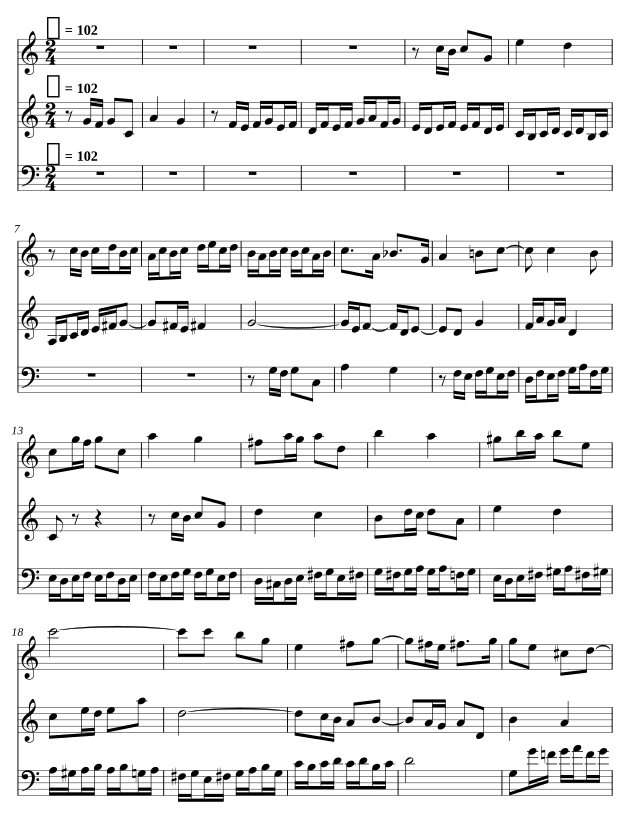
— The subject is announced in the alto:—

The answer is tonal, and is given to the treble. It will be noticed that as Bach treated the first note of the subject as the dominant of C, not the tonic of G, the auxiliary note, F, lay a whole tone below it, while in the answer the corresponding interval is a semitone. There is no regular countersubject, and no codetta. The exposition ends on the first semiquaver of bar 13, at the completion of the subject in the bass.
Middle Section
— In the first episode (bars 13 to 21) the second section of the subject is worked as a bass to a free canon founded on its first section. In bar 21 the subject enters in the alto, modulating into D minor, and followed by the answer in the treble, modulating to A minor. The second episode (bars 29 to 39) is for treble and alto alone, beginning with a new treatment of the material of episode 1, and developing (from bar 33) into a canon in the fifth.
Final Section
— The entries, which are technically the " final group," appear rather early in this fugue. The answer in the bass (bars 39 to 43) is separated from the two succeeding entries by a third episode, reaching to the beginning of bar 47, and furnishing new counterpoints to the semiquaver figure. The subject in the alto (bars 47 to 51) and answer in the treble (bars
51 to 55) complete this group. The fourth and longest episode (bars 55 to 68) separates this from the coda; it begins with a free transposition of episode 1 to the fifth below, with a new continuation from bar 62, still built on the semiquaver bass. The coda contains four partial entries of the subject, in bars 68, 72, 76 and 79; a fourth voice is added from bar 80.
Great unity of character is given to this fugue by the derivation of nearly the entire material from the subject itself.
Complete fugue: Bach, Well-Tempered Clavier, Book 2, No. 1, BWV 870. The reference score and piano recording below contain the entire fugue; the smaller engravings above reproduce Prout’s selected examples.