Playable Books
Ebenezer Prout · section 29 of 50
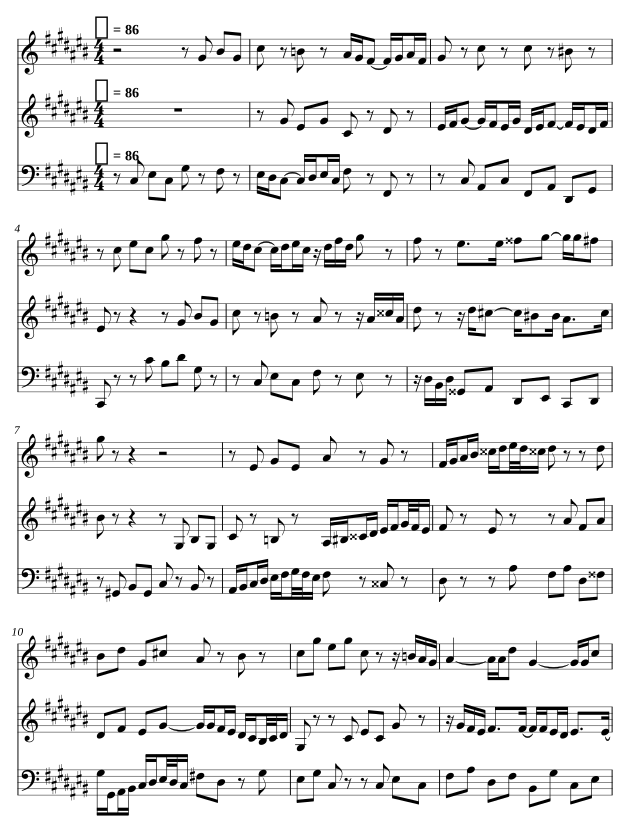
Fugue 27 · Book II, No. 3 · BWV 872
Read and hear this section in the playable edition →C Sharp Major (Three Voices).
A very troublesome fugue to analyse, owing to the difficulty in determining where the subject terminates. An examination of the latter part of the fugue shows that it should be regarded as consisting of only the first four notes. This is consequently the shortest subject to be found in the forty-eight.
Exposition
The subject is given out in the bass:—
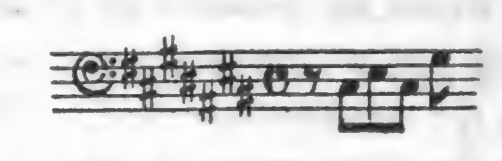
The answer, in the treble, is tonal; there is no regular counter subject, or at least not beyond the exposition. In the third voice, the alto, the subject is given by inverse movement, a somewhat unusal treatment for the exposition.
Counter-Exposition
A counter-exposition occupies bar 4 and the first half of bar 5, and to this succeeds immediately the middle section.
Middle Section
First the answer is given in the treble and alto by diminution (bar 5), and in the bass by diminution and inversion; then the answer in all three voices in notes of the original length, the bass leading, and with continuation in canonic imitation; next follow two stretti (bars 9 to 10 and 10 to 12), the former entirely in inverse movement, the latter first inverted (bass, treble) and then direct (alto, bass).
There are two episodes. The first (bars 12 to 14) is founded on a variation of the subject treated sequentially in the bass. The second (bars 20 to 24) is somewhat similar in character, the bass of bar 12, in a modified form, being treated by diminution in the treble of bar 20.
A second stretto appears in bars 14 to 16, the answer direct being alternated with the subject inverted. An isolated entry in
the bass of bar 17 is succeded by three in diminution, the alto and the bass inverted, then the bass direct. After Episode 2, another isolated entry in the bass (bar 24, answer) leads to the final section.
Final Section
This introduces the last stretto (bars 25, 26) in which the subject in the treble, inverse movement, is answered in the alto by augmentation and in the bass in the original form, though beginning on the submediant. The remaining entries, in bars 27, 28 to 29, 30 to 31, 31 to 32, present no specially new features, and need not be discussed in detail. The coda, from bar 32 to the end, contains one or two reminiscences of the subject by diminution; as is often the case with Bach, it introduces additional voices.
Complete fugue: Bach, Well-Tempered Clavier, Book 2, No. 3, BWV 872. The reference score and piano recording below contain the entire fugue; the smaller engravings above reproduce Prout’s selected examples.