Playable Books
Ebenezer Prout · section 30 of 50
Fugue 28 · Book II, No. 4 · BWV 873
Read and hear this section in the playable edition →C Sharp Minor (Three Voices)
Exposition
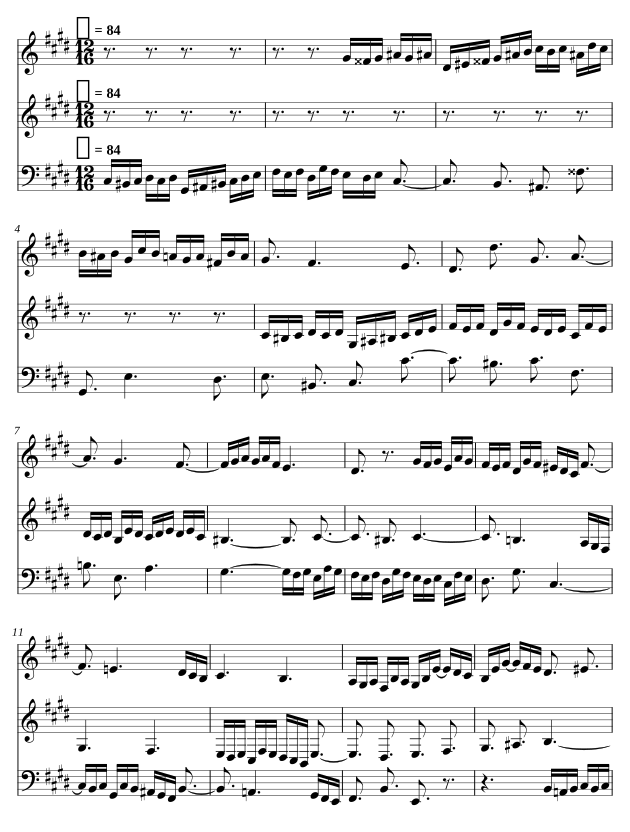
The subject is announced in the bass:—

The answer, in the treble, is real, and reaches to the first semiquaver of bar 4; the rest of that bar forms a codetta, sequentially copying the close of the subject, and modulating back preparatory to the entry of the subject in the alto in bar 5.
Counter-Exposition
There is a partial or irregular counterexposition from bar 16, only two voices (treble and alto) conforming to the rule of tonality, while the remaining voice enters (at bar 20) in the key of the relative major.*
*Riemann (Katechismus der Fugen-Komposition, ii., p. 32, treats this group as part of the middle (modulatory) section. [ED.]
Middle Section
After a short episode (bar 21 to 23) there is a group of entries by inverse movement (bars 24, 26, 28), followed by a return to the subject in its original form and key (bar 30). Then comes an exceptionally long episode (bars 31 to 47), leading back, after various modulations, to the tonic key, in which the subject re-enters in bar 48.
Final Section
Besides regular entries of the subject in the treble (bar 48), bass (bar 55) and alto (bar 66), there is a further example of inverse movement, (bar 53), the form somewhat varied, and the tonality, that of A, and a final appearance in bar 67 (second half), in the direct form but also somewhat varied.
The episodes in this fugue (bars 6 to 15, 21 to 23, 31 to 47, 49 to 52, 56 to 60, 62 to 65) are extensive and of great importance, occupying no less than 40 bars out of 71. Almost all their thematic material is founded on the subject, except the theme given in the treble of bars 35, 36, which is subsequently combined with the subject in double counterpoint in the twelfth (see bars 48, 49, and 55, 56). Thus, in spite of the large proportion of episode, there is great unity of character throughout, the figure of triplet semiquavers being maintained from the first note of the fugue to the end. Bars 69 to 71 form a short coda.
Complete fugue: Bach, Well-Tempered Clavier, Book 2, No. 4, BWV 873. The reference score and piano recording below contain the entire fugue; the smaller engravings above reproduce Prout’s selected examples.