Playable Books
Ebenezer Prout · section 32 of 50
Fugue 30 · Book II, No. 6 · BWV 875
Read and hear this section in the playable edition →D Minor (Three Voices).
Exposition
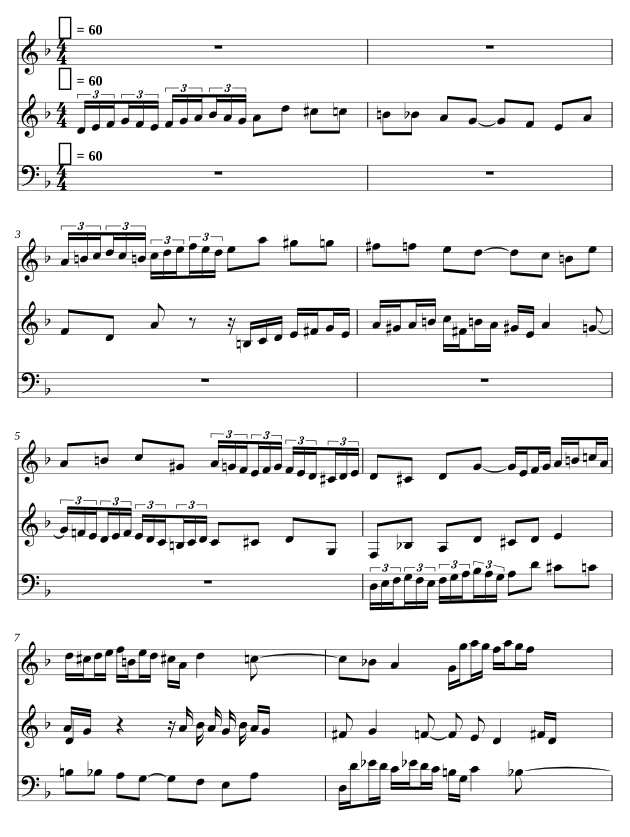
The subject—

is in the alto; as it reaches the dominant by step progressions and does not modulate, the answer, in the treble, is real. A countersubject, mostly in even semiquavers, accompanies it with the exception of its first half bar. The codetta (bar 5) is made from the inversion of the first half bar of the subject, treated imitatively. In bars 6 to 8 the bass takes the subject, the treble the countersubject.
There are few changes of key in this fugue, and it would be possible to regard the first stretti (bars 10 to 12, 14 to 16) as belonging to the opening section, and the middle section as characterised by inverse movement (from bar 17). But the position of the first episode, and the dissimilarity of these stretti to redundant entries or counter-exposition, render it unnatural to include them here. In any case, the division into three sections is not very clear.
*I cannot refrain from quoting the rest of the Author's characteristic comment in his MS., though it was not intended for publication:—" Wonderful old fellow, Bach ! " [ED.]
Middle Section.—The first episode (bars 8, 9) is formed from the fragment of incidental counterpoint in the alto of bar 7. In bars 10 to 12 the impression of a stretto in the octave, at three crotchets' distance, is produced, but the bass really breaks away from the subject before the treble enters. After a second episode (bars 12, 13), consisting of a different treatment of the material of the first, a closer stretto is given to the two upper voices, the answer succeeding the subject at the distance of one crotchet; the bass supplies the countersubject (bars 15, 16). In bar 17 answer and subject are given by inverse movement, again at one crotchet's distance; and in bar 18 the subject in G minor, in its direct form, by bass and alto at the same distance of time. A third episode (bars 19 to 24) separates these from the final entries; the first part of this episode is derived from the codetta, the rest from the matter of the previous episodes.
Final Section
The final section consists of only three bars and contains a stretto in the octave at half a bar's distance, for the two upper voices, with the countersubject in the bass from bar 26.
After the exposition, nearly all the entries of the subject and countersubject are more or less incomplete.
Complete fugue: Bach, Well-Tempered Clavier, Book 2, No. 6, BWV 875. The reference score and piano recording below contain the entire fugue; the smaller engravings above reproduce Prout’s selected examples.