Playable Books
Ebenezer Prout · section 34 of 50
Fugue 32 · Book II, No. 8 · BWV 877
Read and hear this section in the playable edition →D Sharp Minor (Four Voices).
Exposition
The subject commences on the tonic and only touches the dominant quite incidentally:—
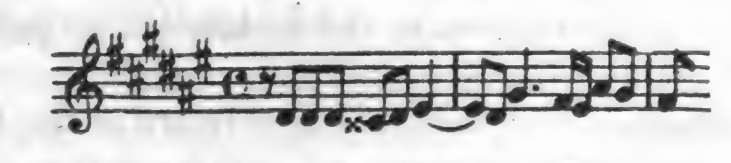
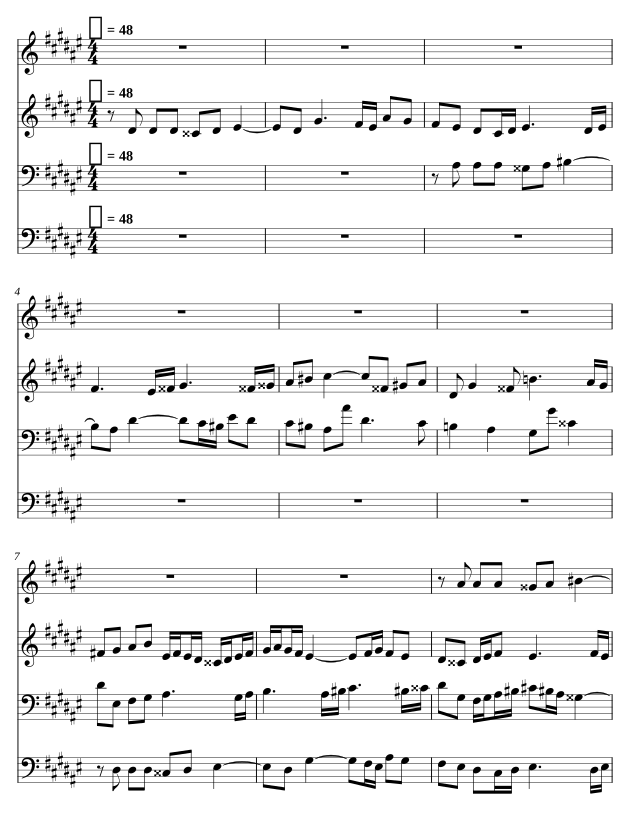
The answer, therefore, is real. The countersubject, begining at the middle of bar 3, is only used for the first half of the fugue, and is not found after 23. The order of entry of the voices is:— alto (subject), tenor (answer), bass (subject), tenor (answer). There is a codetta of two bars (bars 5 to 7, first quaver) between the tenor and bass entries; it is constructed of new material, and serves as the foundation for the two episodes. As in Fugue 29, the first of these (bars 11 to 15) does not modulate away from the original keys.
Middle Section
The middle section proper, as a consequence, does not begin until bar 15, where the subject in the bass, by a slight alteration, is made to modulate into the subdominant key, G sharp minor; the countersubject is given to the treble. This entry is answered (bar 17) by the alto, similarly varied, but with countersubject absent, and passing into F sharp major, then (bar 19) by the tenor, with the countersubject (varied) in the bass, and passing into B, and finally (bar 21) by the treble in the original form and key, with the countersubject in the tenor. This leads on to a stretto, in which three voices participate, the tenor (bar 28) imitating the alto at half a bar, while the bass does not enter until a whole bar after the tenor, which breaks off after six notes only of the subject. The treble enters with the subject in the related key of C sharp minor in bar 27, but not in stretto. An alto entry in B (bar 30), and a varied one for the tenor (bar 32), beginning in G sharp minor but modulating to D sharp minor, with the addition of a codetta of a bar and a half, close this group of entries. The second episode begins in the middle of bar 35, and reaches to the middle of bar 40.
Final Section
The subject is now heard in the bass (bars 40 to 42) and in the treble (bars 43 to 45), the latter being accompanied by the answer in the tenor in inverse movement. It will be seen that the treatment of bars 40 to 43 is mainly homophonic; compare Fugue 18, bars 9 to 11.
Complete fugue: Bach, Well-Tempered Clavier, Book 2, No. 8, BWV 877. The reference score and piano recording below contain the entire fugue; the smaller engravings above reproduce Prout’s selected examples.