Playable Books
Ebenezer Prout · section 41 of 50
Fugue 39 · Book II, No. 15 · BWV 884
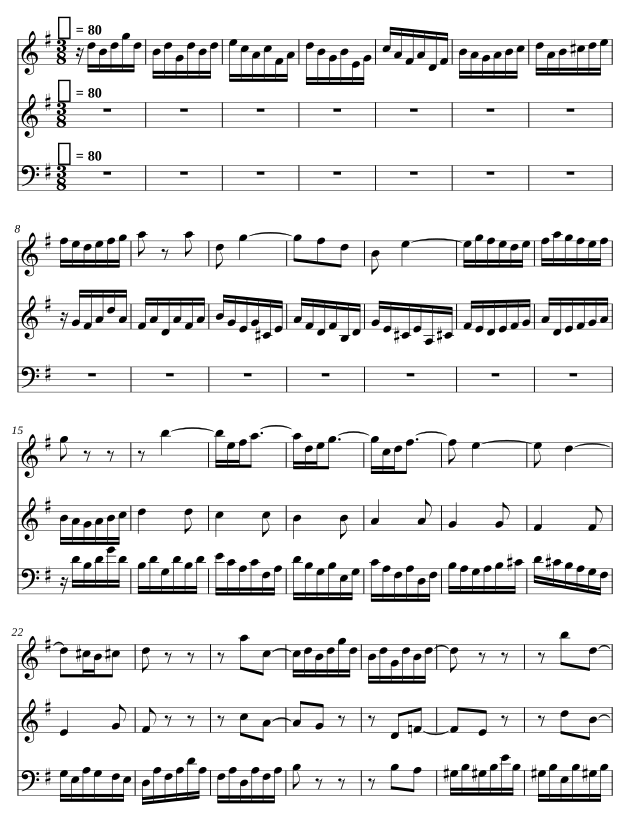
Read and hear this section in the playable edition →G Major (Three Voices).
A fugue of simple construction, requiring little comment
Exposition
The subject is announced in the treble—

and is separated from the answer by a codetta of two bars, likewise in semiquavers, though with the arpeggios replaced by scale-passages. The answer is in the alto, and is tonal; it would also have been possible here to give a real answer, starting on supertonic, as the initial dominant is a note of small value, and part of an arpeggio. There is no regular countersubject. After a second codetta, similarly constructed to the first, the bass introduces the subject in bar 15. Bars 20 to 23 form a codetta to the exposition, making a cadence in the dominant key.
Middle Section
There are two episodes (bars 23 to 33 and 45 to 64). They are both derived from the first notes of the subject. In the first, the treatment is by imitation at the interval of the fourth; the second episode is largely sequential. The latter closes with a long dominant pedal (bars 56 to 64). There is only one middle entry of the subject, namely, in the bass from bar 33.
Final Section
This likewise contains only a single entry of the subject, which is given to the alto. A couple of bars are added to lead to the final perfect cadence.
A peculiarity of this fugue is the extensive compass of the upper voice, which from bar 60 to 63 goes down nearly to the lowest note of the bass. The flow of the parts shows clearly that it is the upper voice which descends here.
Complete fugue: Bach, Well-Tempered Clavier, Book 2, No. 15, BWV 884. The reference score and piano recording below contain the entire fugue; the smaller engravings above reproduce Prout’s selected examples.