Playable Books
Ebenezer Prout · section 42 of 50
Fugue 40 · Book II, No. 16 · BWV 885
Read and hear this section in the playable edition →G Minor (Four Voices).
One of the finest fugues in the whole collection, the countersubject being inverted in the tenth and twelfth as well as in the octave.
Exposition
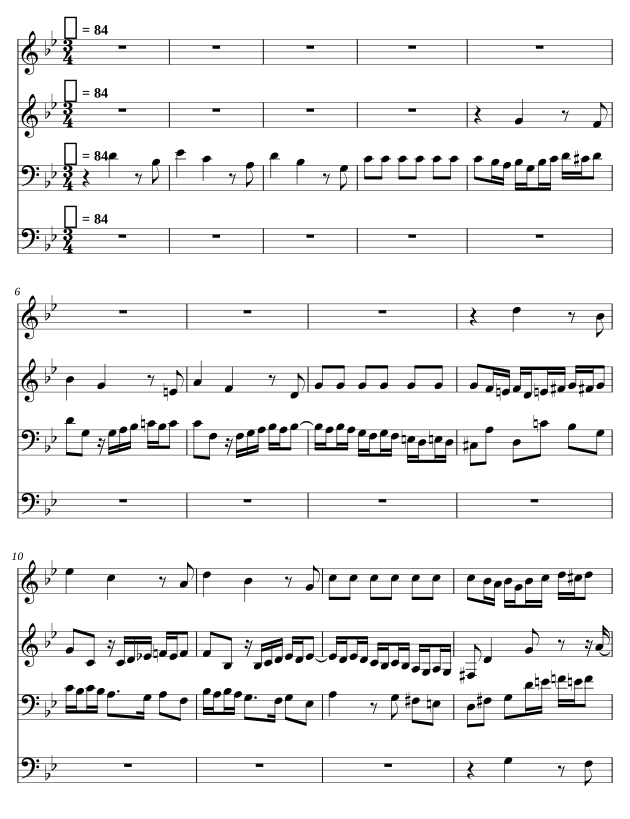
— The subject, which is in the tenor, reaches to the second beat of bar 5: —

The answer, in the alto, commences with the final note of the subject, and is tonal. The countersubject follows the subject immediately, and terminates either at the first or second beat of bar 9, but its ending is usually altered after the exposition. There are no codettas, and the entries of the remaining voices are quite regular. The reappearance of the subject in the tenor at bar 20 in the original key, is best regarded as a redundant entry, although separated from the others by a short episode. It gives the bass the opportunity of taking the countersubject, in the normal double counterpoint at the octave, before the introduction of the new methods of inversion.
Middle Section
The second episode (bars 24 to 28) modulates more freely, and clearly belongs to the middle section, as does also the entry of the subject in D minor in the alto (bar 28), introducing the new feature of double counterpoint in the twelfth. In bars 32 to 40 there is a pair of entries in the relative major keys, the subject in the treble being answered in the bass. The countersubject is now inverted at the tenth. In bar 45 the subject is introduced in thirds, in the two middle voices, the double counterpoint being therefore simultaneously at the octave and the tenth; and similarly at bar 51 it is in sixths (treble and alto), the countersubject in the tenor. The former of these entries (bar 45) is harmonised mostly in B flat, modulating into F, the latter (bar 51) mostly in C minor. At bar 59 there is a still further elaboration, both the subject and the countersubject being given in thirds, in the key of E flat; the resulting double counterpoint is therefore simultaneously in the octave (alto and tenor) in the tenth (treble and tenor, and alto and bass) and in the twelfth (treble and bass).
Final Section
In bars 67 to 69 portions of the subject and countersubject are heard in the tenor and alto (inverted at the twelfth) in the tonic key, broken into at bar 69, after the manner of stretto, by an entry of treble and bass with subject and countersubject at the original interval, but accompanied by tenor and alto in compound thirds; this produces again the combinations discussed in connection with the entry at bar 59, only with a different distribution of the parts. After a perfect cadence at bar
75, a coda is added, founded chiefly on the countersubject, but with an altered entry of the subject in the bass from bar 79.
The episodes of this fugue are all founded on material suggested by the countersubject. They are five in number: bars 17 to 20, 24 to 28, 40 to 45, 55 to 59 and 63 to 67.
Complete fugue: Bach, Well-Tempered Clavier, Book 2, No. 16, BWV 885. The reference score and piano recording below contain the entire fugue; the smaller engravings above reproduce Prout’s selected examples.