Playable Books
Ebenezer Prout · section 43 of 50
Fugue 41 · Book II, No. 17 · BWV 886
Read and hear this section in the playable edition →A Flat Major (Four Voices).
Exposition
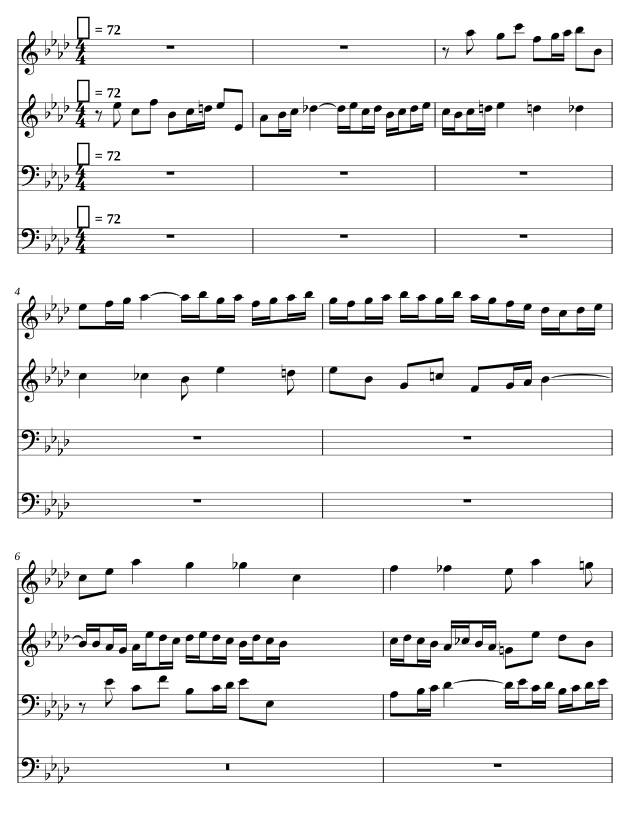
The subject is in the alto:—

The answer is tonal, but (as with so many others) it is only the first note which needs alteration. The countersubject commences on the second beat of bar 3 and closes with the subject, at the beginning of bar 5. There is a bar of codetta, founded on the subject. The remaining entries in the exposition are at bars 6 and 8. The order of the voices is not quite one of the most usual, alto, treble, tenor, bass. An episode (bars 10 to 13), separates the exposition from the counter-exposition.
Counter-Exposition
The subject again leads (bar 13), but now in the bass, and with the countersubject inverted at the twelfth (in the tenor), which necessitates the change of a D flat to D natural in the subject. The answer follows in the alto (bar 16) then the subject in the tenor (bar 18) and finally, after a codetta, the subject again in the treble. The countersubject is always present, though incomplete.
Middle Section
This follows immediately, the subject being presented in the alto in the key of F minor, with countersubject in the treble. The second and last episode (bars 26 to 32) is formed from the last member of the subject. The next appearance of the subject is at bar 32 in the tenor, in the unrelated key of E flat minor, and unaccompanied by the countersubject. The entry at bar 35 in the treble, in the key of B flat minor, may be regarded as the answer to the preceding, though real instead of tonal; the countersubject is in the alto. Next follows an entry in the bass in D flat (bar 37), with a portion of the countersubject in the treble.
Final Section
The subject returns in the key of A flat in the tenor in bar 41, with the countersubject, curiously varied, in the treble; and is answered in stretto by the bass in bar 42. There is a coda from bar 46 to the end, containing an entry of the answer (but in the tonic key) in the tenor at bar 48, where a fifth voice is added, the first bass taking a part of the countersubject while the second supplies the harmonic bass.
Although nominally a four-part fugue, there is a great predominance of three-part writing, less than one-third of the whole being really in four parts.
Complete fugue: Bach, Well-Tempered Clavier, Book 2, No. 17, BWV 886. The reference score and piano recording below contain the entire fugue; the smaller engravings above reproduce Prout’s selected examples.