Playable Books
Ebenezer Prout · section 44 of 50
Fugue 42 · Book II, No. 18 · BWV 887
Read and hear this section in the playable edition →
G Sharp Minor (Three Voices).
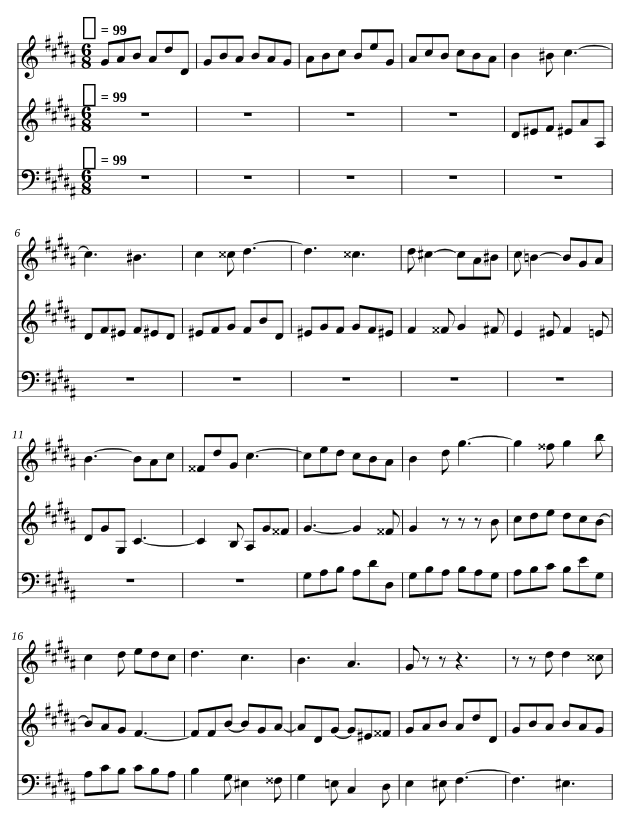
One of the longest and most elaborate of the forty-eight, although containing no stretto. It is virtually a double fugue, its second subject (or countersubject) having a separate exposition from bar 61 to 83, only slightly irregular at bars 71 to 75. Contrast the very irregular entries of the new themes in No. 38.
First Section.—The subject is announced in the treble—

and takes a real answer (alto). There is a codetta from bar 9 to the end of bar 12, the subject entering in the bass at the beginning of bar 13. This completes the exposition proper, but it is noteworthy that all the four following entries (bars 19, 33, 45, 55) are in the original key. It would be possible to classify them as a redundant entry of the subject (bar 19) and a counter-exposition (bars 33 to 59), but the latter would be irregular, and it must be borne in mind that the three normal divisions of a double fugue of this class are: (i) treatment of first subject separately; (2) treatment of second subject separately; (3) treatment of both subjects combined.
Middle Section
A new theme is announced in the treble from bar 61, in the dominant key:—

This is answered in the tonic by the alto (bar 66). The bass then introduces it in the subdominant instead of the dominant (bar 71) and there is a redundant entry in the treble in the tonic (bar 79).
Final Section
After a longish episode, the two subjects are combined at bar 97, the first being in the bass, the second in the alto. In the answer to this (bar 103), the treble takes the first subject, the alto again taking the second. At bar 111 we have the only entry which is not in one of the original keys. Here the key is E, with the subjects in the two upper voices. The two remaining entries are in G sharp minor; in bars 125-129 the first subject is in the alto, and the second (not quite completed) in the bass; in bars 135 to 139 the first is the treble, the second is the alto. A short coda concludes the fugue.
The episodes, though numerous, are not of exceptional importance. They are developed, as usual, from suggestions from the subject (as at bars 37 and 129), the countersubject (as at bars 115, etc.) or the codetta (as at bar 49, etc.). See bars 23 to 32, 37 to 44, 49 to 54, 84 to 96, 107 to 111, 115 to 124, 129 to 134.
Complete fugue: Bach, Well-Tempered Clavier, Book 2, No. 18, BWV 887. The reference score and piano recording below contain the entire fugue; the smaller engravings above reproduce Prout’s selected examples.