Playable Books
Ebenezer Prout · section 45 of 50
Fugue 43 · Book II, No. 19 · BWV 888
Read and hear this section in the playable edition →A Major (Three Voices).
A melodious little fugue, of such simple construction as to call for hardly any special remarks.
Exposition
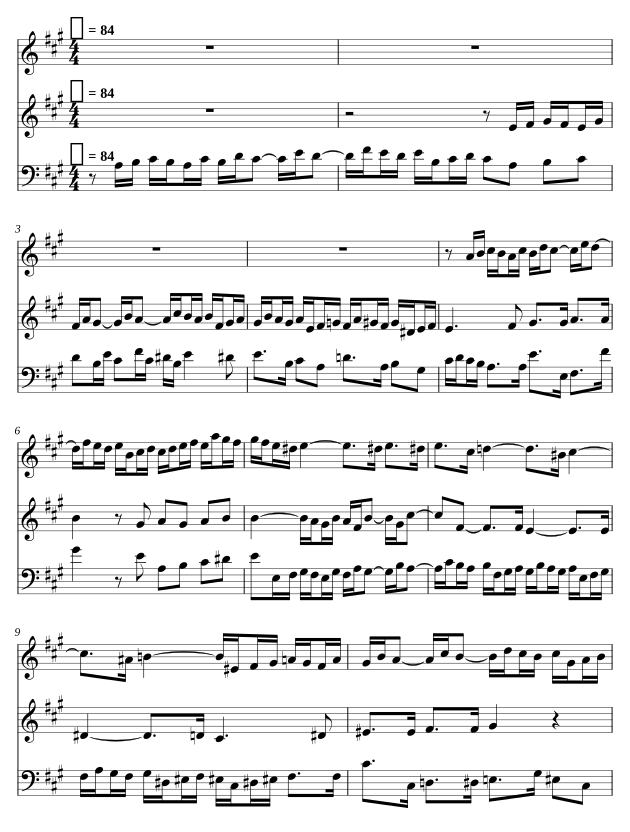
The subject is announced in the bass:—

The answer, in the alto, is real, and there is no regular countersubject. The codetta (bar 4) is in sequence, made from the last part of the subject. The treble enters in bar 5 with the subject; the bass in bar 7 with a redundant entry of the answer.
Middle Section
The middle entries follow the exposition almost immediately, the subject entering in the treble at bar 9, in the key of F sharp minor. This is answered in the alto in bars 12, 13, in C sharp minor. The first episode (bars 13 to 16) and all succeeding ones are founded on the same part of the subject as is the codetta. The next entry is in the key of A (bar 16, bass) and might have indicated the arrival of the final section of the fugue; but Bach here treats it rather as the dominant of the following entry (bar 20, treble) which is in the key of D, and therefore as still belonging to the modulating section. It will be noticed that it is made to close in D, not in A. The second episode (bars 17 to 20) separates these two entries, and contains incidental modulation into B minor. The third episode (bars 21 to 23) modulates from D into E, and in bar 23 the subject enters in the alto in that key, with its sixth note chromatically lowered.
Final Section
This may either be regarded as starting from the entry just noticed (as the answer leading) or, perhaps more naturally, as containing only the single entry, in the original key (bars 28 to 29), with a cadential bar added. The episode which separates these last two entries (bars 25 to 27) gives the semiquaver figures partly by inverse movement.
Complete fugue: Bach, Well-Tempered Clavier, Book 2, No. 19, BWV 888. The reference score and piano recording below contain the entire fugue; the smaller engravings above reproduce Prout’s selected examples.