Playable Books
Ebenezer Prout · section 46 of 50
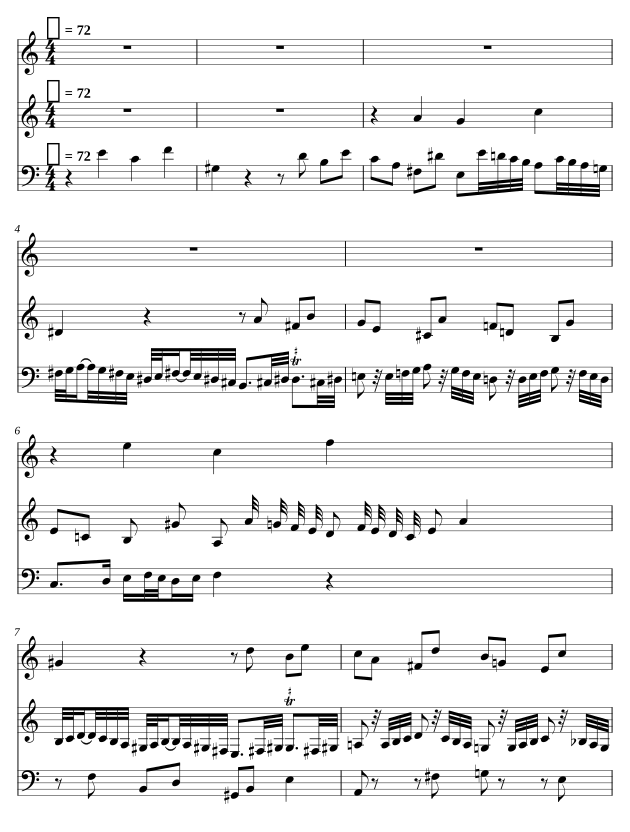
Fugue 44 · Book II, No. 20 · BWV 889
Read and hear this section in the playable edition →A Minor (Three Voices).
One of the most interesting of the shorter fugues. We have shown elsewhere* that virtually the same subject has been treated in entirely different ways by various composers.
Exposition
The subject, which is in the bass,

commences on the dominant; the alto (bars 3 to 5) therefore gives a tonal answer. The countersubject commences with the demisemiquaver. A codetta separates the answer from the entry of the treble with the subject, with a new counterpoint in demisemiquavers.
* " Fugal Analysis," pp. 107-134.
Middle Section
The first episode (bars 8, 9) modulates from the key of A minor into the relative major, in which key the next entry is made, in the bass, with the countersubject in the treble. A passing note (F, quaver) is here introduced between the first two notes of the subject, as is also the case in the final entry, at bar 25. The second episode modulates back to A minor, but the entry of the treble (bar 13) is in the form of the answer, and passes at once into E minor; the countersubject is given to the alto. In bar 17 (subject in alto, countersubject in bass) the key is again A minor, but the sequel shows that we have not yet reached the final section; the first note is shortened in this entry, and the subdominant substituted for the dominant, so that we have again the form of the answer. In bars 21 to 23 there is an entry of the subject in D minor in the treble, with the countersubject in the bass. The episode which follows concludes the middle section, modulating back to the original key.
Final Section
As in No. 43 and some other fugues, there is only one entry of the subject in the final section. This is in the bass (bars 25 to 27) and is unaccompanied by the countersubject, with the exception of a fragment in bar 27. The coda (bars 26, 28) is short and unimportant.
The episodes in the fugue, though short, are all very interesting. The first (bars 8, 9) commences with a transposition of the codetta, while the figures in bar 9 are suggested by the countersubject. Episode 3 (bars 15 to 17) is again derived from the codetta, with new imitative treatment. In the fourth (bars 19 to 21) the bass gives a sequential treatment of the last figure of the countersubject, which is accompanied by a canon at the fifth between the other two voices. The fifth episode (bars 23 to 25) commences with a portion of the countersubject in the bass, the rest of the material being derived from the codetta, Bars 24, 25 are closely related to Episode 3.
Complete fugue: Bach, Well-Tempered Clavier, Book 2, No. 20, BWV 889. The reference score and piano recording below contain the entire fugue; the smaller engravings above reproduce Prout’s selected examples.