Playable Books
Ebenezer Prout · section 47 of 50
Fugue 45 · Book II, No. 21 · BWV 890
Read and hear this section in the playable edition →B FLAT MAJOR (FOUR VOICES).
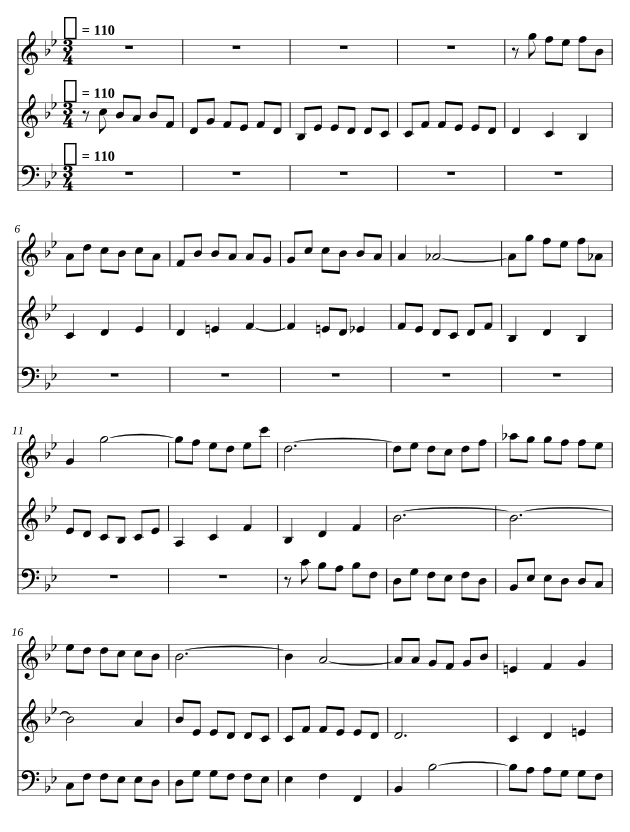
A highly interesting fugue, presenting some unusual features The most striking is the treatment of the two new counterpoints which accompany the entry of the subject in bar 33. In bars 41 to 44, the upper of the two counterpoints of bars 33 to 36 is inverted in the twelfth and the lower one in the tenth. In bars 56, 57 the two counterpoints are inverted in the twelfth with one another; and in bars 80, 81 the second counterpoint again appears at the tenth against the subject.
Exposition
The subject is in the alto:—

Here, as in No. 39, Bach has chosen a tonal answer where a real could also have been justified, and would have been preferred by many composers. He answers the fifth note (the dominant) by the tonic, although it is in the middle of an arpeggio. The answer is given to the treble. The codetta (bars 9 to 13, first quaver) is founded on the first bar of the subject, direct and by inverse movement. The next three entries (bars 21, 32, 40), all separated by episodes, are likewise in the two principal keys, but do not—as would at first sight appear—form a regular counter-exposition. The first of them has the character of a redundant entry of the answer in the bass, now real instead of tonal. But the next entry (bar 32) introduces an important new feature, in the counterpoints already referred to; and we have learned from some other analyses that in such cases as these Bach sometimes prefers to maintain the original tonality.
Middle Section
Bar 32, where the answer (again real) re-enters in the alto, at first absolutely without accompaniment and then (bar 33) with syncopated countersubject in the treble, and one in long notes in the bass, consequently marks the commencement of the middle section. The companion entry, from bar 40, shows the subject in the treble with CS 1 in the bass and CS2 in the alto. In bar 47 an entry is made in the bass in a new key, G minor, and the new counterpoints are only partially used (bars 49 to 51).
The fugue contains only one small stretto, in the key of E flat. The subject enters in the treble in bar 53, commencing on the tonic instead of the supertonic, is imitated at the seventh below the alto at one bar's distance, and again at one bar's distance by the bass a sixth lower still; but only the alto completes the subject.
The last entry of the middle section is in C minor, in the treble, with CS 1 in the alto and CS 2 in the bass.
Final Section
The return to the original key is made in bars 78 to 82 by the answer in the treble, in its original tonal form, but with E natural instead of E flat. A part of the countersubject is present from bar 80. From bar 82 to the end is a long coda, founded on the opening bar of the subject, but without actual entries of it.
The subject—either its first or its second half—furnishes the material for all the episodes. These are mostly short, and need not be discussed in detail. They will be found in the following bars: (i.) bars 17 to 21; (II.) 25 to 32; (III.) 36 to 40; (iv.) 44 to 47; (v.) 58 to 63; (VI.) 67 to 78.
Complete fugue: Bach, Well-Tempered Clavier, Book 2, No. 21, BWV 890. The reference score and piano recording below contain the entire fugue; the smaller engravings above reproduce Prout’s selected examples.