Playable Books
Ebenezer Prout · section 48 of 50
Fugue 46 · Book II, No. 22 · BWV 891
Read and hear this section in the playable edition →B Flat Minor (Four Voices).
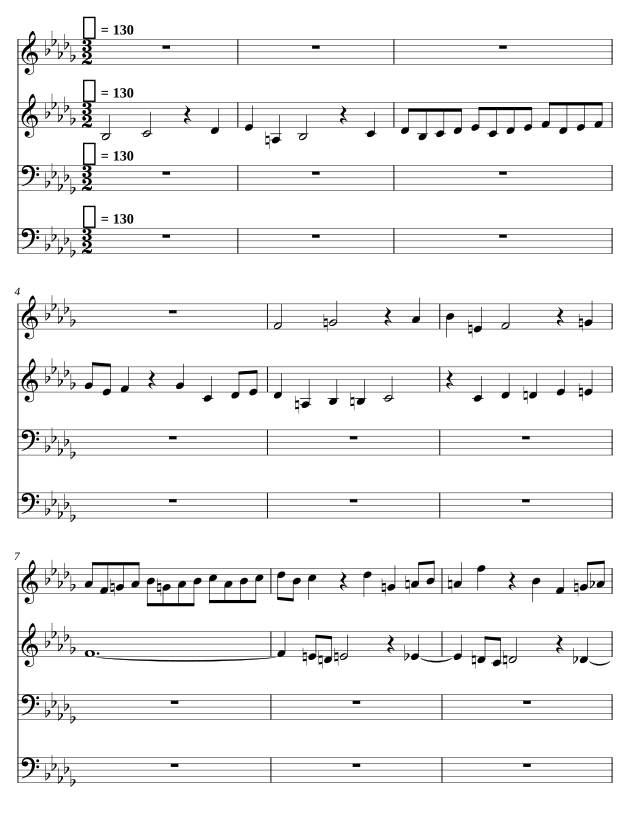
This fugue, quite exceptionally, is divisible into five sections rather than into three. These are: (disregarding the episodes) (i.) The Exposition, bars 1 to 21. (II.) The first stretti, on the original form of the subject, bars 27 to 37. (III.) A series of entries by inverse movement, bars 42 to 62 (*). (iv.) The second stretti, on the inverse form of the subject, bars 67 to 77. (v.) The third stretti, combining both forms of the subject, bars 80 to 84, 89 to 93 and 96 to 99; the last group belongs to the coda. The exactitude of the correspondence, in construction, between sections I. and III. and sections II. and IV. can hardly escape notice. The rule that the first and last sections of a fugue must be in the principal keys still holds good; but the middle section is extended to three sections.
Exposition
The subject is given out in the alto:—

The answer is real, and is assigned to the treble, a rather chromatic countersubject accompanying it in the alto. A codetta (bars 9, 10) precedes the entry of the third voice (subject in bass), and a second codetta (bars 15, 16) that of the remaining voice, the tenor. The countersubject is employed regularly.
* The author in his MS. has spoken of this as a counter-exposition, and this seems a justifiable designation, as indicating its nature; but its position after obvious " middle entries' and its irregularity of intervals of entry (bars 52, 58) and even of key (bar 58) prevent its coming under any ordinarily accepted definition thereof. [ED.]
Middle Section
In bars 27 to 31 and 33 to 37 there are two canonic stretti, each at one minim's distance; the former is in the original key, between tenor and alto, the lower voice leading; the latter in the relative major, between treble and bass, the higher voice leading; the countersubject is absent. Bars 42 to 62 constitute an irregular counter-exposition, with both subject and countersubject in inverse movement. The tenor leads, commencing on the dominant, the countersubject being given to the alto; in bar 46 the subject is in alto, countersubject in tenor; in bar 52 subject in treble, countersubject in alto; in bar 58 subject in bass, countersubject in treble (a part only, bar 59). In bars 67 to 71, and 73 to 77, the canonic stretti on the inverted subject should be most carefully compared with the first stretti (bars 27 to 37).
Final Section
In bar 80 the treble gives the inverted subject, the tenor (in stretto at one minim's distance) the direct form; the alto, in bars 82 to 83, has a fragment of the inverted countersubject. The tonality is irregular (keys A flat, D flat, E flat minor) until the entry at bar 89, but the treatment is the same, so that both groups evidently belong to the final section. In bar 89 the direct form of the subject leads, in the bass; the inverted form responds, in the alto. The coda commences in bar 93, and contains a final stretto, in which the two upper voices give the direct subject in sixths, the two lower replying with the inverted form in thirds.
The episodes (bars 21 to 26, 37 to 41, 62 to 66, 84 to 88) are also interesting, and will repay careful examination.
This is emphatically one of the finest and grandest, as well as one of the most elaborate, of Bach's fugues.
Complete fugue: Bach, Well-Tempered Clavier, Book 2, No. 22, BWV 891. The reference score and piano recording below contain the entire fugue; the smaller engravings above reproduce Prout’s selected examples.