 Playable Books
Jean-Philippe Rameau · section 101 of 109
CHAPTER XIV. Observations on the relationships of all the preceding chords
Read and hear this section in the playable edition →A right hand holding a perfect chord holds at the same time all the consonant chords: the sixth and the sixth–fourth. When it holds a seventh chord, it also holds all the dissonant chords: small sixth, great sixth, diminished fifth, tritone, second, ninth, eleventh or fourth, augmented fifth and augmented seventh, subject to certain particulars that must be noticed.
All dissonant chords are distinguished as major or minor, according to the third above the note on which the seventh chord is formed.
The succession of chords is almost always the same: a minor dissonant chord is ordinarily followed by another minor dissonant chord, until a major dissonant chord appears, ordinarily followed by a consonant one. Thus the rule of sevenths in Chapter VIII trains us to play several dissonant chords in succession, while the rules of the octave and of sixths in Chapters VI and XI train us to intersperse dissonant chords with consonant ones. Notice the close agreement among the chords in these different rules, which serve equally for practicing chords by supposition. If four fingers are used in those chords, simply follow the course of the sevenths until the major dissonant chord appears and determines the conclusion.
Executing these progressions will be very easy if one notices that, of the four right-hand fingers ordinarily used, two always descend while the other two hold firm. If all the notes are arranged in thirds, the two highest fingers descend. Otherwise, the finger below another that adjoins it descends together with the finger still farther below. If there is none below those two adjoining fingers, the highest finger must descend with the lowest. The descending fingers always play the fifth and seventh in a seventh chord, the seventh and ninth in a ninth chord, or the ninth and eleventh in an eleventh chord. If only three fingers are used, the two playing those intervals must still descend while the other remains.
This rule is not universal, however. Sometimes three fingers must descend while the upper finger adjoining another remains, or while the lowest remains if none adjoin. This occurs in an interrupted cadence or a succession of chords corresponding to that cadence, H. In another case, the lower of two adjoining fingers descends alone while the other three remain; or the highest finger descends alone when none adjoin. This occurs in a succession corresponding to a bass descending by thirds, each note bearing a seventh chord.
See the following example.
Example
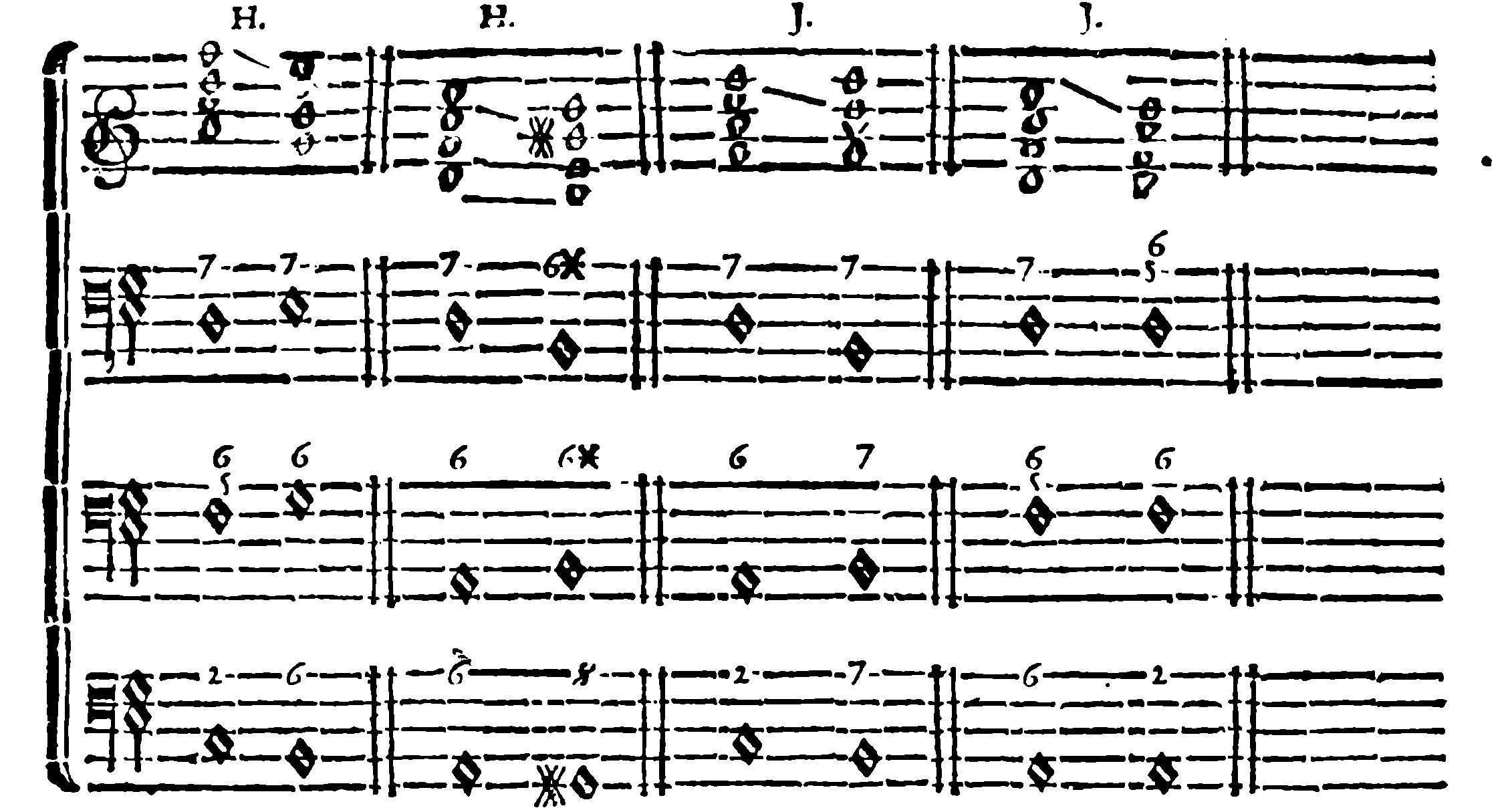
A seventh may be added to a note's perfect chord. Thus a note that seems able to bear only a perfect chord may instead bear a seventh chord, depending on the composer's taste and knowledge.
Everyone should know the chord succession in this example, shown with several different basses, although it is much less common than the others: to avoid being caught unprepared, one must leave nothing unknown. The octave of the bass is rarely added in major dissonant chords; it can be suitable only in seventh, small-sixth and great-sixth chords. Become accustomed, therefore, to playing these chords in only four parts: three in the right hand and the bass as the fourth. Chords by supposition, for their part, always contain five parts without the octave of the bass, which must never be added to them.
We forbid adding the bass's octave to dissonant chords in order to make accompaniment more regular. Otherwise consecutive octaves or fifths would be unavoidable, and these are absolutely forbidden in composition. This is why, in a sixth chord, we often double the third or sixth instead of the bass's octave. Nevertheless, one cannot say that an accompaniment lacking this regularity is therefore bad, since accompaniment serves only to sound all the notes of a chord, without any other requirement. Yet it is always better to bring things to perfection when possible. We have therefore arranged our chords so that those who train themselves in their successions will avoid almost all faults without having to give them particular attention.
For the relationships among chords, see our examples in Chapters V, VIII, XI and XII, together with the discussion in Books II and III. We still have to explain how their successions are connected through the preparation and resolution of dissonances.