 Playable Books
Jean-Philippe Rameau · section 102 of 109
CHAPTER XV. How to prepare and resolve all dissonances, and thereby recognize the current key and the chords belonging to each of its notes
Read and hear this section in the playable edition →We have distinguished dissonant chords as major or minor only with reference to a certain interval within them. Henceforth we shall speak simply of the dissonance rather than the chord.
The preceding rules make preparing dissonances so easy that accompanists need know no more on the subject, though they may consult what we say in Books II and III. The rules make resolving them almost as easy. For a fuller understanding, however, it is useful to know what follows.
Dissonances are distinguished as major and minor. To understand this, play a seventh chord on a tonic dominant: its major third forms all major dissonances, and its seventh forms all minor dissonances.
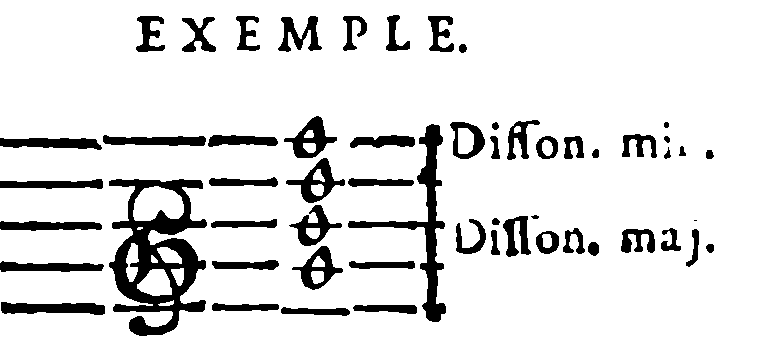
FIRST ARTICLE · The major dissonance
The major dissonance never appears without the minor. Once the major appears, there is no need to attend to the minor; but if the chord is dissonant and contains no major dissonance, the minor becomes its entire focus.
To recognize the major dissonance more readily, notice that it is always formed by the leading note of the current key. That leading note is always the major third of the tonic dominant, and the dissonant chord containing it is always formed from that dominant’s seventh chord. Thus either the chord or the leading note identifies the key. Conversely, knowing the key immediately identifies the chord containing this dissonance and the note that forms it, since the leading note is always a semitone below the tonic or its octave, double octave, triple octave, and so forth.
Starting in a given key, you know its leading note. If the key changes during the piece, a sharp appearing as a figure, attached to a figure, or attached to a bass note will mark the new leading note. Conversely, a flat added to the old leading note, or the removal of its sharp, in the bass or the chords, shows that it no longer serves that function and must be sought elsewhere. Once the key is determined in this way, you know not only the construction of its major-dissonant chord but also all its other chords, following the rule of the octave in Chapter VI. A note may sometimes bear a chord different from its assigned chord in that key, as seen in the rules for sevenths and elsewhere. It immediately resumes its ordinary chord, however, or at least that same chord is played on the following note. Thus an irregular bass route does not change the chord succession. If the new sharp changes and another appears, reckon by the order of sharps, always taking the last one as the leading note. Book III, Chapter XXV, Article III explains this at greater length. An accompanist must absolutely master this knowledge.
To resolve the major dissonance, simply slide the finger playing it a semitone upward: this never fails. The chord containing it always resolves to the tonic’s perfect chord, with the sole exception that a seventh must sometimes be added to that perfect chord.
Example
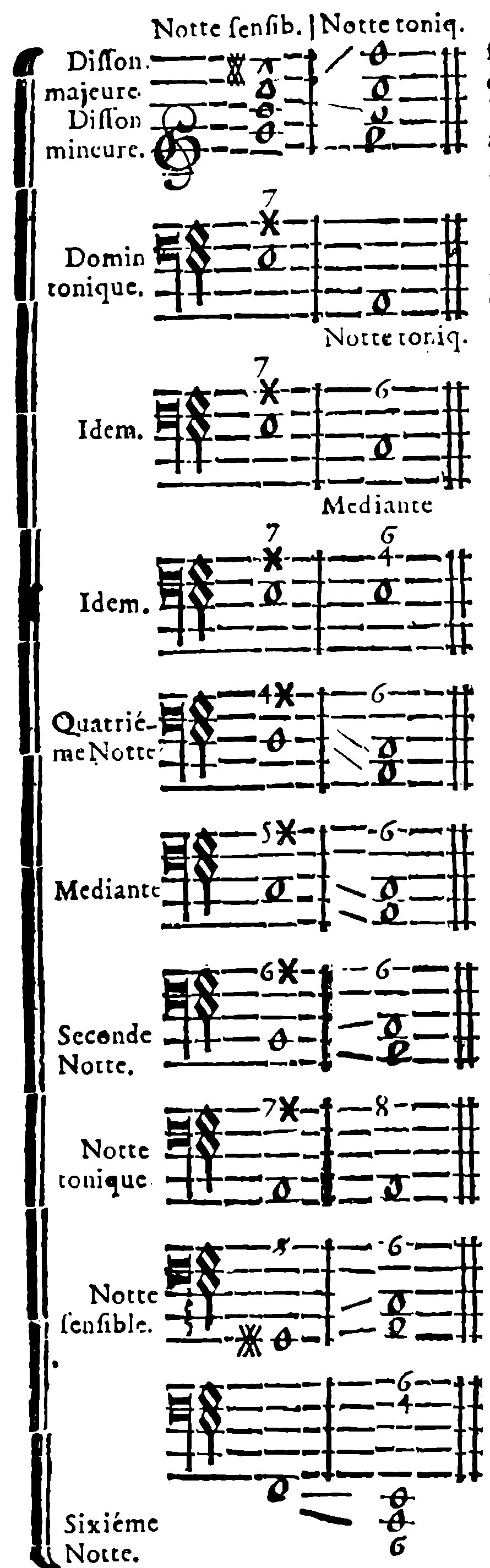
These two chords serve the different basses below them, which contain all the major-dissonant chords. The major dissonance, formed by the leading note—the major third of the tonic dominant—always rises a semitone to the tonic.
The dominant’s seventh chord naturally resolves to the tonic’s perfect chord. The chord successions in the other basses derive from this.
Here the dominant moves to the mediant, but the chords do not change.
The dominant stays on the same degree, with the same chord succession.
The fourth degree, bearing the tritone chord here, moves to the mediant or tonic with the same chord succession.
The mediant, bearing the augmented-fifth chord here, stays on the same degree or moves to the tonic without changing the chords.
The second degree, bearing the small-sixth chord, moves to the mediant or tonic through the same chords.
The tonic, bearing the augmented-seventh chord, stays on the same degree to resume its perfect chord.
The leading note, which always bears the diminished-fifth chord, moves to the tonic or mediant with the same chord succession.
Here the sixth degree replaces the dominant, which must therefore be removed from the first chord. It moves to the dominant or mediant with the same chord succession. To find the further progressions that inversion of this augmented-second chord can produce in the other bass lines, simply put the sixth degree in place of the dominant in the first chord. The dominant can then no longer occur in the bass while the sixth degree occupies its place.
The augmented-second chord and its derivatives may resolve by raising only the major dissonance while the other notes remain, or similarly by lowering the minor dissonance. An example appears in Book III, Chapter XXXIII.
Notice that the notes bearing the chords marked in the preceding example never change their degree names, whatever the key: 5♯ occurs only on the mediant, and so forth.
This example is in a minor key but serves all keys in general, except that the 5♯ chord and the 2♯ chord with its derivatives do not occur in major keys.
We could have discussed the minor dissonance together with the major, since both occur there. The line leading it to the following note shows that it must always descend. A diminished fifth or tritone is enough to demonstrate this.
Example
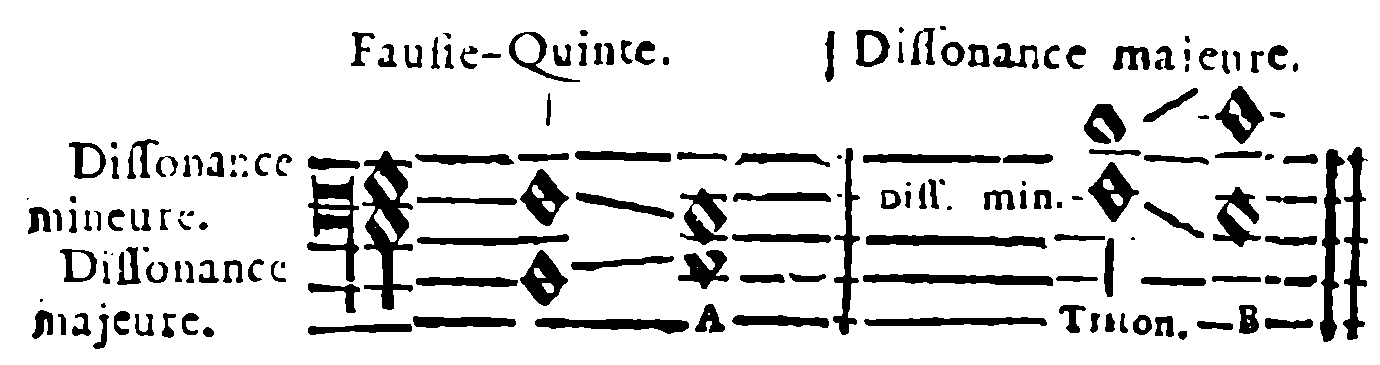
These two intervals, inversions of one another, likewise resolve to two mutually inverted intervals. The major dissonance always rises and the minor always falls, resolving to a third at (A) and a sixth at (B). Thus F and B resolve to E and C. Or, speaking of all keys generally, the leading note that forms every major dissonance always resolves upward to the tonic; the fourth degree that forms every minor dissonance when the major is present always resolves downward to the mediant. This may be verified in every key.
SECOND ARTICLE · The minor dissonance
Every minor dissonance is formed from the seventh. When no major dissonance accompanies it, however, neither the degree forming it nor the degree resolving it can be fixed, since every note of a key may bear a seventh chord. To recognize the key through it, let the fingers follow their accustomed passage from one dissonant chord to another until a major dissonance appears and declares the key. There is this exception: after a great-sixth chord, one may arrive at a consonant chord that itself declares the key. Such a consonant chord, preceded by the great-sixth chord, ordinarily occurs only on its particular degree, as explained in Chapters VI, VII, VIII and IX. Sometimes, however, one ascends from a great-sixth chord to a perfect chord that does not yet establish the key, as in the chapter on sevenths, where the bass rises in this way to a perfect chord, falls a third, and rises similarly again. The final progression of these basses settles the matter absolutely: they always end on the dominant or on the tonic, the latter then preceded by a diminished-fifth chord.
No further example of resolving the minor dissonance is needed; the preceding example sufficiently explains it. Note only that chords by supposition contain at least two minor dissonances that must always descend. The eleventh chord, called the fourth, contains three when filled with all its constituent sounds; otherwise it contains only one. Of those three minor dissonances, ordinarily only the two harsher ones—the ninth and eleventh—should descend, while the seventh remains. Some music requires the contrary, but this is less common.
The example already lists the major dissonances. The minor ones are the second, diminished fifth, seventh, ninth and eleventh, called the fourth. Add to these the third of a small-sixth chord and the fifth of a great-sixth chord.
The second must be distinguished from the other minor dissonances: here the dissonance lies in the bass, so the bass must descend to resolve it.
Of the two fingers lying together in dissonant chords, the lower always forms the minor dissonance. In the chord of the second, only the bass can lie next to that second. In the other chords, if no fingers lie together, the upper finger plays the minor dissonance and must therefore descend.
The irregular cadence is an exception. There the sixth of a great-sixth chord, not its fifth, forms the dissonance. This sixth must ascend diatonically while the fifth remains at the same degree.