 Playable Books
Jean-Philippe Rameau · section 27 of 109
Chapter thirteen
Read and hear this section in the playable edition →Rule for the Progression of Dissonances, Drawn from That of Fundamental Chords
We have already observed that dissonances fall into two kinds according to the quality of the thirds generating them, and follow those thirds' properties: major dissonances ascend, minor ones descend. But in the natural succession of chords we also observe that a minor dissonance is always preceded by a consonance that itself becomes the dissonance without changing position, remaining on the same degree where it was heard as consonant. We must therefore determine this dissonance's progression not only in relation to what follows it, but also to what precedes it: these are what we call resolution and preparation. In the bass's most perfect progression, descending a fifth, the third prepares and resolves the dissonance, which, as we know, is the seventh in fundamental harmony. In descents by a third and seventh, the fifth and octave prepare and resolve it, although in natural harmony the third is the only consonance that can resolve it. But in the opposite progressions, with the bass ascending by the same intervals through which it just descended, the seventh cannot be prepared. The rule requiring dissonance preparation therefore cannot be universal if the seventh can sound in these latter progressions without offending the ear.
As for the major dissonance, although it always occurs with the minor, the two must not be confused. To resolve one, it must ascend; to resolve the other, it must descend. The latter favors preparation, while the former never requires this precaution. Zarlino recognizes no major dissonance except the tritone, and mentions even that only in passing. Later authors cite others, but none points out their origin in the major third of the fundamental sound of a seventh chord, just as the seventh itself is the origin of every minor dissonance. This lack of attention prevented those later authors from changing Zarlino's rules: they continue to agree that every dissonance must be prepared without distinction, while experience convinces them otherwise. The following passages from Messieurs de Brossard and Masson prove this, and can themselves be supported by Zarlino's examples: “If the bass is syncopated”—formerly forbidden, though now practiced without scruple—“the seventh is then naturally resolved by the octave, sometimes by the fifth or sixth, and so forth.” (A)
Observe that what was formerly forbidden was at least not forbidden in Zarlino's time.* He adds that the most ancient musicians used the diminished fifth in accordance with the following example. Syncopating the bass for the diminished fifth or for the seventh is therefore the same thing.
Example
Third part, chapter 30, fols. 209 and 210.
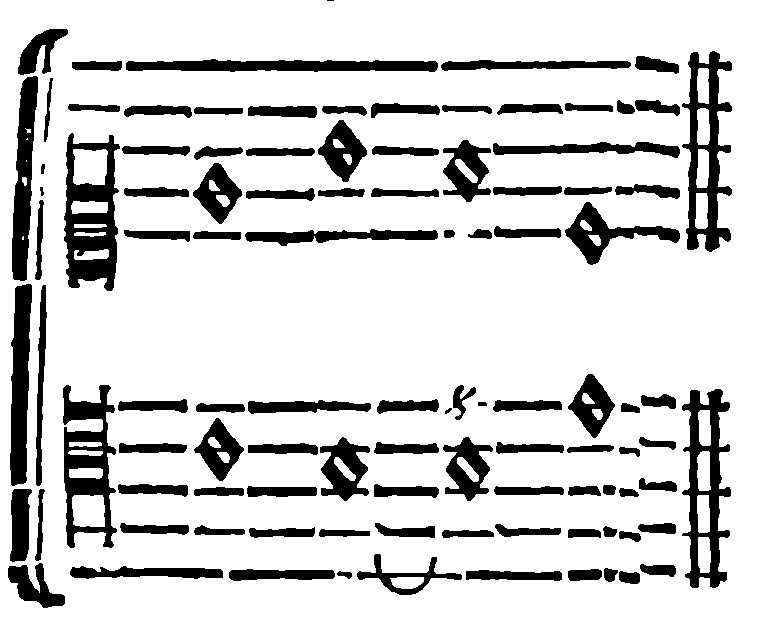
A fifth may be followed by another fifth, provided the latter is diminished or augmented.
The seventh is also used, provided it is prepared by the bass. (B)
(A) De Brossard, Dictionaire de Musique, p. 110.
(B) Masson, Traité de Composition, p. 77.
Example
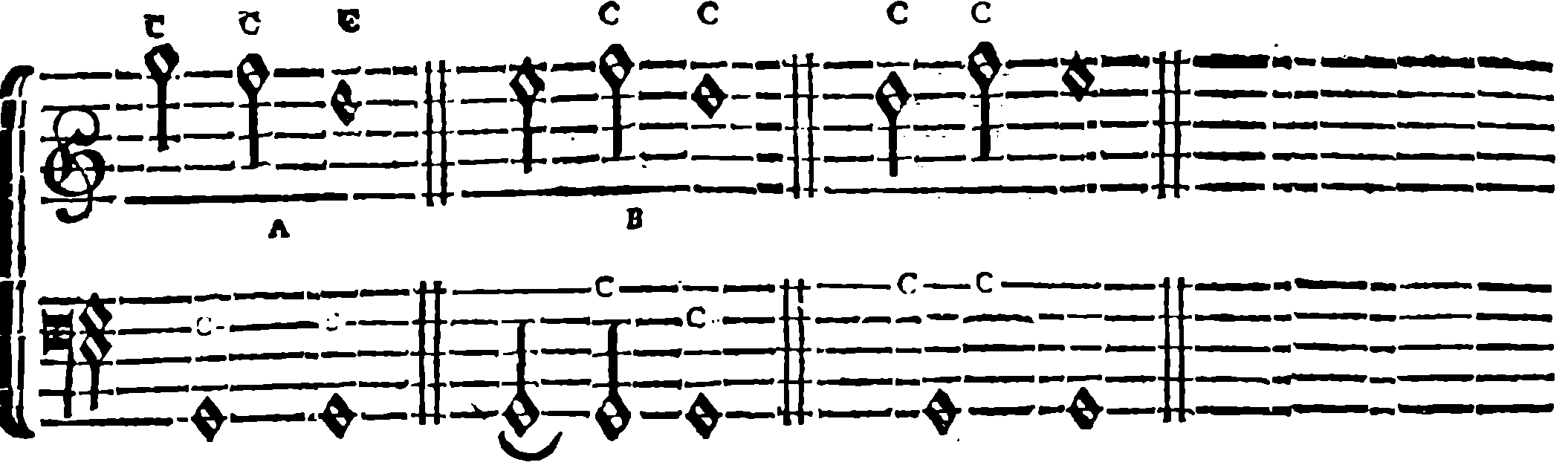
Two fifths may occur consecutively, namely a perfect fifth and a diminished fifth, and so forth.
Example
A chord succession like B is found in Zarlino, third part, chapter 61, fol. 294, between the Canto and Tenore in the third example.
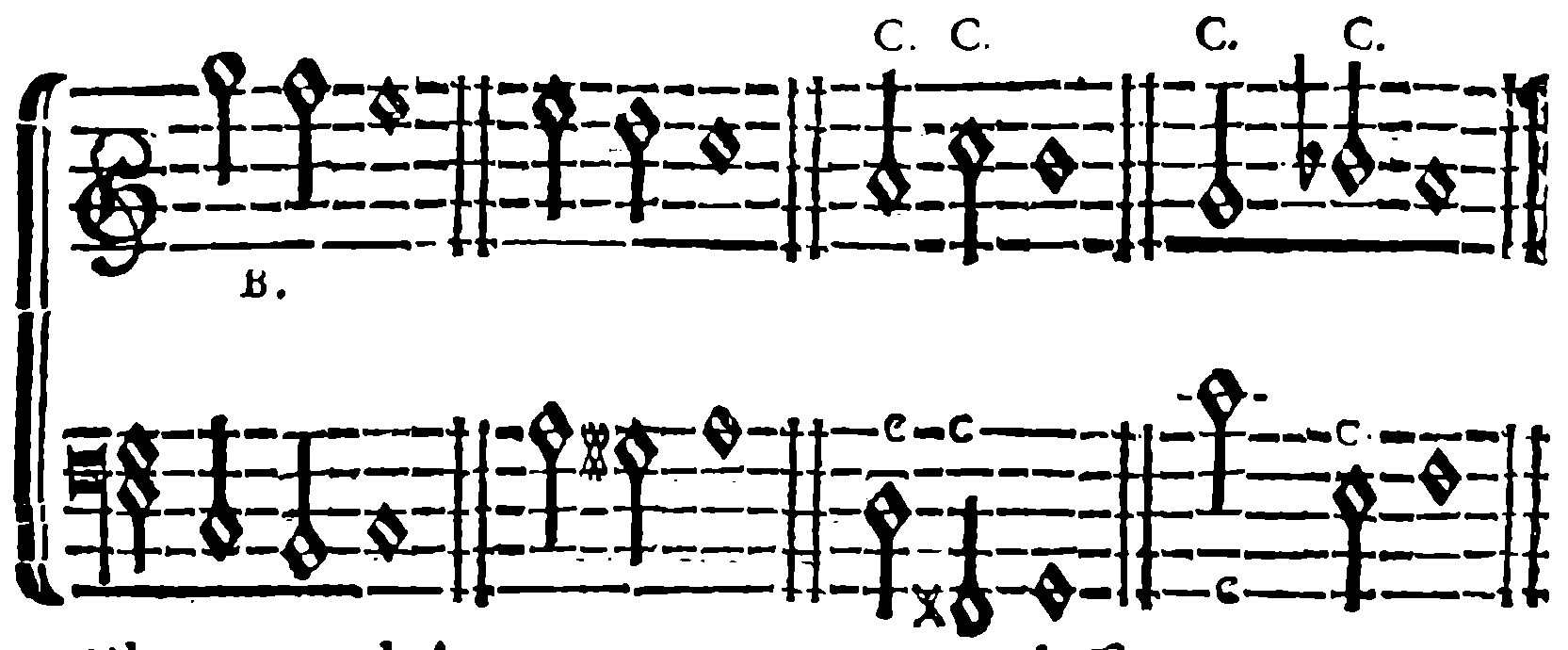
Please observe that all the different notes marked C belong to the same chord. Examples of the freedom to pass through all the sounds of one chord are irrelevant here, since Masson intends to discuss two different chords.
To return to our subject, we must first combine the first two seventh examples, A and B, with fifth example B, giving the seventh examples a natural ending, thus:
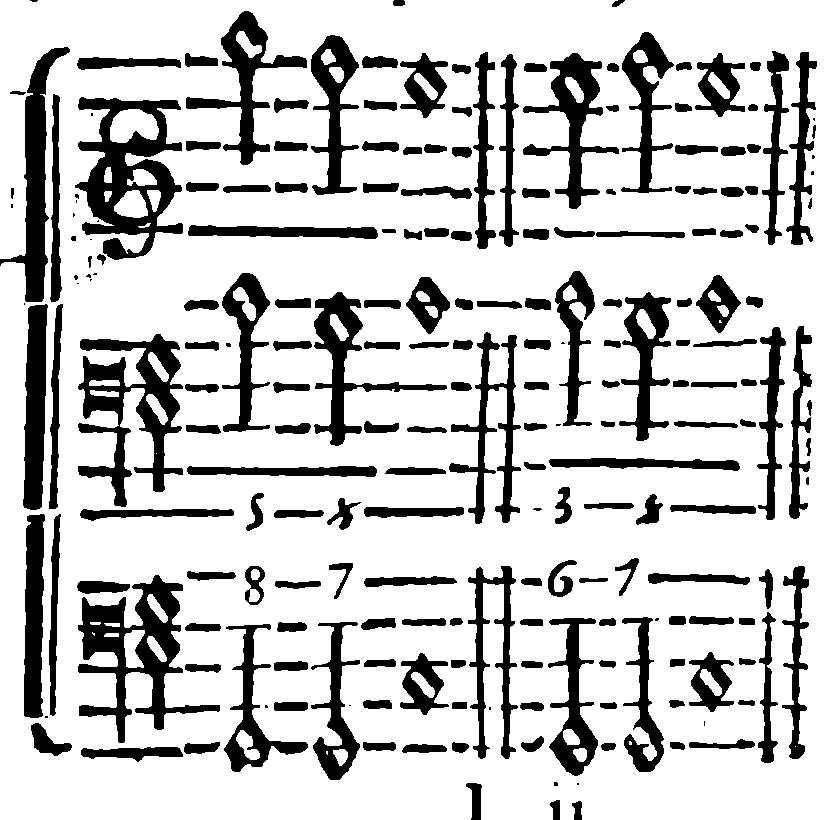
Through this combination we shall see that these different progressions arise from a single principle.
Example
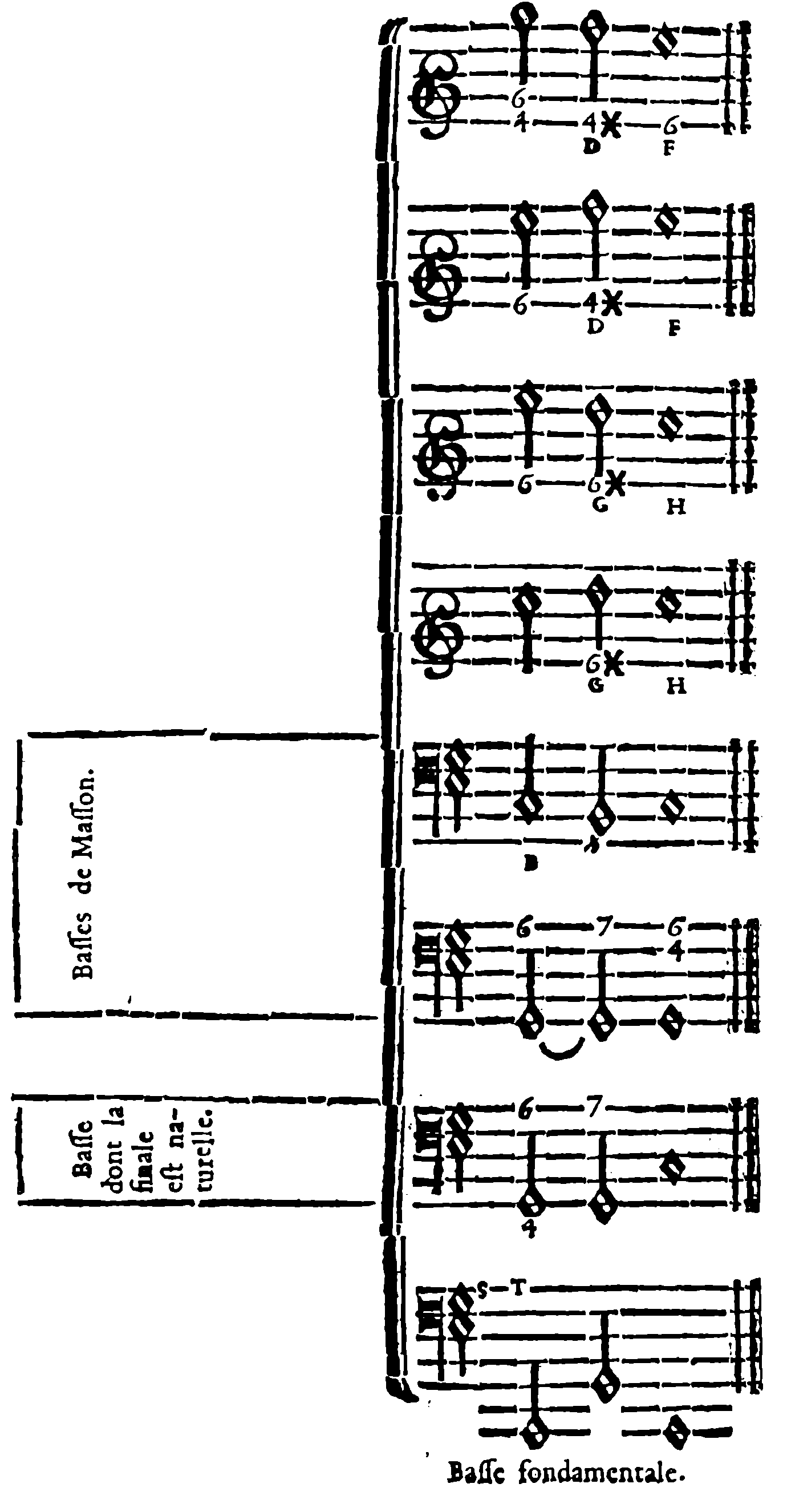
All these parts sound well together except those forming two consecutive octaves, such as D–F and G–H. We included them only to show, through the different progressions of consonances, all the melodies obtainable without changing the substance of harmony, even when any chosen part serves as the bass. Everything can be inverted and originates in the fundamental bass, which proceeds from the tonic to its dominant and back again. We have not exhausted every melody that this harmonic succession could yield. Yet it always shows that, if preparation of the dissonance may be omitted in the seventh, diminished fifth, tritone, or small-sixth chord, this arises only from reversing the bass's natural progression: instead of descending a fifth, it ascends a fifth, S–T. Note that we speak here only of reversing intervals' direction, not of their relationship through the octave. In this way neither the minor nor the major dissonance is prepared. But prepare the minor dissonance according to every rule, and the major will still never be found prepared.
Example
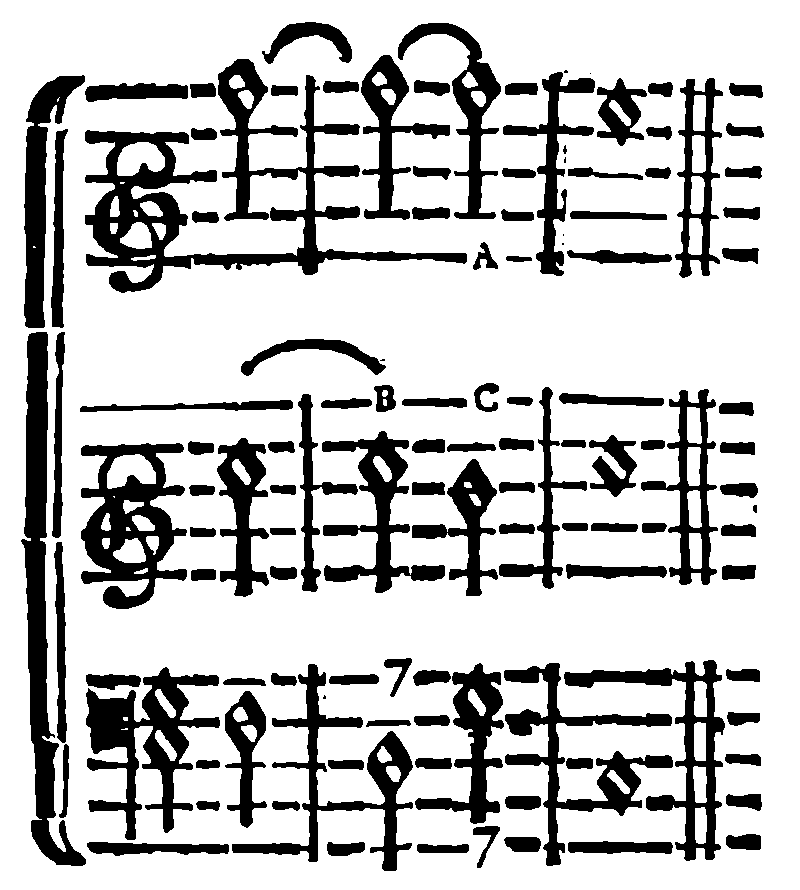
A and B: prepared minor dissonances. C: a major dissonance that cannot be prepared.
Anyone believing that dissonance must invariably be prepared on weak beats can correct that belief here, since the rule cannot be observed at A. Otherwise one of harmony's finest ornaments would have to be destroyed: its suspension through several dissonances, prepared by consonances accompanying those very dissonances. It is better to say that the rule applies only to the first dissonance, as at B. If we make the bass ascend a third or seventh, as we previously made it ascend a fifth, we find that the dissonance cannot be prepared there either.
Example
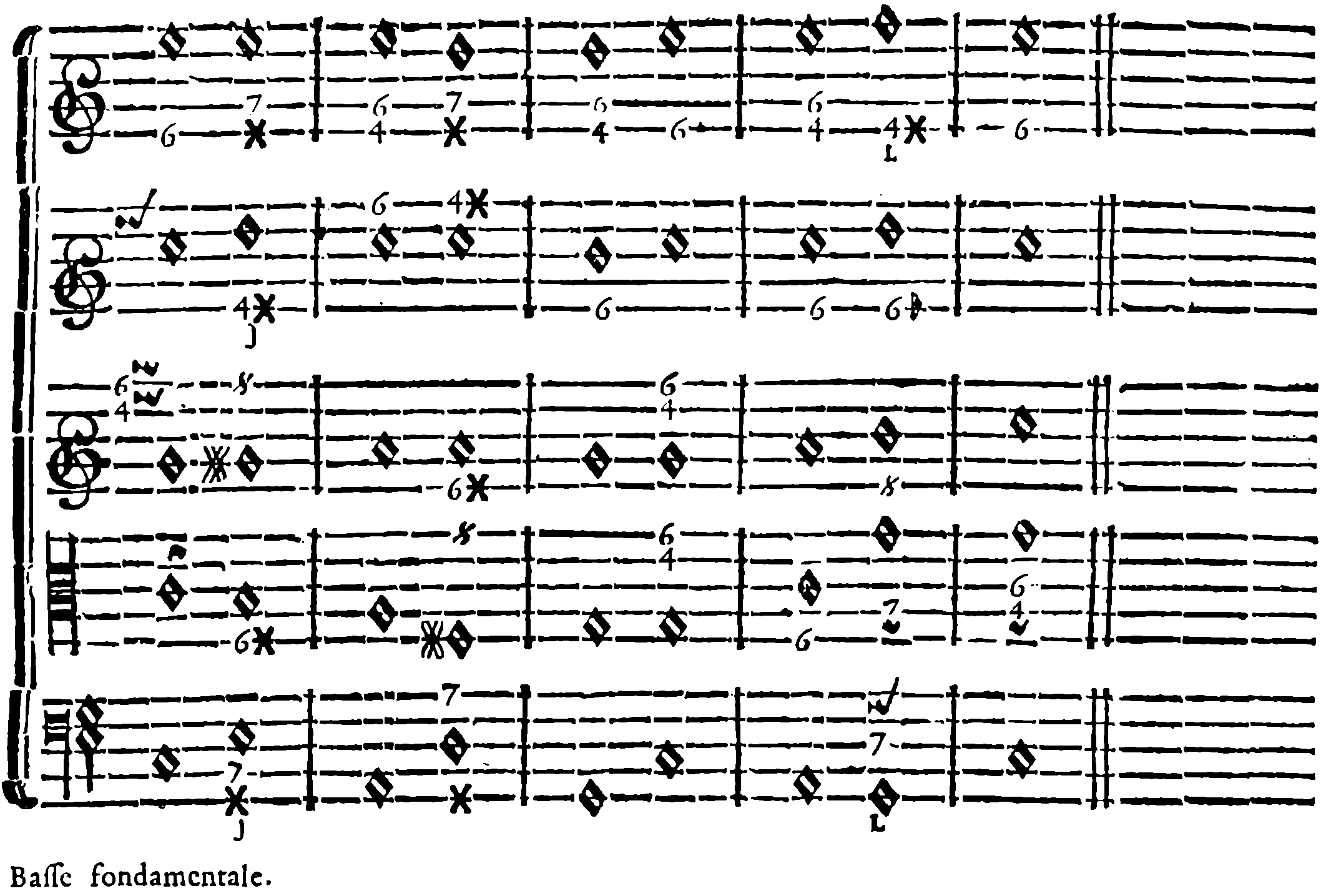
The seventh is unprepared at J, where the fundamental bass ascends a third, and at L, where it ascends a seventh or descends diatonically. From these progressions we may derive those of the other dissonances occurring in each part, by making each part serve as the bass in turn.
The custodes indicate alternative progressions that may be given to the parts; the other parts must then be adjusted accordingly, following their harmonic order in the example.