 Playable Books
Jean-Philippe Rameau · section 26 of 109
CHAPTER TWELVE. On Borrowed Chords, with Which Perfect Cadences Can Be Avoided while Being Imitated
Read and hear this section in the playable edition → Theory of HarmonyArnold Schoenberg · the leading-note seventh chord and the diminished seventh chord
 Practical Manual of HarmonyNikolai Rimsky-Korsakov · the leading-note seventh chord and the diminished seventh chord
 Guide to the Practical Study of HarmonyPyotr Ilyich Tchaikovsky · the leading-note seventh chord and the diminished seventh chord
We have already shown in Book I, Chapter VIII, Article VII, p. 41, that the diminished-seventh chord and its derivatives borrow their foundation from the lowest sound of a tonic dominant's seventh chord. To judge this more clearly, compare the chord progressions in the following two examples. The only difference is in the progression of the sound borrowing its foundation from the seventh chord's lowest sound, since it must follow the movement assigned to the dissonance it forms.
See the examples below.
Examples
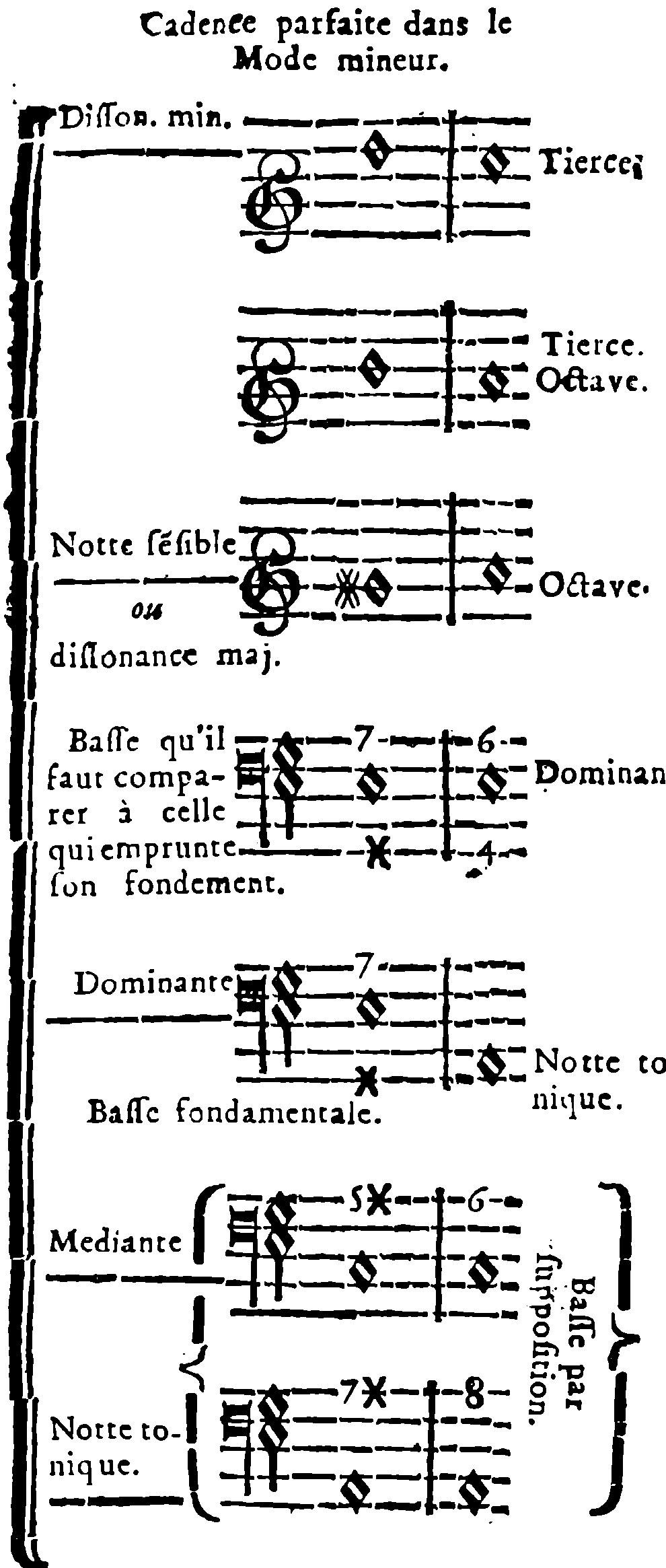
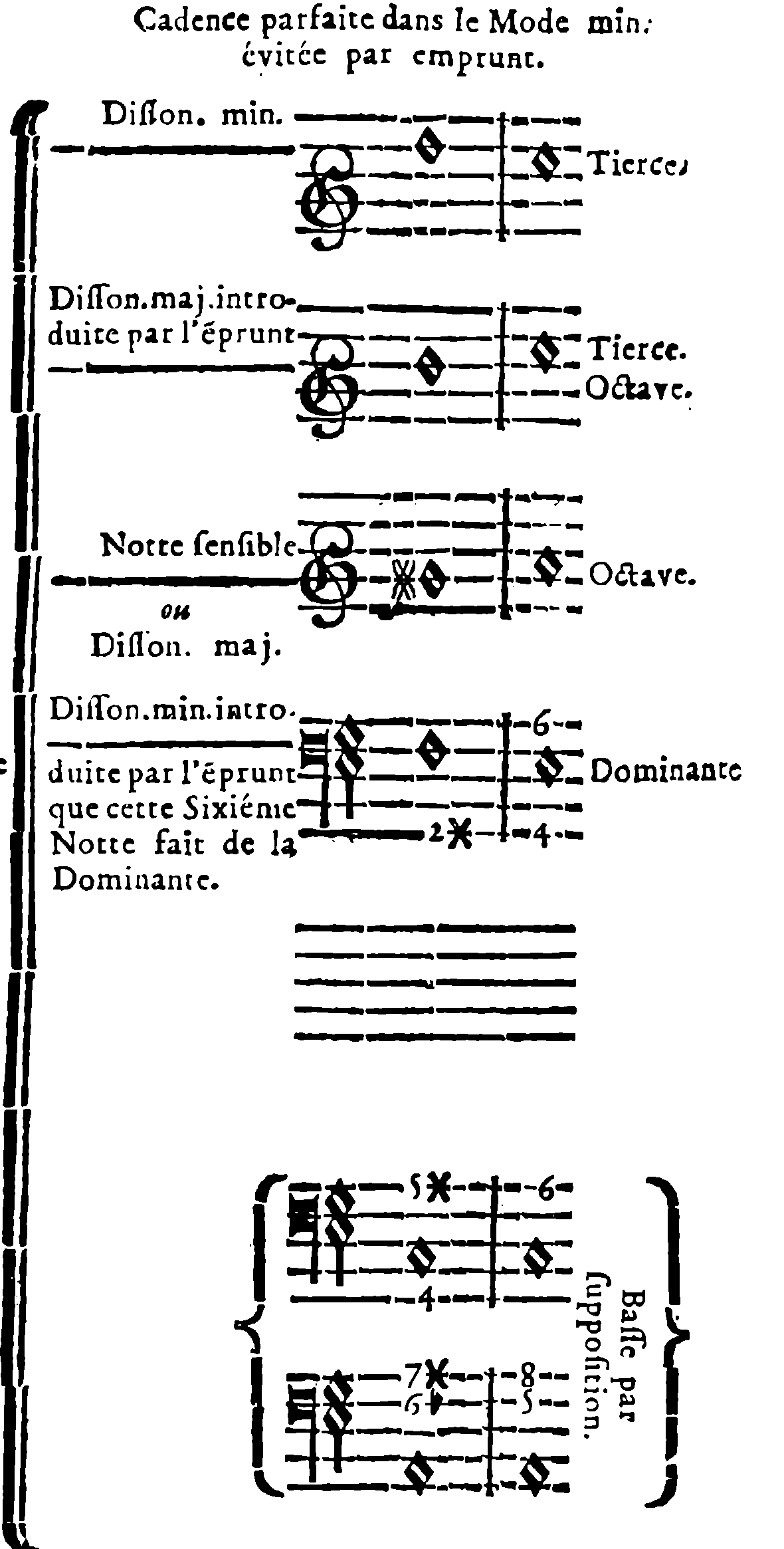
1. If the four upper parts on either side are inverted, the same agreement found here will remain. The only difference will be in the sixth note, which borrows its foundation from the dominant.
2. In the part where the octave is shown by an ordinary note, we have marked the third with a custos; on the other side we have done the reverse. The ordinary note indicates the most natural progression of the sound in the first chord, while the custos indicates the freedom to change that progression. This does not alter the substance of harmony, as we shall explain more fully in Book III.
3. In the inversions of these chords, observe that the sounds occupying the lowest position will always be the same on both sides. This is seen in the two basses by supposition: with each, the four upper parts form chords by supposition. Their sole difference lies in the sixth note's borrowing from the dominant. These chords are therefore optional in minor keys only; their application to suitable subjects depends on the composer's good taste, as we shall see later.