 Playable Books
Jean-Philippe Rameau · section 29 of 109
Chapter fifteen
Read and hear this section in the playable edition →On Occasions When the Seventh Must Be Removed from the Ninth Chord
Although our observations in Chapter X suggest that the seventh should always be part of the ninth chord, it is nevertheless unsuitable when that ninth chord occurs on a tonic. Here is the reason.
A ninth cannot occur on a tonic unless the tonic has been preceded by its leading note, either in the bass or in the chords. If the leading note is in the bass, we know that it cannot tolerate duplication, since its progression is fixed. Otherwise its duplicate would also ascend, producing two consecutive octaves even if it rose only after the bass. Once a dissonance has sounded, it makes us desire a particular following sound, to which it must absolutely pass. If its duplicate remains on the same degree before proceeding to that sound, the resulting suspension deeply offends the ear, destroying the satisfaction that should have come from the consonance that first followed the dissonance. But if the duplicate descends, as a seventh properly does, while the leading note must ascend, the supposed tonic ceases to be tonic and the key changes. This is possible only in major keys. In a minor key, the minor third of a note bearing such a seventh would form an augmented fifth with it. The lower sound of that interval must lie beneath every other sound; here, however, the minor third forming that lower sound would lie above. In inversion this would also form a diminished fourth, which must be completely excluded from harmony. An interval by supposition, such as the augmented fifth, cannot be inverted, because it occurs in a chord extending beyond an octave whose lowest sound cannot change position.
If the leading note lies in the chords or soprano, it may remain on the same degree to form the seventh of the tonic subsequently appearing in the bass. But observe that this seventh is always augmented. As such, the chord is not a ninth chord but an eleventh chord, in which the third cannot occur. If the third replaces this eleventh, a ninth chord is then implied, and the seventh must no longer be considered augmented: it can retain that status only within the eleventh chord. It must instead be regarded as an ordinary seventh, which must descend. But the key always changes in this case, since a note is no longer tonic once it bears a ninth or seventh chord. Only the perfect chord and augmented-seventh chord can belong to it.
Thus, if a ninth chord is sounded above a tonic, we must always avoid including the seventh. In that case it could only be augmented, and consequently would not agree with the rest.
Example
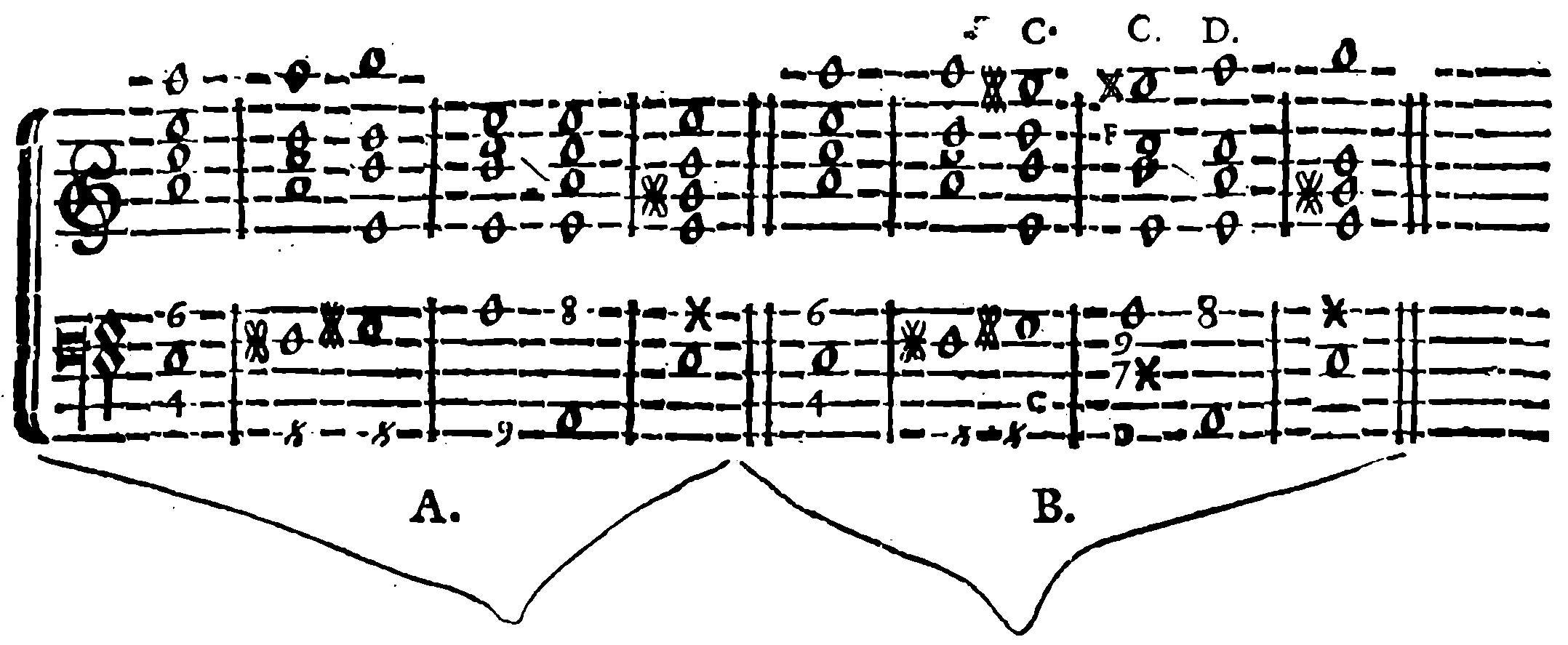
Example A is good; B is bad where the leading note is doubled at C and ascends to D in both parts, forming an augmented fifth between C and F. Putting C above F would also produce a diminished fourth. If this can be tolerated in a major key by adding a ♯ to note F, observe that the key would change: the supposed tonic would become the fourth note, as experience proves. Its leading note would cease to be such and become an ordinary seventh, descending instead of ascending to D as an augmented seventh.