 Playable Books
Jean-Philippe Rameau · section 30 of 109
Chapter sixteen
Read and hear this section in the playable edition →On Dissonant Consonances, Discussing the Fourth and the False Idea Attached to It through Irrelevant Rules
Every dissonant chord can be composed only by uniting consonances. Dissonance arises from comparing two consonances considered separately within a chord. Thus the seventh chord, composed of two fifths and three thirds united, has two outer sounds dissonant with one another: they form neither a fifth nor a third together, but a seventh, or a second by inversion.
Here most musicians go wrong: they often examine only the intervals between the bass and the other sounds of a chord, without considering all the intervals formed by comparing its sounds with one another. They therefore sometimes take a genuinely dissonant sound for a consonant one. For example, the small-sixth chord contains only three consonances above its bass: third, fourth, and sixth. But compare the third with the fourth, and these sounds form a dissonance together. Likewise, the great-sixth chord contains three consonances—third, fifth, and sixth—but another dissonance lies between fifth and sixth. These consonances are therefore dissonant with one another. We need only determine which sound forms the dissonance. This is easy when the chords are related to their foundation: in the small-sixth chord it is the third, and in the great-sixth chord the fifth. Both are actually the seventh above the fundamental sound of the seventh chord from which these two chords derive.
Example
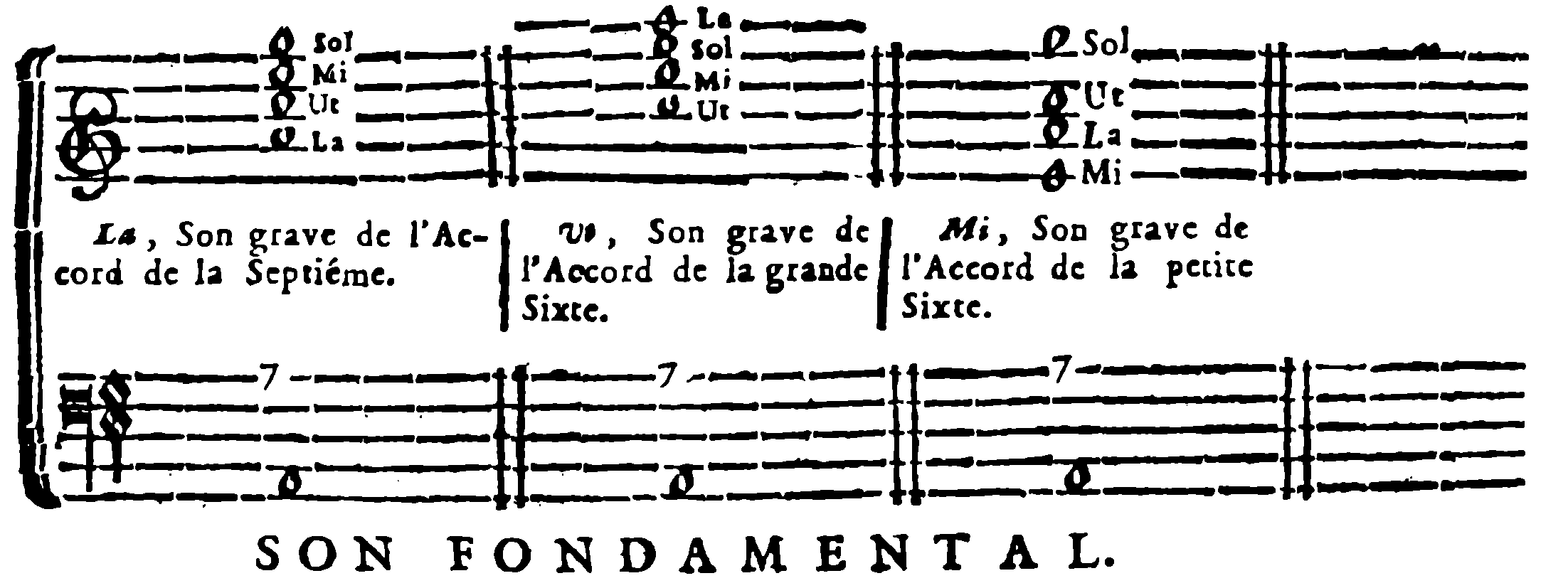
G always forms the seventh above the fundamental sound A. Invert the original seventh chord, and the resulting chords contain only the same sounds; referred to their foundation, G always forms the dissonance. The proof is still clearer because, however the original seventh chord is arranged, as a small-sixth or great-sixth chord, the sound forming the dissonance is always prepared and resolved just like the seventh from which it originates, without any alteration in the substance of harmony.
An exception must be made for the great-sixth chord formed by adding a sixth to the first perfect chord of an irregular cadence. There we must consider only the perfect chord, not the seventh chord, which does not occur in that cadence. In this case the added sixth forms the dissonance. This will become clearer later. See Chapter XVII, Article III, and Chapter XVIII.
Small- and great-sixth chords have not long been in use; some musicians still refuse to accept them. They thus abandon what experience offers in submission to rules that may be called false. On one hand those rules declare without distinction that the fourth is dissonant; on the other they allow the bass to be syncopated beneath this supposedly dissonant fourth, as beneath any other dissonance. This leads to countless errors from which we should free ourselves. Since we must oppose opinions almost universally accepted, we cannot avoid returning everything to its principle before reaching our intended goal. This precise inquiry will even show that what seems new in our rules follows from the very rules we seek to overturn. Those rules were founded only upon different properties of dissonance, each arising from a different source and consequently requiring its own rule. We shall divide the discussion into articles to make it clearer.
Article one
On the principle of dissonance
Which Sound of an Interval Must Be Considered Dissonant, and to Which Sound the Rule of Preparing and Resolving Dissonance Applies
The same principle that generates consonances also generates dissonances. Everything refers to this first, fundamental sound. Its division generates every interval, and intervals are such only in relation to it. Third, fifth, and seventh, which comprise all the others—as sufficiently shown in Book I and further explained in Chapter XIX of this book—originate in this first sound. It is therefore the principle of dissonance, since the seventh is formed only by comparing a generated sound with this first sound. Every other dissonance—here we mean only what we distinguish as minor dissonance—can be formed only from a seventh, or its inversion, the second. Ninths and elevenths, the latter called fourths, do not invalidate this proposition: remove the supernumerary sound from their chords, and the only dissonance remaining is a seventh or second.
These observations allow only one conclusion: dissonance has a single principle. The third and fifth composing the seventh chord cannot serve as its principle, because comparison with the seventh forms no new minor dissonances. Instead they form those same intervals, third and fifth, with the seventh. This observation will serve us later.
We further conclude that the principle, perfect in itself and equally the source of consonances and dissonances, cannot be considered dissonant. Dissonance must therefore reside only in the sound compared with it. This is especially clear because the rule of preparing dissonance through syncopation and resolving it by subsequent descent concerns only the seventh's upper sound, not its lower sound, which is its principle. When that seventh is inverted into a second chord, the principle lies above and the sound governed by the rule below. This lower sound must then syncopate and descend. Thus the rule concerns only the dissonant sound, not its principle. A rule prescribing bass syncopation can apply only in this one circumstance; if the bass may syncopate elsewhere, that arises from another principle, which must first be explained. For example, when a third or fifth syncopates while accompanying a seventh, this arises from the natural progression of consonances, not the rule governing dissonances. Likewise, choosing to syncopate any consonance depends on taste, not on the rule to which only dissonances must submit. When the bass syncopates beneath a second, then, the bass sound is itself the dissonance governed by the rule. But observe that the principle of this dissonant sound lies solely in the second's upper sound, naturally the seventh's lower sound, not in the other sounds accompanying the second. Likewise the seventh's principle lies solely in its lower sound, not in accompanying sounds, which may syncopate at the composer's pleasure or according to their required progression relative to the bass. Consequently, the lower sound of the second syncopates in relation not to the fourth or sixth but to the second's upper sound, the principle of the dissonance. Otherwise there would be as many principles as sounds against which the dissonance was said to syncopate. Suppose instead that the upper sounds of the second and fourth were considered dissonant here. See how many errors follow: the rule loses its firmness; the dissonant sound is no longer the one required to syncopate; uncertainty allows any sound to syncopate at will; the seventh ceases to be the object of every dissonance, and its principle becomes confused.
Example
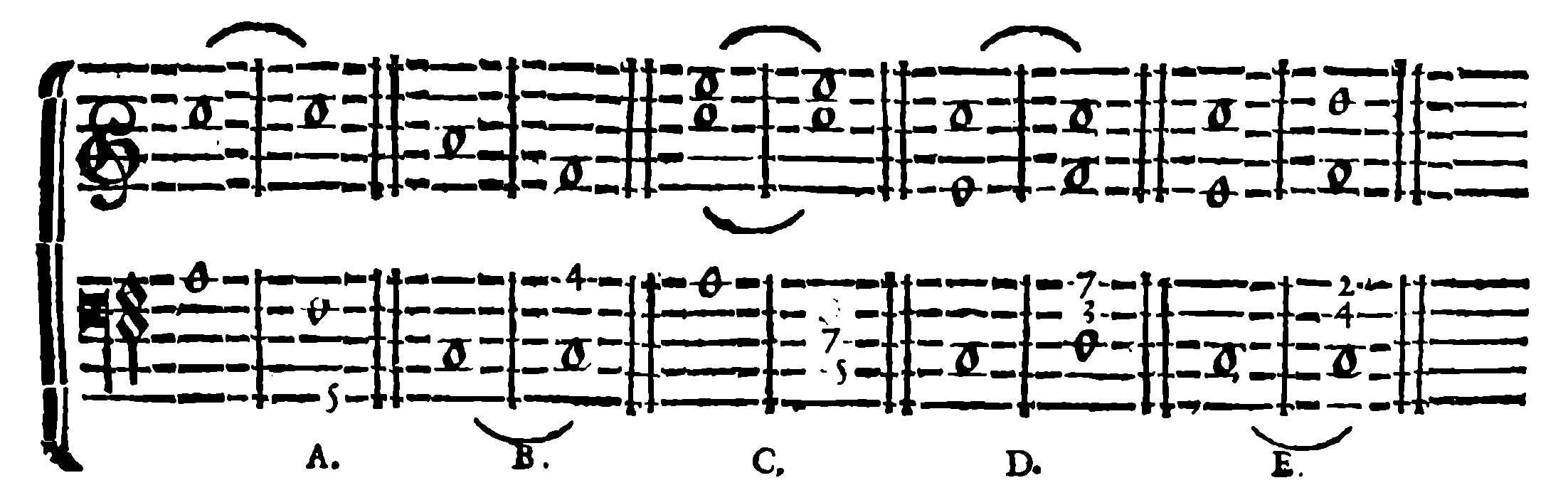
If the fifth syncopates at (A), this arises from the natural succession of consonances and the composer's choice to sound the fifth rather than another consonance, not from obedience to the dissonance rule. If the bass syncopates beneath the fourth at (B), this comes only from inversion of that syncopated fifth. The fifth at (C) syncopates for the same reasons; but the seventh syncopating with it does so because the rule requires it. At (D), the seventh again syncopates according to the rule, while the consonant third does not. At (F), the bass syncopates because it represents the upper sound of that seventh governed by the rule. The fourth there does not syncopate, since it is consonant and represents, in fundamental harmony, the third of chord (D). Just as the seventh at (D) syncopates relative to its principle in the bass, the bass of the second at (F) syncopates relative to its principle, now inverted into the upper part as the second's upper sound. It does not syncopate relative to the fourth, which merely accompanies it, just as the seventh at (C) did not syncopate relative to the fifth, nor at (D) relative to the third.
To judge this correctly, observe that every minor dissonance can be formed only by a seventh or its inversion, a second. This is infallibly true in complete chords: what is absent between a part and the bass will occur between two upper parts. Remember that the rule concerns only the seventh's upper sound, which becomes the second's lower sound through inversion.
Article two
Which Chord Is the Source of All Dissonant Chords; How Many Dissonances and Sounds It Contains; and What Its Bounds Are
Just as the seventh is the origin of every dissonance, the seventh chord is the origin of every dissonant chord.
This chord contains only four different sounds and only one minor dissonance, the seventh. Everything lies within the bounds of the octave.
The seventh chord consists only of a seventh added to the perfect chord; the perfect chord must therefore always remain within it. The lowest, fundamental sound of a perfect chord may bear either a major or minor third. When it bears a major third, that third often forms a new dissonance with the added seventh, becoming the origin of every dissonance distinguished as major. Yet the rule's prescribed progression of the minor dissonance, always the seventh in question, does not change. This new major dissonance need not detain us: in complete chords we always find the seventh or second, and we now know which sound must obey the rule. The third, inseparable from the perfect chord, does not prevent the dissonance from following its natural course. Although the third, when major, can form a new dissonance with the seventh, it is not absolutely its principle. That principle resides above all in the lowest, fundamental sound of both the third and seventh.
To establish that every dissonant chord originates in the seventh chord, we need only ask whether its inversions contain fewer or more sounds and dissonances, whether they lie within the same bounds, and whether they alter modulation in any way. Exact correspondence throughout leaves no doubt of their origin in the seventh chord, the first dissonant chord harmonic ratios offer us. The second, diminished-fifth, and tritone chords, unanimously accepted by musicians, derive from it with precisely this regularity. Why, then, should the small- and great-sixth chords not be equally accepted, since they can enjoy the same privileges? Each inversion is formed merely by freely choosing one sound of the seventh chord as bass. Why may its third or seventh serve as bass, producing diminished-fifth, great-sixth, second, and tritone chords, while its fifth may not serve as bass to produce a major or minor small-sixth chord? We have grouped the great-sixth and diminished-fifth chords here because they share the same lowest sound relative to the fundamental chord from which they derive, differing only as major differs from minor, as do the second and tritone chords. Everywhere the minor dissonance lies in a seventh or second, formed by the seventh's upper sound or second's lower sound, and always follows the progression fixed by the rule.
Have these small- and great-sixth chords been rejected because Zarlino or other authors did not mention them, or because the fourth occurs in the small-sixth chord? Yet Zarlino did not discuss the seventh chord whose major third forms a new dissonance with its seventh, although he discussed the diminished-fifth and tritone chords derived from it. This did not prevent that seventh chord from being used, nor many other chords that became known only gradually. Invoking such authority would therefore be self-contradictory. As for the fourth in the small-sixth chord, the reason it is not dissonant in the second chord, as we tried to prove in the preceding article, applies here as well. Moreover, since dissonance resides in the seventh's upper sound or second's lower sound, this fourth together with the third forms one of those intervals according to their arrangement; the third therefore forms the dissonance, not the fourth. Likewise, the bass forms it in the second chord; the fifth joined to the sixth forms it in the great-sixth chord; and in the eleventh chord, called the fourth, that fourth joined to the fifth again forms it. This careful examination readily corrects the false idea of the fourth held until now.
Observe in passing that all these chords can be reduced to the seventh chord through division into thirds, except the eleventh chord. This obliges us to call that last interval an eleventh: reduction into thirds is possible only after removing the bass sound, with which the upper sound forms an eleventh, not a fourth, when the chord is arranged according to its natural division. By contrast, the fourth in second and small-sixth chords lies within the octave. Every sound in chords thus confined to an octave may be inverted at the composer's pleasure; the same cannot be done with the lowest sound of ninth and eleventh chords, which must never change position.
If it can no longer be denied that the second chord is an inversion of the seventh chord, and consequently the second an inversion of the seventh, we must likewise admit that the fourth is an inversion of the fifth, and so forth. For greater certainty, let us cease examining a derived chord when all its properties can be found in its fundamental chord. We shall then know where we stand, considering intervals not in themselves but in those they represent: third, fifth, and seventh, which compose the fundamental perfect and seventh chords. Their progression is determined only by that of the lowest sound of one of these two chords.
Example
These chords serve for each bass.
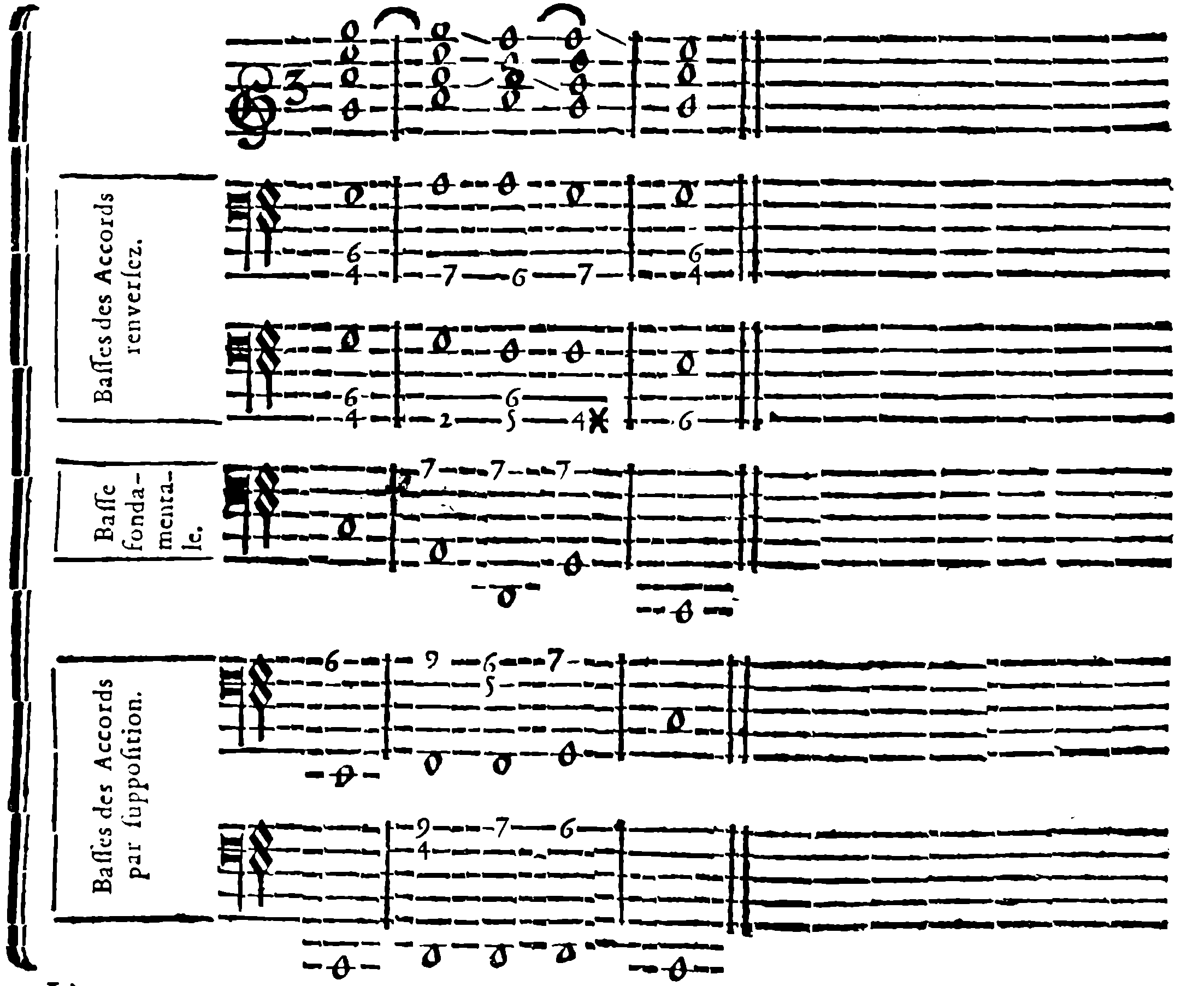
Here the perfect and seventh chords alone, prevailing in the fundamental bass, form all the others. The dissonance is everywhere the same and follows the same progression. All chords contain the same number of sounds within an octave, except for the extra sounds in basses carrying chords by supposition, where the ninth appears on one side and the eleventh on the other. Modulation is not altered in any way, whatever bass or chords are used. In the dissonant chords, however, the octave of each bass being tested must be removed as far as necessary to avoid consecutive octaves.
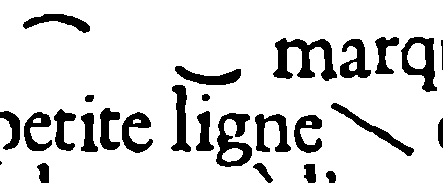
Notes joined by a semicircle ⌢ mark dissonances prepared through syncopation. The short following line ╲ shows their descending resolution. Observe that the third in the small-sixth chord, the fifth in the great-sixth chord, and the bass in the second chord always form the dissonance represented by the seventh above the fundamental bass. That same seventh also forms the dissonance in chords by supposition once their extra bass sound is removed.
Article three
Treating the Fourth as Dissonant When the Bass Syncopates Destroys Music's Finest and Most General Rule
The rule of preparing every dissonance with a consonance is so general that it admits no exceptions. Yet if the fourth were dissonant when the bass syncopates, this rule would be false: as the bass descends diatonically after the syncopation, as it naturally should, the fourth always prepares the diminished fifth or the dissonant fifth of a great-sixth chord.
Example
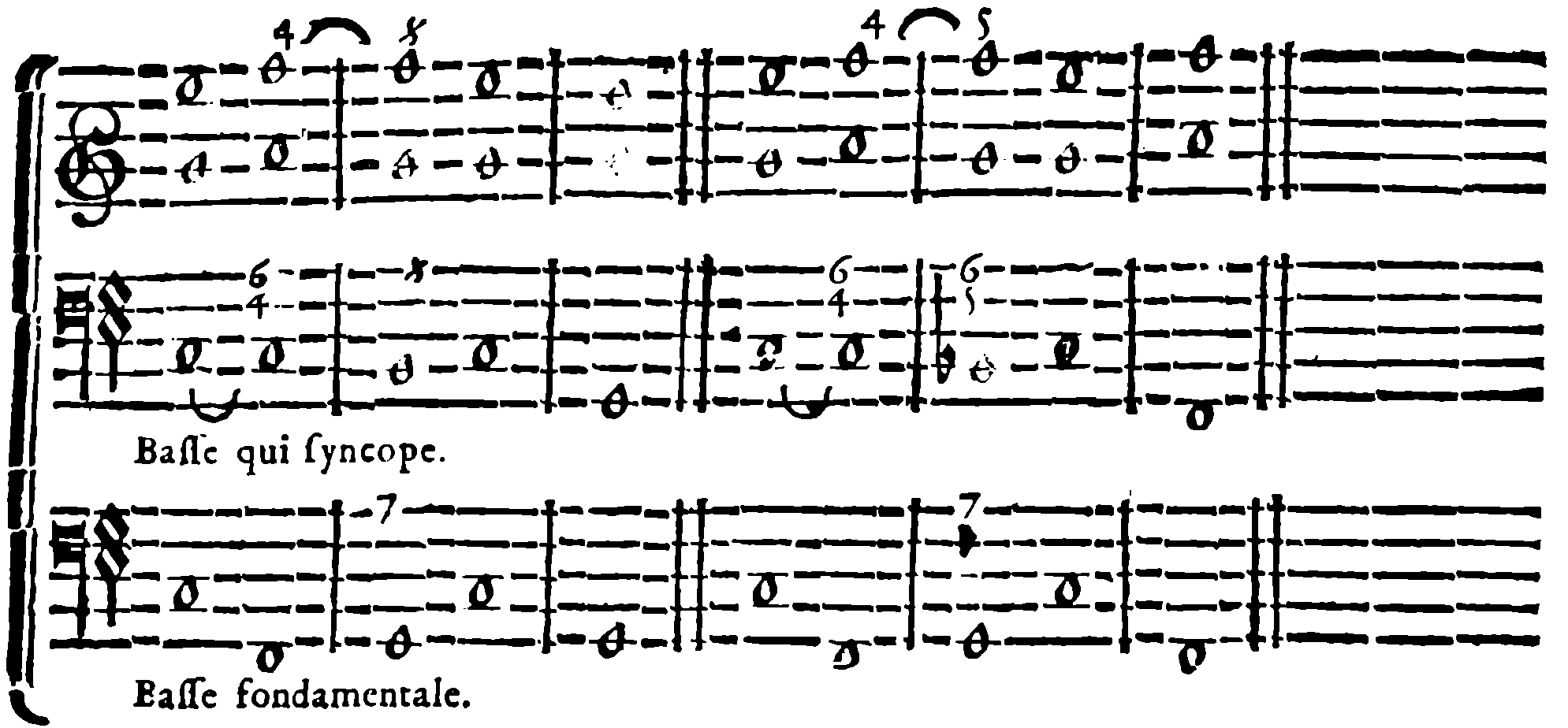
This harmonic succession is the most natural. The only possible objection is the imperfection of the first syncopation, which does not begin on a weak beat. For that requirement to apply, however, a second must belong to the sixth–fourth chord or be implied in it. The second then being the object of the dissonance, its syncopation must begin on the weak beat and end on the strong—provided no other dissonance immediately precedes it, already syncopated according to the rule. When we say every dissonance must be prepared by a consonance, this is to be understood only insofar as the dissonance can be prepared.
Article four
Authors' Failings in Establishing Rules of Harmony: The Rules' Different Principles and the Errors They Spread
All who have sought to prescribe rules of harmony have abandoned its principle. The first sound and first chord presented to them received no privilege; everything was equal. When they discussed the relative perfection of consonances, it was only to determine which should be preferred in filling out chords. When they offered reasons for the particular progression of thirds and sixths, they used only comparisons. On reaching dissonances, they confused everything—second, seventh, ninth. They say these must always be prepared, then give rules to the contrary; they say dissonances must be prepared and resolved by a consonance, then contradict themselves elsewhere. They do not explain why some must ascend and others descend. They conceal the principle, each reporting, according to his ability, what experience teaches him. Yet although experience alone can convince, music differs from sciences in which our senses reveal things beyond doubt. What depends on sight is less subject to illusion than what depends on hearing. One person approves a chord that displeases another. Hence musicians disagree, each stubbornly defending what imagination or limited experience supplies, while authority nearly always prevails over reason and experience. But on what does that authority rest? Who has founded his reasoning on a solid principle? Who can guarantee the perfect accuracy of the senses of anyone claiming consummate experience? On the contrary, neither reason nor experience seems to have guided the writers of musical rules. Beginning with Zarlino, they have considered each interval separately. But the principle resides solely in the first, fundamental sound and then in the chord it must bear. No interval's properties can be determined before those of the fundamental sound and its complete accompanying chord, without which harmony is imperfect. Otherwise reason and experience offer little help. Reason loses its force when removed from the principle, and experience can only deceive in these circumstances. Examining an interval alone can never define its properties unless we also examine every chord in which it occurs. Here one sound must descend, there ascend; here it moves by step, there by leap; here it is dissonant, there consonant; here it must syncopate, there it cannot. This is precisely the source of obscurity in the rules. For example, we are told that every dissonance must be prepared through syncopation, then that the bass may also syncopate beneath a dissonance. This is contradictory: either the dissonance need not be prepared through syncopation, or the syncopated bass itself forms the dissonance. This is the soundest conclusion from the two opposed rules, though perhaps it has never been considered. We must therefore explain it.
1. The bass or any other part may equally be syncopated when one or more dissonances are introduced for melodic taste; but that subject need not detain us here.
2. The major third naturally belonging to the perfect chord cannot be removed when the seventh added to it syncopates. The seventh therefore syncopates both against this major third and against the chord's fundamental sound. Since the major third then becomes the object of every major and augmented dissonance, an inverted chord may place the minor dissonance—the seventh—in the lowest position. That minor dissonance always syncopates if it is to be prepared. It is therefore only in relation to the major dissonance that the bass syncopates here, and still more precisely in relation to the fundamental sound remaining in the complete chord. This apparent exception should be clarified to remove doubt. Moreover, we have a chord by supposition in which the extra sound added in the bass, being far more dissonant than the others, must syncopate when the major dissonance, then forming an augmented seventh, lies in the soprano.* Monsieur de Brossard overlooked this, although Angelo Berardi's table, reproduced in his Dictionary, could have shown him that the seventh over a syncopated bass is augmented. Only this seventh can naturally resolve to the octave in that case, exactly as indicated there. As for the fourth over a syncopated bass, Berardi erred like the others, since that fourth is not dissonant in this case.
3. When dissonance cannot be prepared, as explained in Chapter XIII, the bass often syncopates, but only in inverted harmony, to receive the dissonance after having borne a consonance, as in this example by Masson, p. 77.
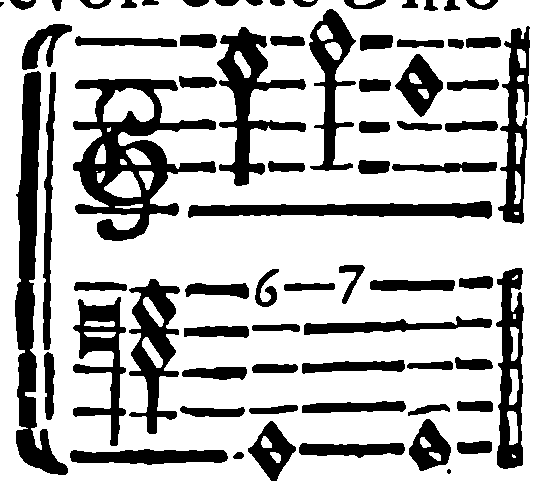
4. The bass may syncopate as much as desired when the sounds passing above it all belong to the chord of the first note beginning the syncopation, as in this example by Zarlino.
* Monsieur de Brossard, p. 133.
Third part, chapter 30, fol. 210.
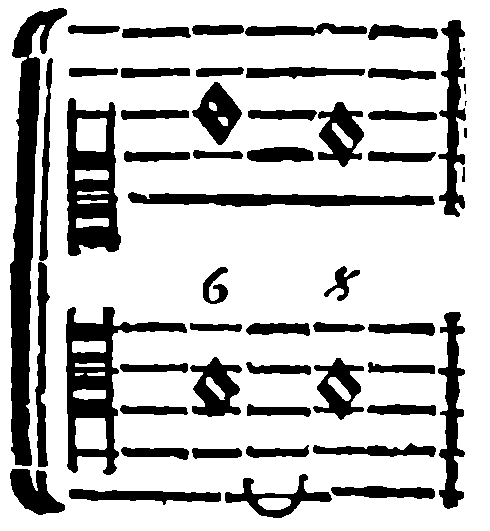
These are the different principles behind the rule permitting bass syncopation. Without explanation, the rule leaves us in error: we do not know whether consonance or dissonance must syncopate, and consequently do not know the syncopated note's subsequent course. The confusion is resolved by these simple principles, reduced to two certain rules without exception: first, prepare with a consonance every dissonance capable of preparation; second, introduce after a consonance, whether descending or ascending, any dissonance that cannot be prepared. Both rules come from the progression of our fundamental bass beneath fundamental chords. The rest depends only on taste, since any chord sound may be chosen as bass. If that sound belongs both to a consonant chord and to the following dissonant chord, where preparation is impossible, it plainly must syncopate or remain on the same degree, which amounts to nearly the same thing. Still more so when the chord's substance does not change and several of its sounds merely pass in succession above a stationary or syncopated bass. A rule prescribing bass syncopation is superfluous here, since the choice is free. Yet the rule was established only from these different properties glimpsed through experience. Unwilling to alter the rule requiring every dissonance to syncopate, writers almost entirely destroyed it through the rule permitting bass syncopation beneath fourths, sevenths, and so forth. According to the first rule, the syncopated bass is dissonant, and consequently the fourth and seventh no longer are. They refuse to admit this yet imply it. Why, we repeat, mention bass syncopation at all? Beneath the second, tritone, and augmented seventh, the bass always obeys our first rule requiring the minor dissonance to syncopate. Elsewhere its syncopation falls outside that rule and depends solely on choice or the consonances' natural progression relative to the fundamental bass under fundamental chords—like syncopating the fifth or any other consonance. Excessive slavery to syncopation has carried its implications too far.
Another defect in the rules is their failure to specify each part's progression precisely enough when saying that the sixth should follow the fifth, or that the seventh should resolve by the third, fifth, or sixth, and so forth. Sometimes one part must remain on the same degree; sometimes both must move; sometimes one must ascend or descend. We remove these doubts by first giving such precise and intelligible rules of modulation, our guide everywhere, that mistakes are impossible, and then stating that every minor dissonance must descend diatonically and every major dissonance ascend a semitone, whatever course the bass takes. These dissonances are easily recognized in their origin. Since we explain this elsewhere, we shall say no more now.