 Playable Books
Jean-Philippe Rameau · section 50 of 109
Chapter seven
Read and hear this section in the playable edition →Remarks on dissonance
Far from encumbering composition, dissonance makes its paths easier. Whenever a bass rises a second, fourth, or sixth, an upper part will always contain a note that, having formed a consonant interval with the first bass note, can remain unchanged and form the seventh of the second bass note. Do this whenever possible, because it often avoids the fault of rising from the minor third to the octave, or, by inversion, from the minor sixth to the octave, as we shall see elsewhere. Notice, however, that the bass note bearing this seventh must be followed by another whose third can resolve the seventh. Otherwise use the perfect chord.
Example
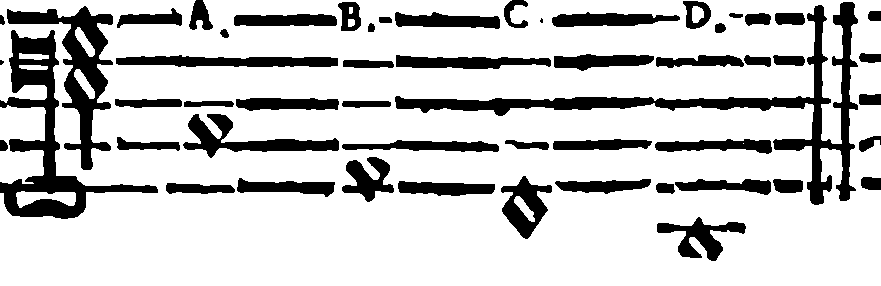
I cannot place a seventh upon note B, although it is prepared by the fifth of note A, because the third of note C cannot resolve it. But replacing C with D allows me to sound the seventh upon B, since it resolves naturally onto the third of D. The same applies to the rest. Always remember that a tonic note, as such, cannot bear a seventh chord, and that here we discuss fundamental harmony alone.