 Playable Books
Jean-Philippe Rameau · section 55 of 109
Chapter twelve
Read and hear this section in the playable edition →Further rules drawn from the preceding example
Remember that when a bass note is to carry a seventh chord, the note forming the seventh can always be omitted, unless it is prepared by a consonance in the preceding chord. Yet if that consonance is major, as a third or sixth can be, it is better to raise that third or sixth a semitone. If the bass note carries only a chord derived from the seventh chord, however, you may omit one of the two sounds forming the dissonance. Either is easily recognized by noticing that they always adjoin one another, as explained in chapter XI.
The same bass note may be repeated as often as good taste permits, with the same chord or with different chords, as we learn how this can be done.
One may also pass from one note to another whose chord differs only in name. From a seventh chord one may pass to the diminished-fifth chord upon the note a third above the note that bore the seventh; upon its fifth one may place the small-sixth chord; likewise, upon its seventh one may place the tritone chord. All these chords are essentially one and the same. The same applies to the others in similar circumstances. See the following example.
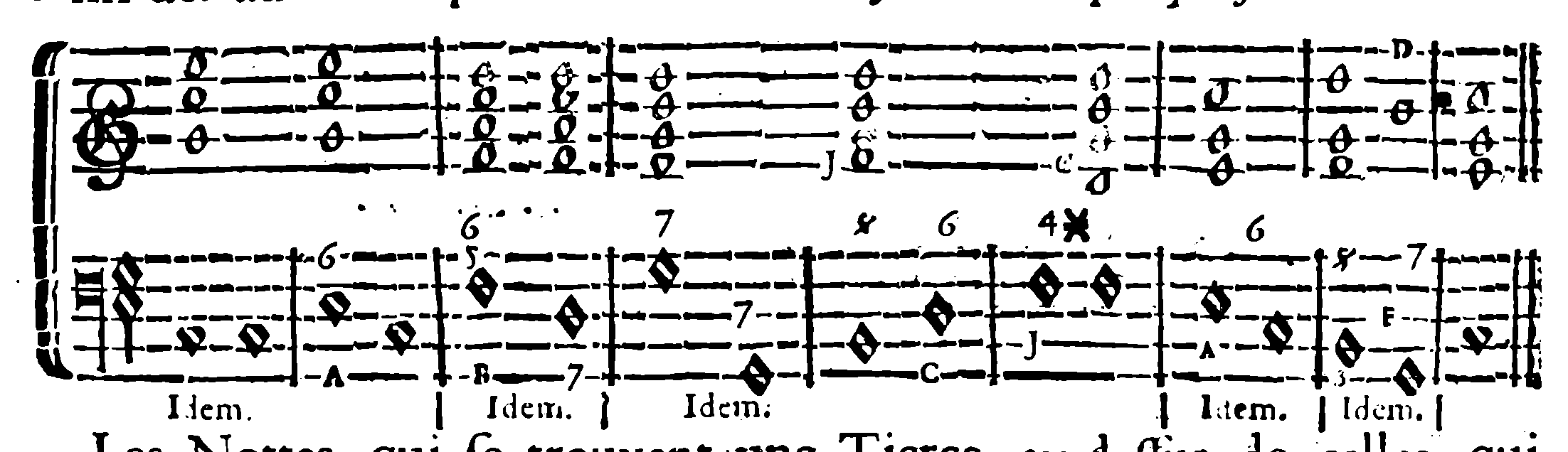
Notes a third above notes that immediately afterward carry a perfect or seventh chord should ordinarily carry a chord derived from the following one. At A, the sixth chord derives from the perfect chord that follows; at B, the great-sixth or diminished-fifth chord derives from the following seventh chord.
When the bass notes change position without changing the substance of the chord, the other parts may remain unchanged in consonant chords. With dissonant chords, however, ensure that all four different sounds forming them can always be heard. One can add the octave of the note being left, D, when it did not occur in the chord of that same note previously heard in the fundamental bass; or leave the octave of the present note, J, and replace it with the octave of the note being left, C.