 Playable Books
Jean-Philippe Rameau · section 56 of 109
Chapter thirteen
Read and hear this section in the playable edition →On the perfect cadence
Every melodic conclusion on a tonic note preceded by its dominant is called a perfect cadence. The tonic must always be heard on the first beat of the measure for the conclusion to be felt. Its preceding dominant must carry a seventh chord, or at least a perfect chord, since the seventh can be understood without being sounded. See the following example.
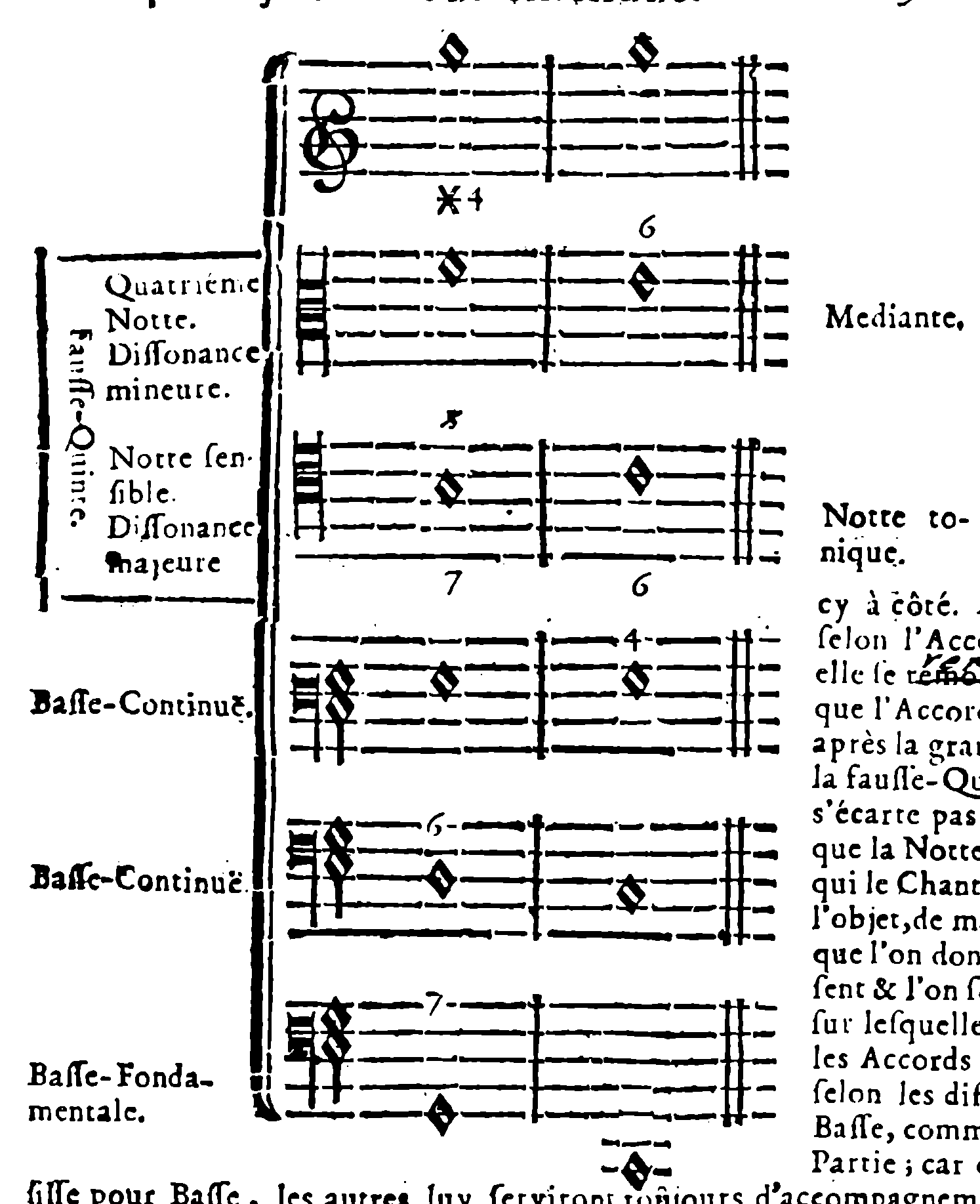
The perfect cadence enables us to judge which bass notes should carry perfect chords: wherever we feel the melody come to rest, the perfect chord must certainly be heard. This repose is felt not only in the progression most natural to the cadence, but also in progressions formed from its accompanying sounds, whose disposition is shown alongside. Each part has been figured according to the chord it would carry if placed in the bass. Remember that the perfect chord may follow the great-sixth chord as well as the diminished-fifth chord. Thus, as long as we remain in the key under consideration, the melody can rest only upon the tonic and its dominant. This fixes our object: whatever progression we give a continuo bass, we both feel and know the notes on which the melody may rest, and the chords that must precede that repose according to the bass's different movements, as marked in each part. Whichever part is chosen as bass, the others will always accompany it in such a case.
To make this still clearer, we shall examine the leading note's power in this situation: how it enables us to distinguish dissonances, and what obligations it imposes upon the order of chords.