 Playable Books
Jean-Philippe Rameau · section 57 of 109
Chapter fourteen
Read and hear this section in the playable edition →On the leading note and the manner in which all dissonances resolve
As soon as the leading note appears in a dissonant chord, it certainly determines a melodic conclusion. It must consequently be followed by the tonic's perfect chord, upon the tonic or in its derived forms. If the leading note is absent from a dissonant chord, however, the conclusion is not determined. That dissonant chord must be followed by another dissonant chord, continuing in a chain until the leading note is heard. It then determines a conclusion, or at least an imitation of one—for example, when we arrive on the mediant instead of the tonic. The preceding seventh-chord examples prove this: after the first seventh chord, another always follows, until the tonic dominant is reached and the leading note is heard.
Remember an exception to the rule just given: the dominant's perfect chord may follow the great-sixth chord on the fourth note, although the leading note is absent from that latter chord, which is nevertheless dissonant.
To recognize a leading note in a dissonant chord at present, there must necessarily be a diminished fifth or tritone, either between upper parts or between a part and the bass. Moreover, these intervals must be formed by the major third and seventh of the fundamental note of a seventh chord, that fundamental always being the tonic dominant. Otherwise the rule would be false. Thus, in C, this diminished fifth or tritone lies between B and F, according to their disposition: one forms the major third, the other the seventh, of G, the tonic dominant.
Example
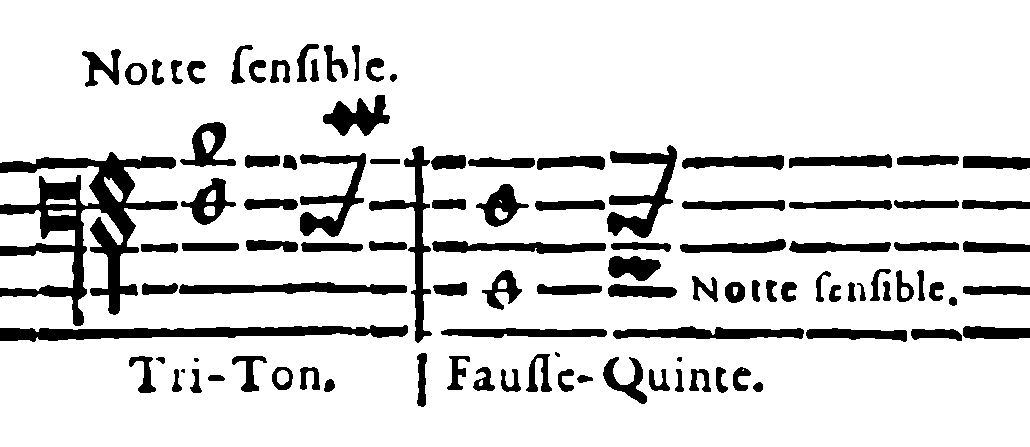
We have just seen the same thing in the perfect-cadence example. Whichever part of that cadence is taken as bass, the others must form its chord, and one of these two intervals will always occur. Their difference arises only from the different positions of the two notes forming both intervals.
The guides [guide-note signs] placed after these intervals show their natural progression, as marked by the notes of the perfect-cadence example. From this we must draw a certain rule for the progression of all dissonances, which is called resolution.
Just as we distinguish thirds as major and minor, so we distinguish all dissonances as major and minor.
Major dissonances are all those formed by the leading note. Just as that note must naturally rise a semitone to the tonic, as the examples have shown, all major dissonances must do the same.
To recognize a major dissonance when the key is known, observe that whenever the note a semitone below the tonic occurs in a dissonant chord, that note itself is the major dissonance. If the key is not known, refer the chord to its foundation: the major dissonance will always be formed by the major third of a tonic dominant carrying a seventh chord. Thus the major third of a tonic dominant with a seventh chord may be regarded as a major dissonance. Consequently the leading note, upon which the diminished-fifth chord is always formed, the major sixth above the key's second note, and the tritone above its fourth note are also these major dissonances.
Minor dissonances are all those formed by the note making a seventh against the fundamental bass. They must resolve by descending diatonically; the seventh and diminished fifth are such dissonances.
When no major dissonance is found in a dissonant chord, only the minor dissonance is present. The minor dissonance, however, always accompanies the major one. This does not alter the progression prescribed for either.
Thus we learn at once the different ways of resolving dissonances. These consist not in different movements of the dissonances themselves, but only in different movements of the bass, which may pass to any note of the chord that should naturally be heard. This is always understood by referring every chord to its foundation.