 Playable Books
Jean-Philippe Rameau · section 58 of 109
Chapter fifteen
Read and hear this section in the playable edition →On the eleventh, called the fourth
The perfect cadence is ordinarily preceded by a dissonant chord hitherto called the fourth,* though it should rather be called the eleventh. In this situation it differs from the perfect chord only by sounding the fourth instead of the third. It therefore occurs only on notes that naturally should carry a perfect or seventh chord, one of which always follows it upon the same bass note. The dissonance formed by the fourth is thereby resolved by descending diatonically to the third whose place it occupied. It must therefore be counted among minor dissonances, being formed, like the others, from the seventh of the fundamental sound. We shall explain this only when discussing dissonances by supposition. For now, here is an example of all the ways it is prepared and resolved.
* See Book II, chapter XI.
Example
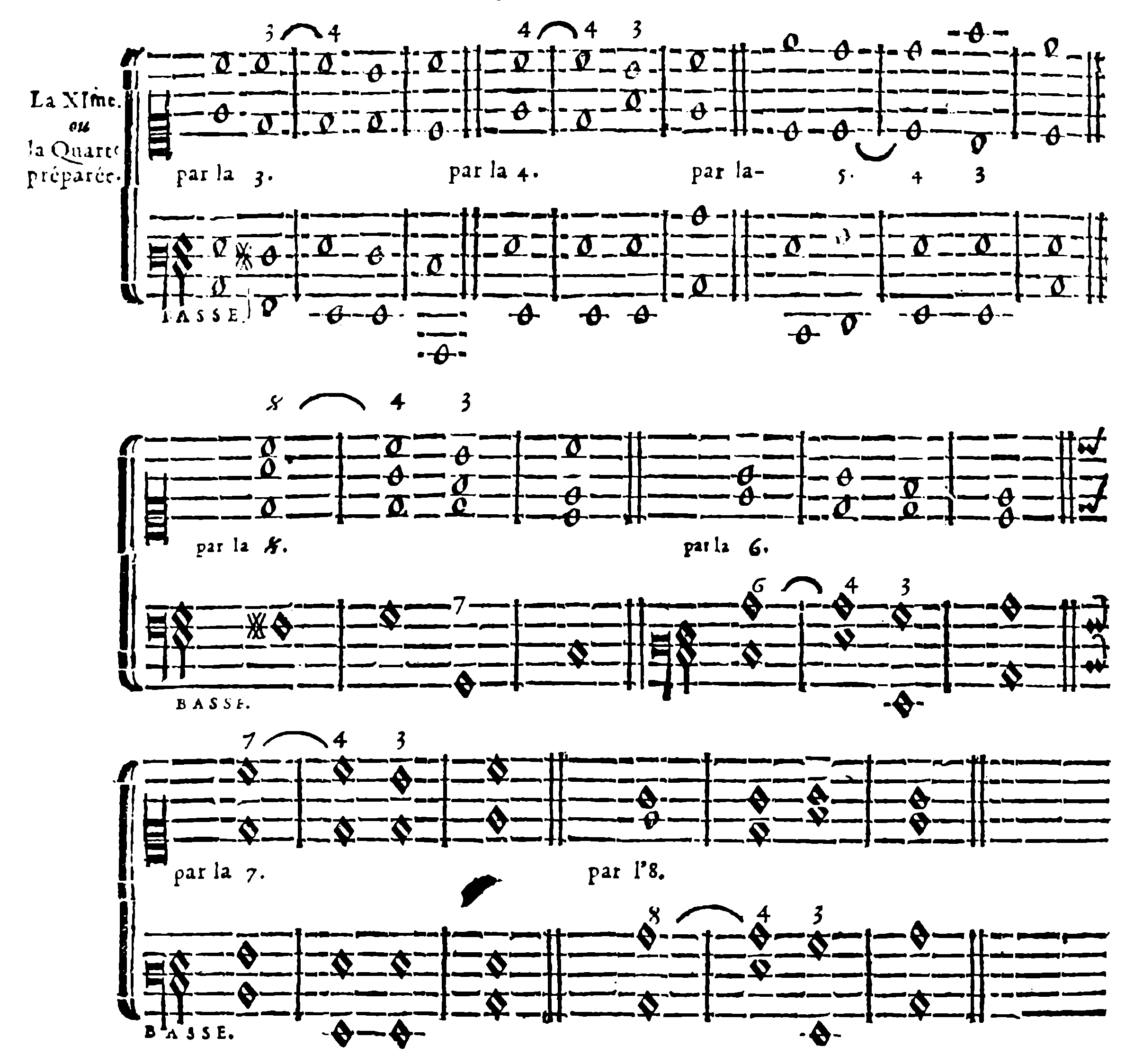
The eleventh, which we nevertheless figure with a 4 to follow custom, is prepared, as shown, by every consonance and even by the diminished fifth and seventh. This can be seen in each pair of notes joined by a semicircle ⌢. It is always prepared on the measure's last beat and heard on the following first beat.
Study all these different preparations carefully in the key of C. They arise solely from the bass's different progressions, and the same applies in every key. This is not quite the place to discuss this dissonance. But a perfect cadence is seldom made without this dissonance immediately preceding it, and several authors have not even separated the two. We therefore thought it appropriate to imitate them on this occasion.