 Playable Books
Jean-Philippe Rameau · section 59 of 109
Chapter sixteen
Read and hear this section in the playable edition →On the irregular cadence
The irregular cadence* ordinarily occurs on a dominant preceded by its tonic, whereas the perfect cadence occurs on a tonic preceded by its dominant. The latter descends a fifth; the irregular cadence rises a fifth. Thus the irregular cadence can also occur on the tonic preceded by the fourth note, since descending a fourth and ascending a fifth are equivalent. The two notes concluding this cadence should naturally bear perfect chords. Adding the sixth to the first note’s perfect chord, however, makes the conclusion more perceptible and yields a very pleasing succession of harmony and melody.
This sixth added to the perfect chord forms the great-sixth chord, which naturally belongs to the fourth note when it immediately precedes the tonic dominant. Thus moving from the fourth note to the tonic, with the same chords that the fourth note should take when rising to the dominant and that the tonic naturally takes, produces an irregular cadence. So does moving from tonic to dominant with a sixth added to the first note’s perfect chord.
* See Book II, chapter VII.
Example
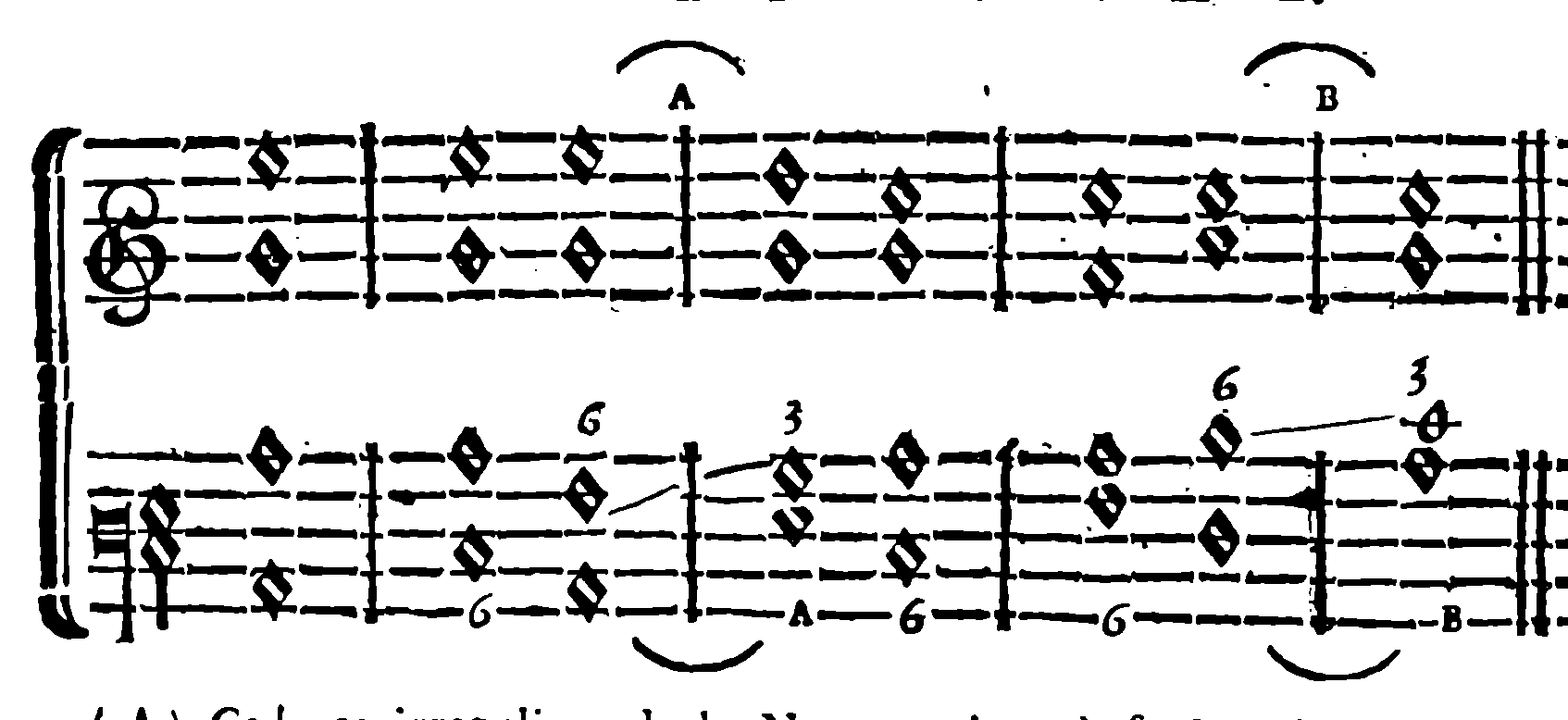
(A) Irregular cadence from the tonic to its dominant.
(B) Irregular cadence from the fourth note to the tonic.
Here a dissonance occurs between the fifth and added sixth; the sixth therefore forms the dissonance. Since it cannot descend onto that fifth, it must rise to the third. In the preceding example, the mark ╱ between the first note’s sixth and the other note’s third shows this movement.
Through inversion, this sixth added to the perfect chord gives us an easy way to set several consecutive bass notes in four or five parts, with one part continually moving in sixths with the bass, without violating any rule. The fundamental bass supplies the proof.
Example
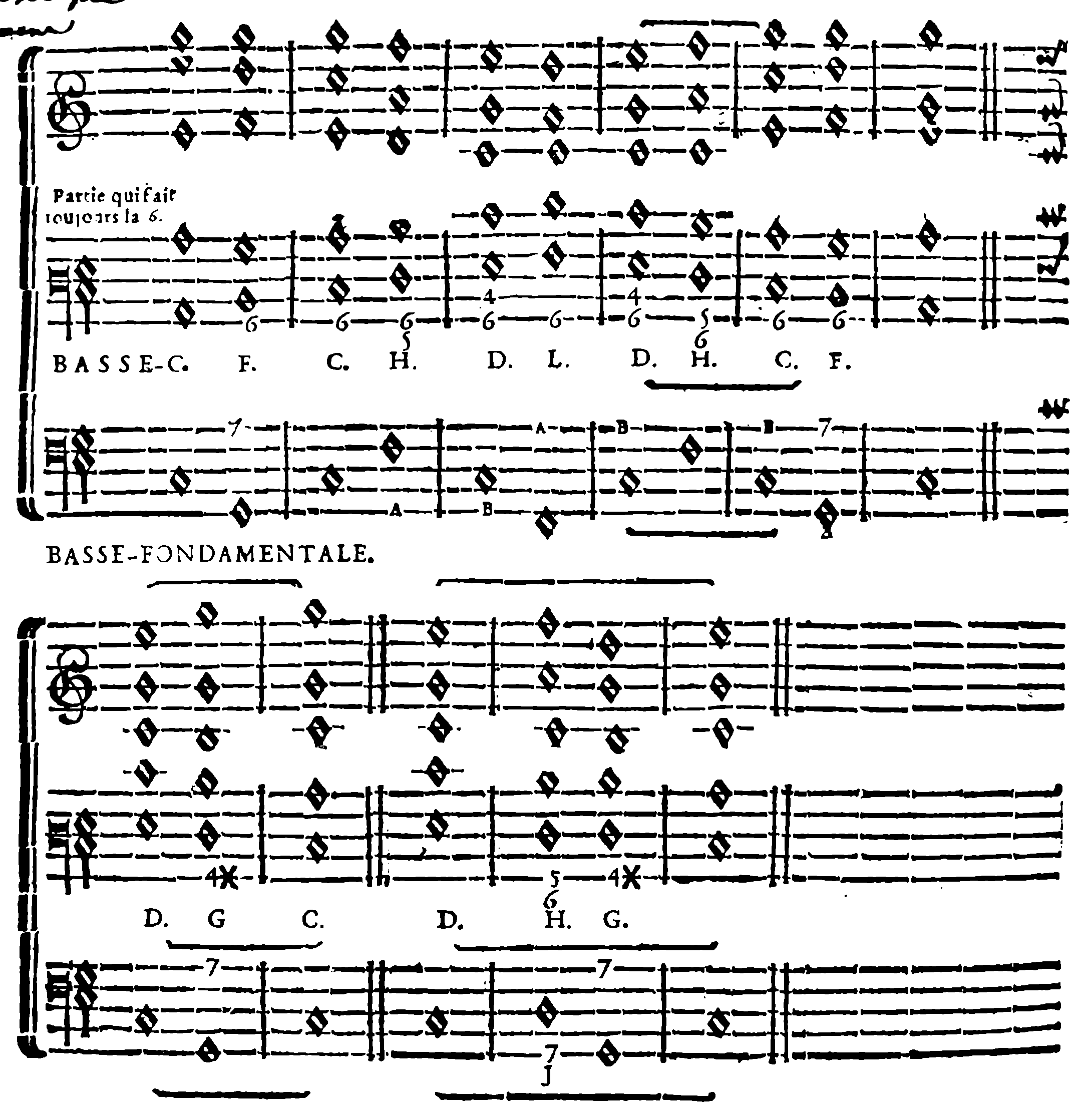
See this example in the Supplement
(A) (B) Irregular cadences in which the sixth is added to the perfect chord on note A.
These six parts could sound together except where the fundamental bass rises a second to the note carrying a seventh at J. There one part would need changing because it makes two consecutive fifths with that bass. Notice simply the two parts that continually move in sixths, both ascending and descending. The added sixth gives us an easy way to combine three further parts with them, although the whole progression contains only three different chords.
At C we first find the tonic’s perfect chord, which makes a sixth chord over its mediant and, at D, a sixth–fourth chord over its dominant. Then at F we find the tonic dominant’s seventh chord, which makes a small-sixth chord over the second note and, at G, a tritone chord over the fourth note.
Finally, at H we find the fourth note’s perfect chord with an added sixth, which makes the small-sixth chord over sixth note L. But this same chord does not always belong to an irregular cadence. In that case it arises from the seventh chord on second note J, where we see it follow its natural progression.
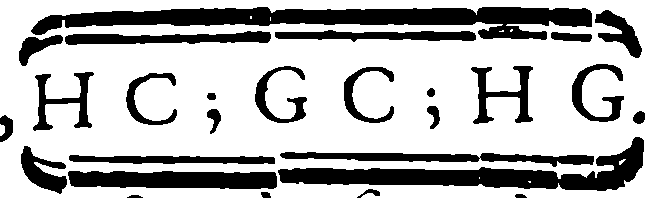
Before these small- and great-sixth chords, which shine in this harmonic succession, were understood, adding even two parts correctly to these sixths was almost impossible. We now add three easily, and even the fundamental bass may join them. Observe this inversion of harmony carefully. It consists simply in choosing any note of the fundamental chord that should sound and placing it in the bass, with the chord’s other notes above. Always conform the harmony to one of the two cadences just discussed, or to the natural fundamental-bass progression in this book’s first examples. Although the bass’s movement after a consonant chord is unrestricted, the chord following it is restricted by the bass’s different movements. If referring a bass progression to its foundation is difficult, simply observe each note’s position in the current key. We are considering only C for now. Knowing which chord each note needs according to its movement, we cannot fail if we supply the appropriate chord. Practice increases experience, and we learn to choose between two different chords available on one note. The preceding example permits either a tritone or great-sixth chord on the fourth note, or both successively, always with the great-sixth chord first. This applies when the fourth note moves to the mediant or tonic. Semicircles above and below the parts mark the measures concerned: H C; G C; H G.
Furthermore, when a bass progression agrees with the fundamental progression, each note should receive a fundamental chord. The exception is movement from the sixth note to the mediant, where the inverted harmony of the irregular cadence is particularly suitable.
Example
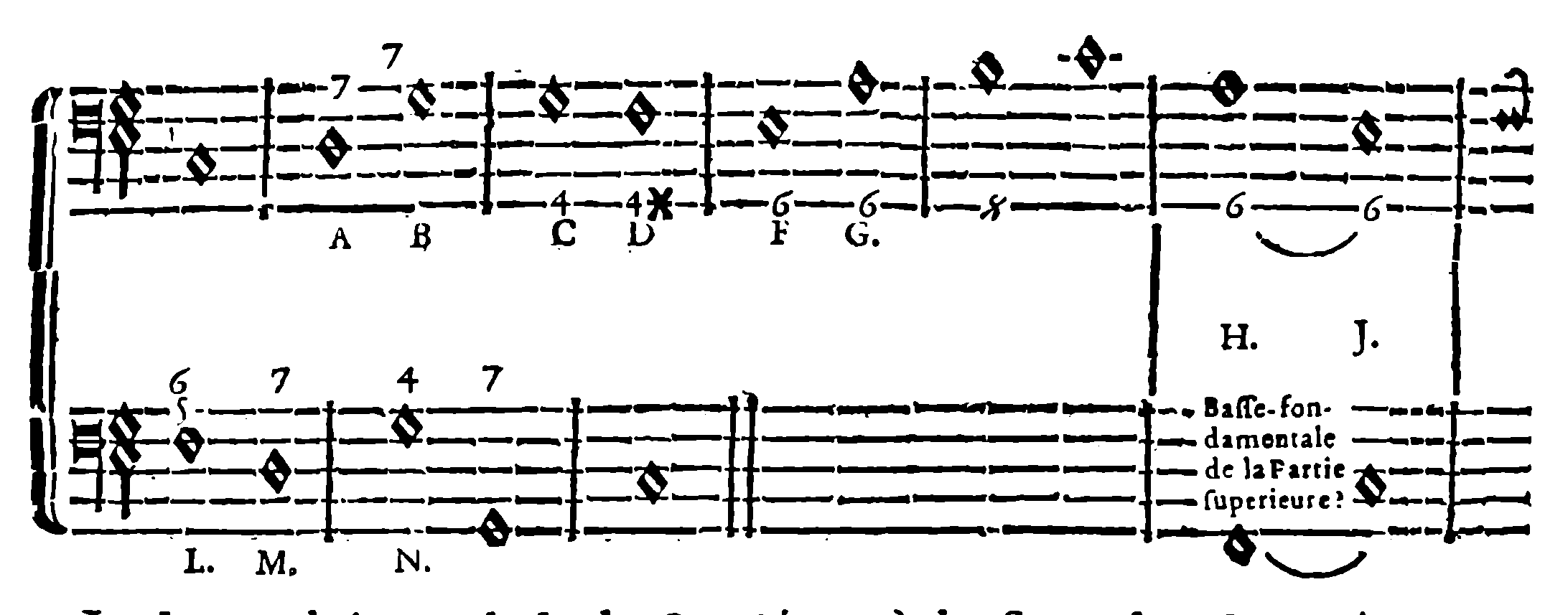
I give second note A a seventh chord because its movement from A to B is fundamental.
I give B a seventh chord because its seventh is prepared by the minor third above A. We should therefore remain on that minor third rather than raise it to the octave, which is absolutely forbidden—unless it is doubled in a composition of more than three parts. Then one copy may rise while the other remains stationary and observes the rule. Since the leading note sounds at B, I must raise it to the tonic, whose perfect chord must be heard. But the tonic is absent from my bass; only its dominant is present. I am therefore obliged to represent that perfect chord by the sixth–fourth chord given to the dominant at C.
I could have given either the great-sixth chord or the tritone chord to fourth note D, which descends to the mediant.
I must give mediant F a sixth chord, since only that chord can resolve the preceding dissonance, although the mediant’s movement to sixth note G is fundamental. Here the dissonance’s absolute need for resolution is our first concern.
Inverted irregular cadence between H and J. See the fundamental bass below.
Note L must bear the great-sixth chord, the same chord as the seventh chord on M a third below it, as explained earlier in chapter XII.
Note M bears a seventh chord for the same reason as A.
The eleventh is prepared through M, N; this eleventh prepares the perfect cadence that follows.