 Playable Books
Jean-Philippe Rameau · section 61 of 109
Chapter eighteen
Read and hear this section in the playable edition →On the manner of preparing dissonances
When we explained how to prepare and resolve the seventh, we intended at the same time to speak of all dissonances, since it is their origin. It is true that, having distinguished them as major and minor, only the minor ones must conform in every respect to the seventh; for the major ones arise from the leading note, which nevertheless belongs to the seventh chord. Now, if the leading note does not require preparation, we must conclude that none of the major dissonances requires this precaution either (see Book Two, Chapter XIII). But if the seventh must be prepared by some consonance, we must say the same of all minor dissonances. Thus, provided we do not depart from the key being treated, we may readily sound a dissonance whose constituent note was consonant in the preceding chord. We may also do this when passing from one key to another, once we know how to make their connection pleasing. Remember also what we said: the same note may serve several consecutive dissonances when the chords containing it are fundamentally one and the same chord; and the eleventh may be prepared by the seventh or the diminished fifth, although these are themselves dissonances. This should make us understand that a note which has formed one dissonance may form another in a chord that seems in some way different, provided we do not change key in such a case.
If we said that the seventh could be prepared only by the third, fifth, and octave, this must be understood only in relation to the fundamental progression of the bass. Its most natural movement is to descend by a third, fifth, or seventh. Remember that ascending a second is equivalent to descending a seventh, and likewise for other intervals having the same relationship. Of such related intervals, we should ordinarily choose the smaller for the bass: ascending a second is preferable to descending a seventh, and so on. But if we consider chord inversion—we may put any note of a fundamental chord in our bass, and that chord will change its name according to the different intervals its sounds form above the note then occupying the bass—we shall find in one place that the sixth or fourth prepares the seventh instead of the third or fifth. Elsewhere we shall find that this third, fourth, fifth, sixth, or even octave prepares a diminished fifth, because the seventh chord is represented in the diminished-fifth chord just as it is in every other dissonant chord. Thus we cannot go wrong in preparing a dissonance by any consonance, provided we do not strive to avoid what is natural. For example, instead of placing the tonic in the bass, I substitute its mediant or dominant, each bearing the chord derived from that tonic's perfect chord. If I wish to sound a seventh prepared by the octave, fifth, or third of that tonic, its octave becomes a sixth above the mediant and a fourth above the dominant; the fifth and third change correspondingly. By this relationship, our first rule for sevenths applies generally to every minor dissonance. Similarly, after the tonic's perfect chord, whether the tonic, its mediant, or its dominant is in the bass, suppose I sound a diminished fifth, a tritone, a great-sixth or small-sixth chord, and so forth, instead of the seventh which one consonance of that perfect chord must prepare. This results from my having substituted in the bass one of the notes of the seventh chord for its fundamental note.
Example
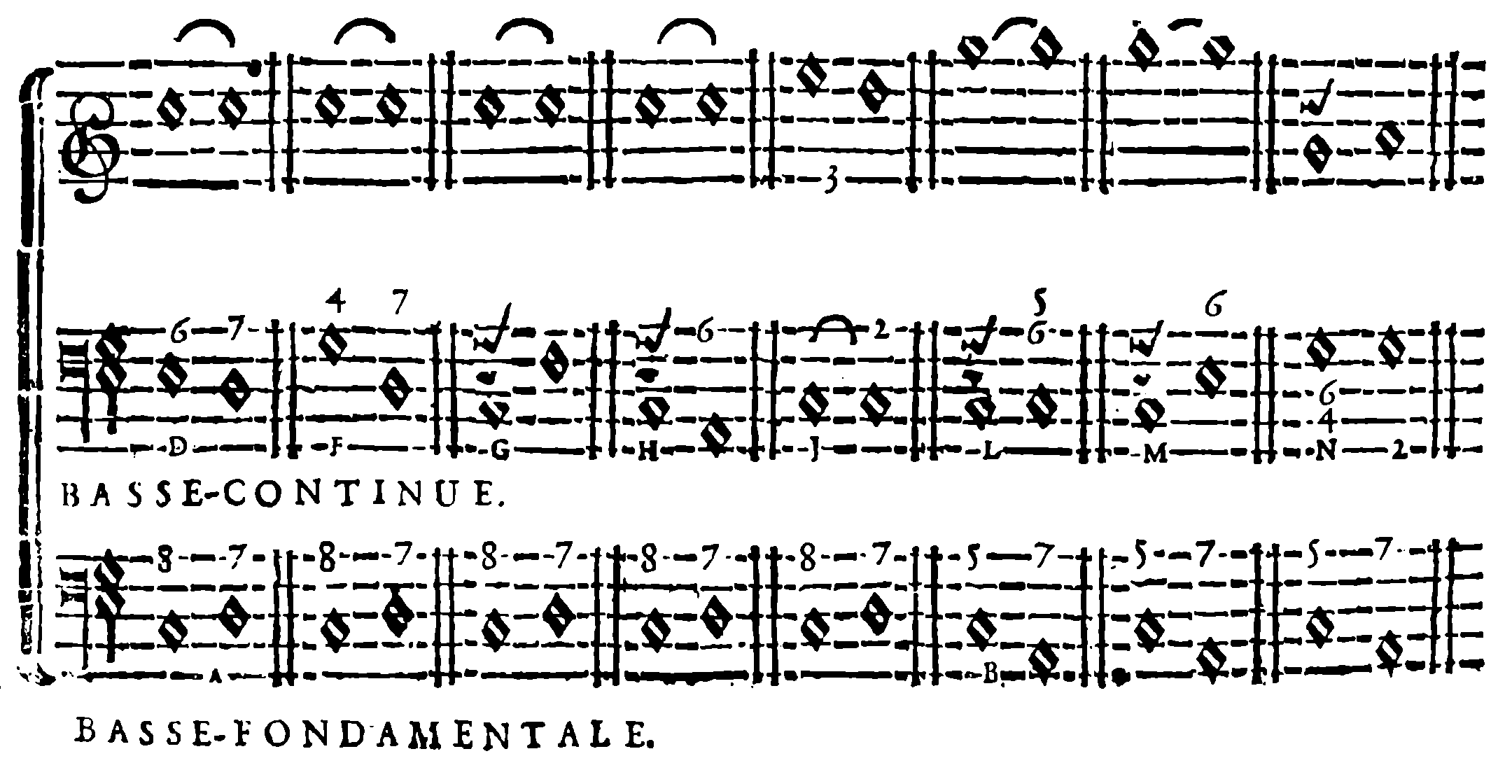
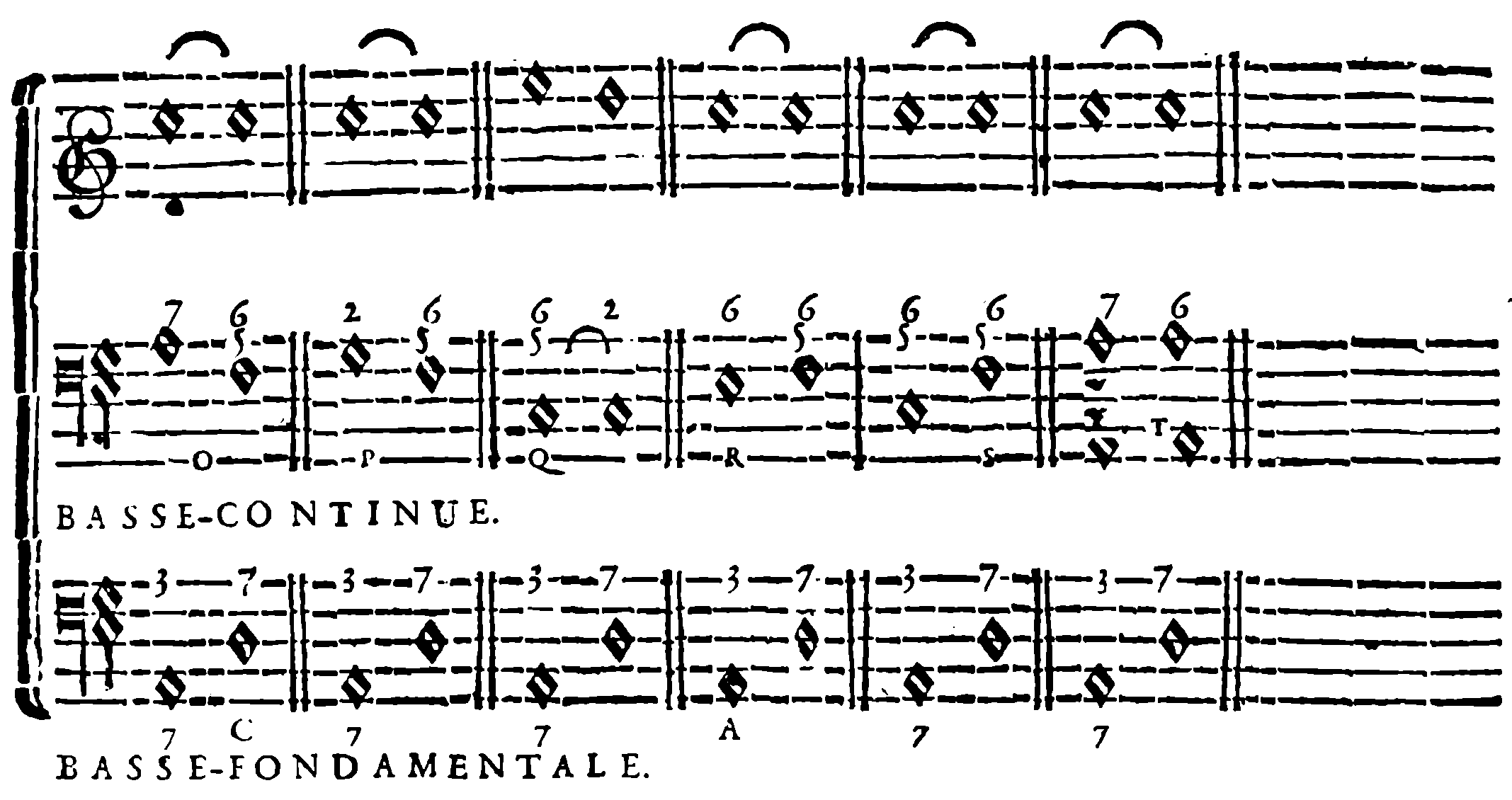
Continuation of the preceding example.
1. A: the seventh prepared by the octave according to fundamental harmony. D: the mediant, above which the octave of the fundamental bass becomes a sixth. F: the dominant, above which the octave of the fundamental bass becomes a fourth.
The seventh is thus prepared by the octave, sixth, and fourth. G: in the great-sixth chord, the fifth representing the seventh is prepared by the octave. The cue signs on the mediant and dominant show that this fifth may equally be prepared by the sixth and fourth of those two notes. The same applies at the other places containing cue signs.
H: in the small-sixth chord, the third representing the seventh is prepared by the octave, sixth, and fourth.
J: the second prepared in the bass is preceded by the third in the upper part.
2. B: the seventh prepared by the fifth according to fundamental harmony.
L: in the great-sixth chord, the fifth representing the seventh is prepared by the fifth, third, and octave.
M: in the small-sixth chord, the third representing the seventh is prepared by the fifth, third, and octave.
N: the second prepared by the octave or by the fourth shown with a cue sign.
3. C: the seventh prepared by the third according to fundamental harmony.
O: in the great-sixth chord, the fifth is prepared by the third of the fundamental note to which the seventh is added.
P: this same fifth is prepared by the fourth of the note which forms the seventh of the fundamental bass; that note must bear the second chord.
Q: the second prepared as at J.
R: this same fifth is prepared by the sixth of the note that is the dominant of the note in the fundamental bass. Observe here that any note which is the dominant of another can always represent it, bearing an inversion of the perfect or seventh chord that the other should carry. This inverted chord is the sixth–fourth or small-sixth chord.
S: this same fifth is prepared here by the octave of the note which forms the third, or mediant, of the note in the fundamental bass.
T: in the small-sixth chord, the third is prepared by the third, sixth, or octave; and the preceding seventh is resolved by the sixth of the same note above which that seventh was heard.
We had not yet discussed the second. Before saying more about it, however, observe that it prefers to be prepared only in the preceding manner.
It is clear enough that all the different ways of preparing dissonances arise from the way the seventh is prepared. The only difficulty is recognizing, in the bass, the notes making up the chord of its fundamental note. This deserves our entire attention; otherwise we doubt everything and do not know what to rely on. Let us therefore firmly remember that the first dissonant chord heard must always be preceded by a consonant one. This consonant chord is simply the perfect chord of the tonic, its dominant, or its fourth note. That perfect chord may also be represented by the sixth chord on the mediant of each of these notes, and by the sixth–fourth chord on the tonic's dominant alone.
When we compose in only two or three parts, we often sound only the consonances of a chord in which a dissonance has a place. Thus, unless we heed the bass progression and know the key we are in, all our rules become useless. We therefore cannot take too much care to understand these rules, which we confine to the single key of C. Knowledge of this key suffices for all the others; thereafter we need only know how to distinguish them.
Since a piece of music must begin only with a consonant chord, a dissonant chord can be used only after a consonant one. Yet one dissonant chord is often followed by another. As we said, a consonant chord cannot follow a dissonant one unless the leading note makes itself distinguishable in the latter. Otherwise we keep passing from one dissonant chord to another, as our rules for the seventh show. This is rather difficult to recognize in pieces for two or three parts: these dissonant chords always contain at least two consonances, the third and fifth, or, through inversion, the sixth and fourth, besides the octave that may also occur. We therefore often pass from one dissonant chord to another without knowing it. Let us not neglect these first principles if we wish to know what we are doing, for our greatest satisfaction should lie in complete understanding.