 Playable Books
Jean-Philippe Rameau · section 63 of 109
Chapter twenty
Read and hear this section in the playable edition →An exact enumeration of the different bass progressions according to the different dissonances employed
We must always derive the rules concerning dissonances from our fundamental bass and fundamental seventh chord. We shall see that the seventh chord alone governs all the different dissonant chords we can employ. The different progression of the bass, drawn from the movements of the sounds contained in this seventh chord, obliges us to name each chord according to the intervals the upper parts then form with that bass.
Here we merely extend our first rule for the seventh by giving a seventh chord to every note of a key when the bass proceeds by ascending fifths or descending fourths.
We may prepare the first seventh by whatever consonance we choose, or leave it unprepared, in accordance with what we have just said in the preceding chapters. Afterwards, however, we must follow the rule requiring it always to be prepared and resolved by the third.
See the following example.
Example
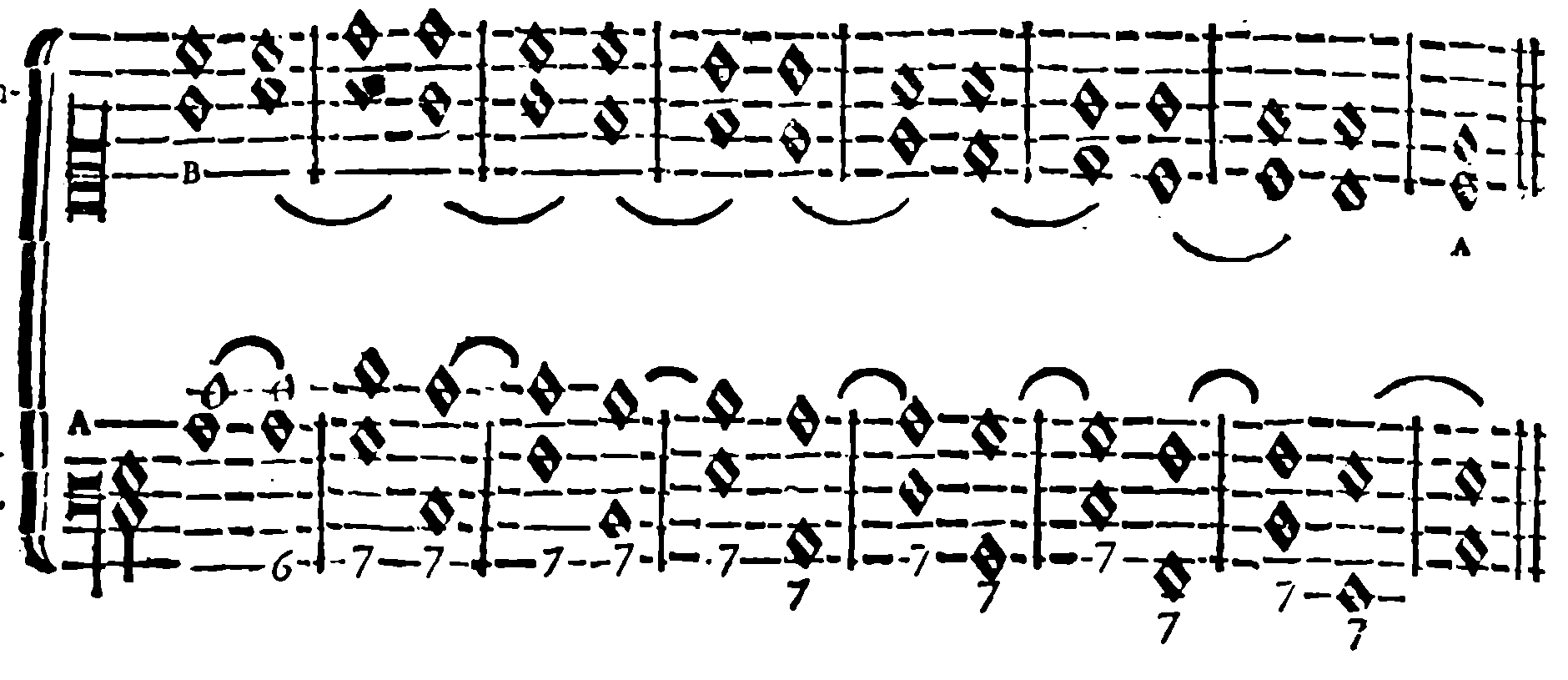
Observe that all the parts continually descend. These sevenths are accompanied alternately by the third and fifth, or by the third and octave: thus, 1. 3. 5. 7., or 1. 3. 7. 8.
To make this harmony more complete, five parts would be needed, as we shall see.
Some of these sevenths will be found not to have their natural proportion, such as those on C and F, which we expressly forbade in our first rules. This need no longer trouble us in such a succession of dissonances. They arise from the modulation, in which no sharp or flat may be added to any note. Later we shall find other false intervals derived from these. Since circumstances make them so, we must always write them as though they were correct. We cannot avoid admitting these kinds of intervals into the harmony if we wish to remain in the key in which we began. The ear is not in the least offended, being preoccupied with the sounds assigned to that modulation.
If we take the tenor part, marked A, as the bass, the first note corresponding to the first seventh will bear a small-sixth chord. The following note bears a seventh chord. From this we obtain a new bass progression through chords which only seem new, as the next example will show; this part is again marked A there.
Next take the haute-contre part, marked B, as the bass. Its note corresponding to the first seventh will bear a second chord, and the following note a great-sixth chord. This yields yet another progression, and so on, as the next example shows, where this part is again marked B. Observe that second and tritone chords contain the same intervals, except that the fourth is perfect in one and augmented in the other. The latter is therefore called a tritone chord, because the augmented fourth consists of three whole tones. The cause of the difference between the great-sixth and diminished-fifth chords also causes the difference between these last two chords.
The major or minor small-sixth chord, which is not distinguished by two different names, shares the same difference. Everything arises from a seventh chord whose bass has a major third in one case and a minor third in the other. We do not distinguish this difference by different names, except that we assign exclusively to the tonic dominant the chord whose major third forms a diminished fifth or tritone with that same dominant's seventh. To the other dominants we assign indiscriminately the chord whose third is minor, and in which neither diminished fifth nor tritone occurs between the third and seventh. These latter dominants must follow one another until the tonic dominant appears. This applies to their derivatives as well as to the dominants themselves.
The following example shows all the chords arising from the different bass progressions. Each part may reciprocally serve as upper part or bass, except the fundamental part and the part beneath it, which can serve only as basses.
Turn the page for the example.
Example
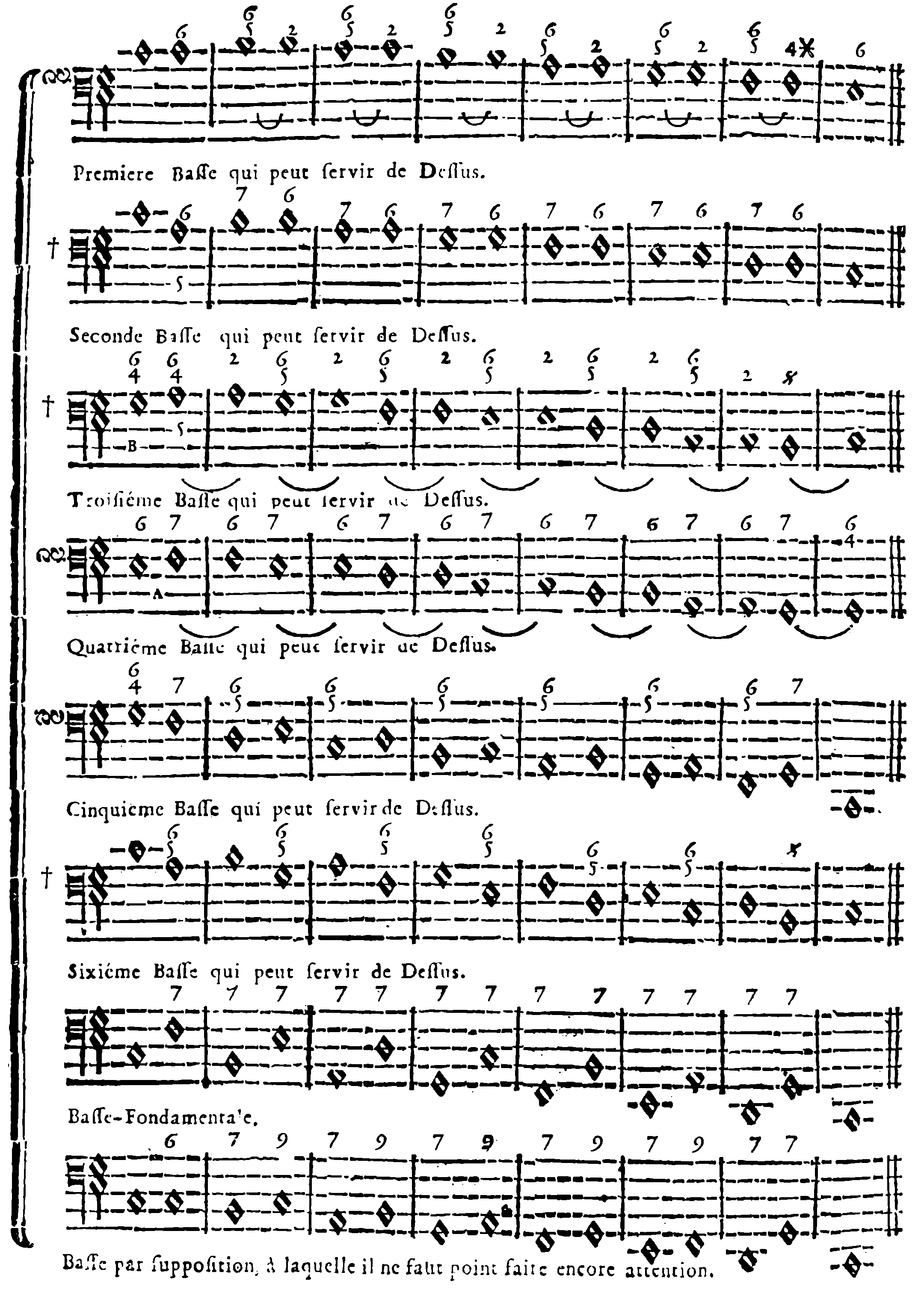
1. First observe that the progression of the first four basses is the most natural in relation to the fundamental bass. The progressions of the fifth and sixth basses are borrowed from the first four.
The fifth bass takes its progression from the first and fourth; all three are marked ∞.
The sixth bass takes its progression from the second and third, marked with a cross, †. We recognize this because each measure of the fifth and sixth basses contains one note from each of the basses from which its progression is drawn. Notes on the same degree in these different basses bear the same chord figures. Where we have not placed a 7 on every note of the fifth and sixth basses that ought to bear a seventh chord, our purpose is to show that we may play only a perfect chord on those notes, omitting the seventh that could occur there. Consequently, we must avoid sounding the octave in the chord on the preceding notes, since that octave prepares the seventh.
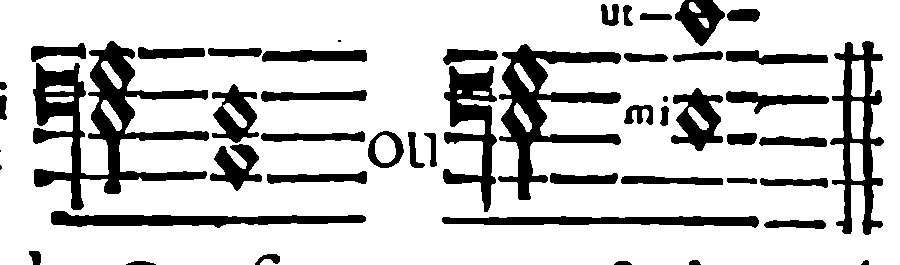
2. In the natural progression of the first four basses, we observe that the first and second, and likewise the third and fourth, are arranged in thirds. While the last two descend, the first two remain on the same degree; they continue alternating in this way to the end. Since a minor dissonance naturally descends, we cannot avoid giving this movement at least to the parts forming it. In such a succession of harmony, the consonance lying a third below must follow the same movement. Remember that a sixth above and a third below amount to the same thing, as here:
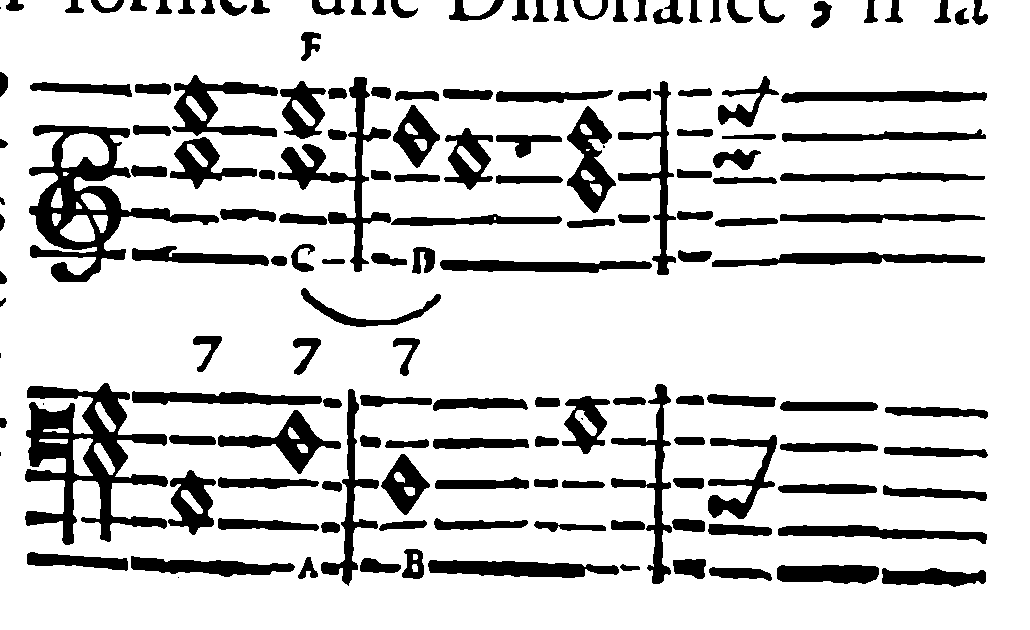
It is true that the consonance's movement is restricted here only in relation to the fundamental bass. A consonance may remain on the same degree and become a dissonance if the bass moves first:
Thus:
A, B: the bass descends a third instead of a fifth. The consonance C, a third below the dissonance F, then remains on the same degree to form the dissonance D.
3. To hear the effect of all these parts together, omit the fifth and sixth basses. When we wish to hear those two, omit the four upper parts, or at least the first and third, although unisons or octaves that do not make a pleasing effect will then occur constantly.
4. Take the first four basses separately. The upper three contain all the sounds belonging to the chords figured on the fourth. Likewise, take any of the others as bass, transposing it an octave down to place it below the remaining parts, or transposing those parts an octave up. The chords figured on whichever part serves as bass will always be contained in the others. If we next use the fifth bass as bass, only the second, third, and fourth should sound above it, because the first resembles it too closely. If we use the sixth as bass, only the first, second, and fourth should sound above it. Change just one note that creates two consecutive octaves in the first measure.
Thus a single example teaches the different construction of all dissonant chords, the progression of dissonances, and the differences between these chords arising from different bass progressions. As we see, everything consists merely in inversion.
5. The fifth and sixth basses have a pleasing effect when taken separately. We may even syncopate them:
Thus:

Or by inversion.

It is rather difficult to add two more parts to these, because inversion introduces a certain supposition that requires a thorough knowledge of harmony. For the present, therefore, practise them only as written: in two parts alone.
When a part is used as bass, it must begin and end on the tonic. At the close, arrange for that tonic to be preceded by its dominant. The other parts require only a very slight alteration, which we can make agree with their progression as heard above the fundamental bass.