 Playable Books
Jean-Philippe Rameau · section 71 of 109
Chapter twenty-eight
Read and hear this section in the playable edition →On All Licenses, Beginning with the Interrupted Cadence
An interrupted cadence is a certain bass progression that interrupts the conclusion of a perfect cadence. After sounding the seventh chord on a tonic dominant, if, instead of falling naturally onto the tonic, you make the bass rise only a whole tone or semitone, the perfect cadence is interrupted. The seventh then resolves through the fifth of this raised note, which rises a whole tone in major keys and a semitone in minor keys. (See our discussion of the interrupted cadence in Book II, Chapter VI.)
Example
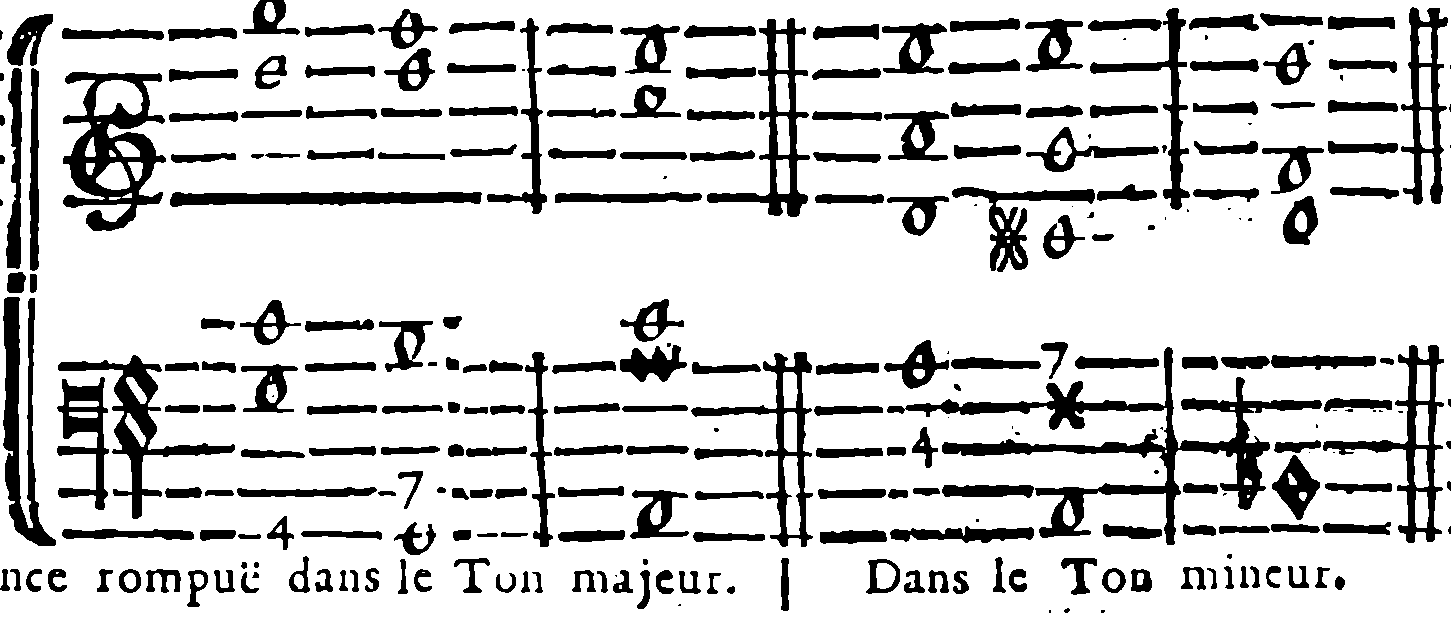
In the perfect chord ending this cadence, the third is doubled at the octave in preference to the bass, contrary to the natural order. This arises more from the bass’s false progression than from that of the parts: the minor dissonance still resolves downward and the major upward, while the doubled third represents the fundamental sound that should naturally be heard. In major keys one may indeed descend to the octave of the bass instead of ascending to the third, as shown by the cue sign. But in minor keys the example must be followed strictly.
We must now invert the chords composing this interrupted cadence to see what advantages we can derive from them.
Example
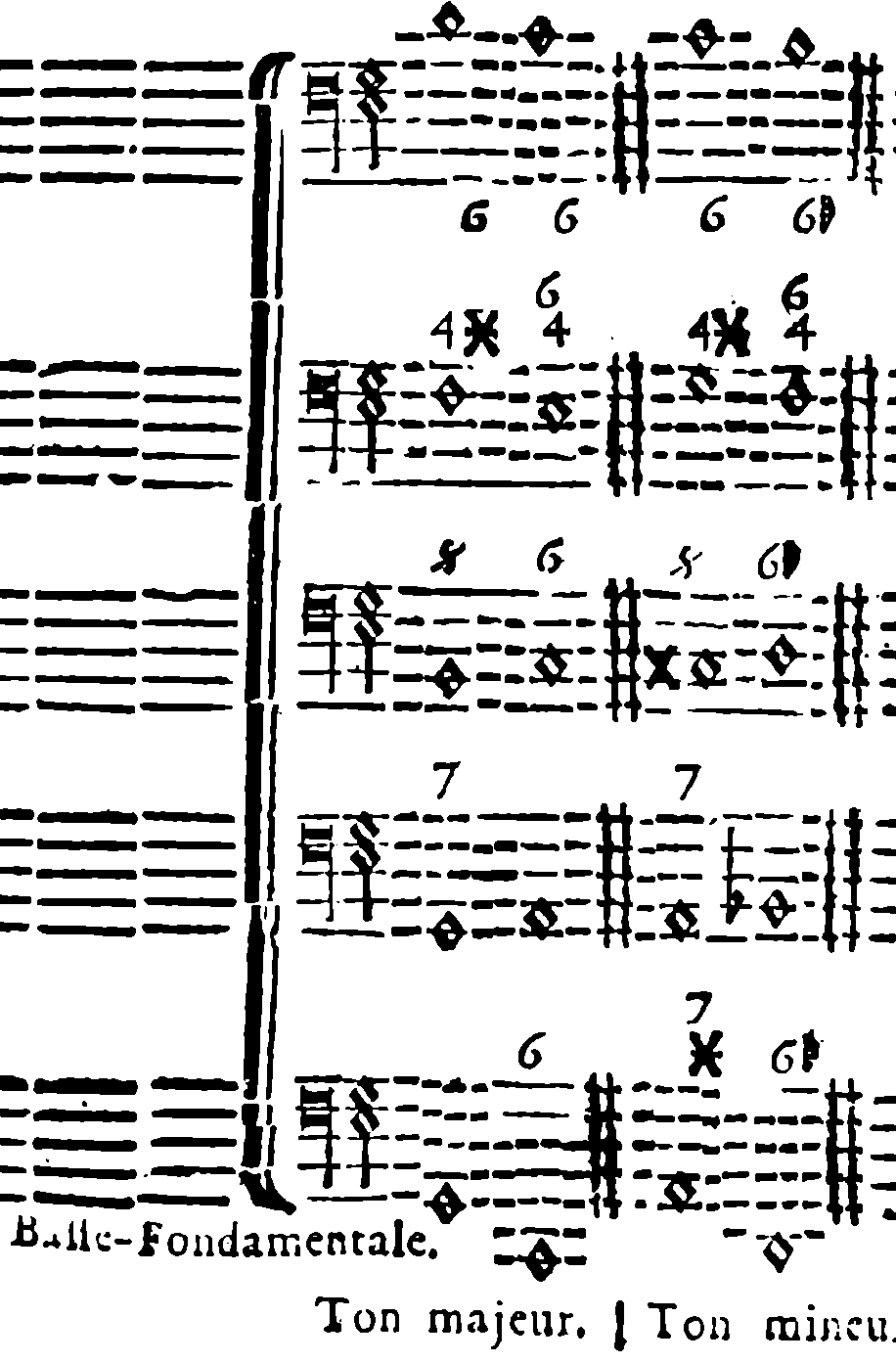
Placing each of these basses below the others in turn will produce the different chords figured there. From this one can derive a pleasing succession of harmony and melody with the bass progressing diatonically, downward or upward.
See the following example.
Example
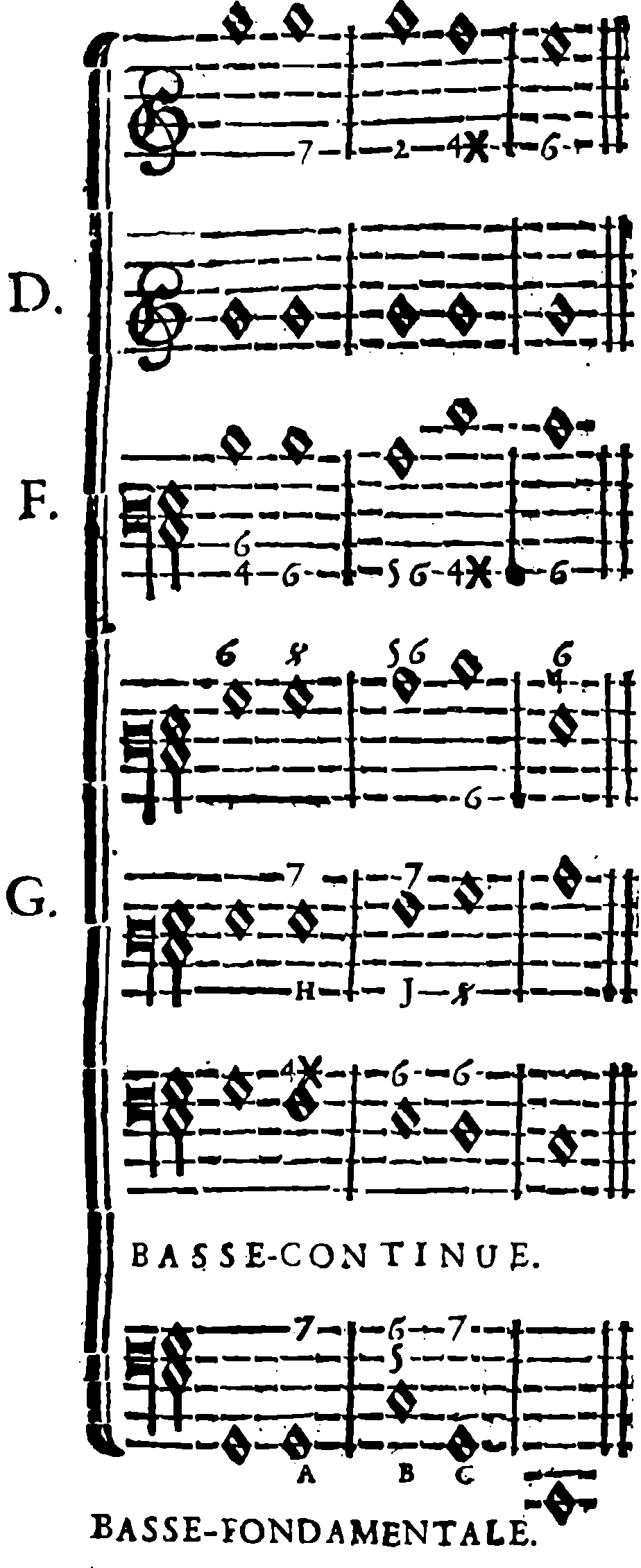
When this part serves as bass, part D must be omitted and the final two notes of part F must be changed. The same must be done to this part when F serves as bass.
This part cannot serve as bass.
When this part serves as bass, its progression must remain diatonic to the end, preferably ascending rather than descending.
Part D must be omitted when this one serves as bass, because the irregular cadence that D sounds against notes B and C of the fundamental bass cannot be inverted with a seventh or second chord on the first of the two notes forming it.
The perfect cadence from A to B is evaded by the sixth added to the perfect chord on B. This prepares an irregular cadence, evaded at C by the added seventh, so that the perfect cadence may be heard at the end.
See Book II, Chapters IX and X, on this subject.
If the fifth is omitted from the chord on B, an interrupted cadence will be heard from A to B, just as at notes H and J of part G.
The upper parts’ progression is restricted by that of the continuo bass. But when they are made to serve as bass in turn, they may be given whatever progression is desired. This means only that consonant progressions may be changed into diatonic ones without changing the underlying harmony. The movement of the other parts, now serving as upper parts, must then be adapted accordingly.
One may sound the sixth above the second of the two notes rising by a whole tone or semitone in the interrupted cadence. But then the seventh chord must not be used on the first of those notes, because its seventh could not resolve there.
As we see, the conclusion of each cadence may be interrupted by adding a dissonance to its final note, provided that the dissonance is prepared and resolved according to the fundamental-bass progression, by which one must always be guided to avoid error. For we see that this dissonance cannot be prepared at C, though it is good, because the fundamental bass descends a fourth there or, equivalently, ascends a fifth.
The irregular cadence and dissonances that cannot be prepared must be counted among the licenses—for example, when the fundamental bass ascends a third, fifth, or seventh—along with everything arising from inversion of these different progressions. Yet what we call license here is inseparable from the substance of good harmony. For this reason we have discussed these matters in the order we thought best for beginners’ understanding.