 Playable Books
Jean-Philippe Rameau · section 73 of 109
Chapter thirty
Read and hear this section in the playable edition →On the Ninth Chord
This chord differs from the preceding one only in its fifth, which was augmented and must here be perfect—or rather in the third of the fundamental sound, which is minor here instead of major. Thus, if we take a dominant’s seventh chord with a minor third, we form the ninth chord by adding a note a third below that dominant.
Example
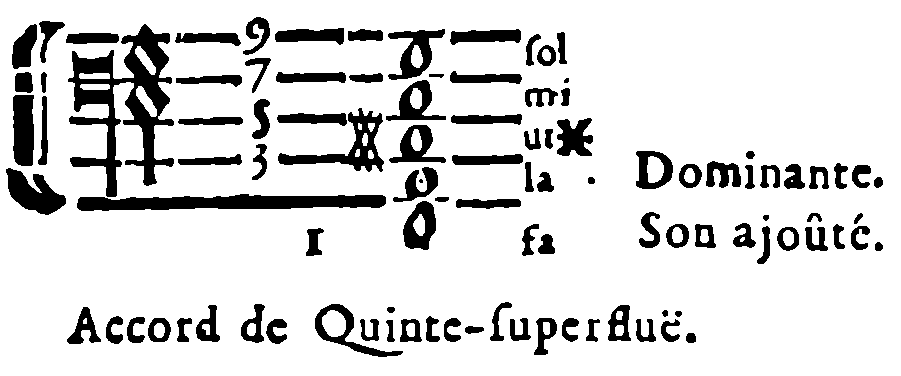
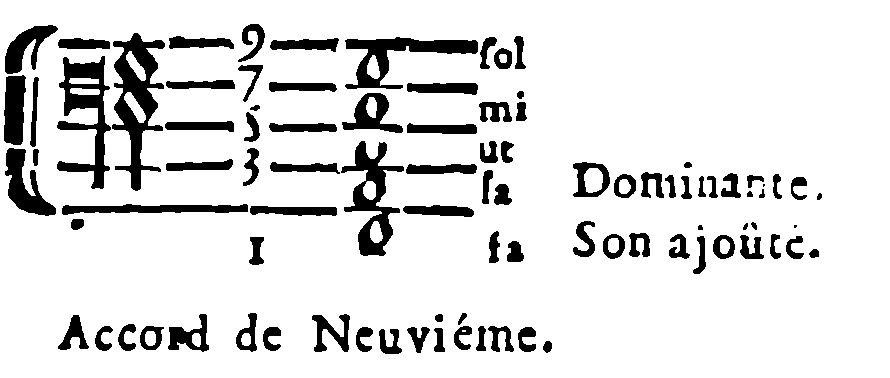
We have good reason to point out that every chord by supposition—this one, the augmented-fifth chord, the eleventh chord, and the augmented-seventh chord—derives from a dominant’s seventh chord. We shall discuss the last two in the following chapters. In this way one immediately knows how these chords must be prepared and resolved. By means of a fundamental bass, one will see that everything relates to our rules for sevenths.
See the following example.
Example
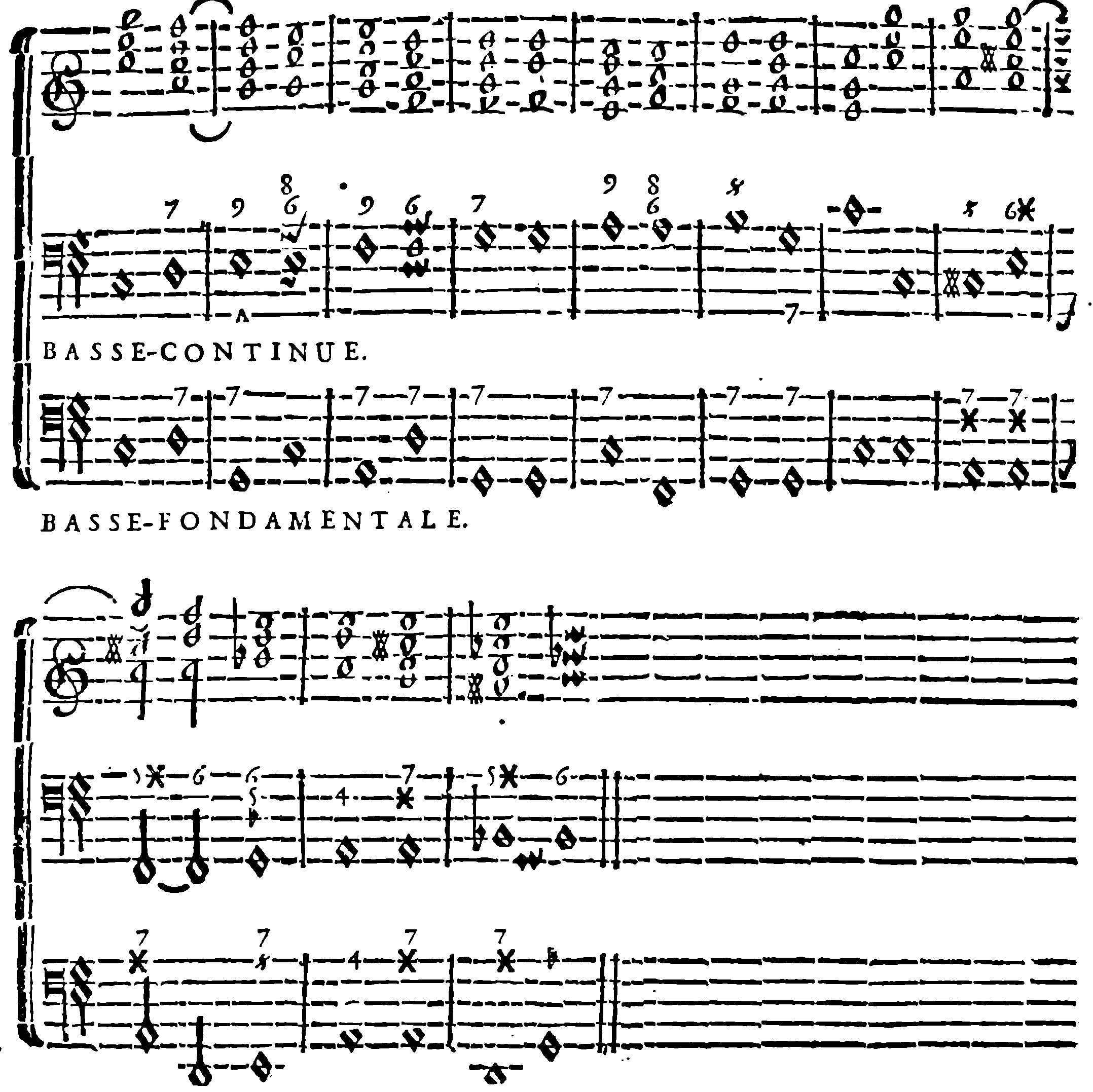
All continuo-bass notes bearing ninths or augmented fifths must be omitted whenever the fundamental bass is to be heard below. Otherwise, the fundamental-bass notes would have to lie above those figured 9 or 5♯, because the fundamental-bass sound, then displaced by supposition, can be heard only above the sound substituted beneath it.
Notes bearing 9 and 5♯ may descend a third, as the cue signs show, as well as remain on the same degree. The ninth therefore resolves in two ways: to the octave when the bass stays, and to the third when it descends a third. Notice that the seventh would then resolve to the octave, as we shall see elsewhere.
Some also maintain that the ninth may resolve to the fifth by making the bass ascend a fourth. But the resulting harmony is unsuitable, so we leave this to the discretion of people of good taste.
Example of the Ninth Resolving to the Fifth
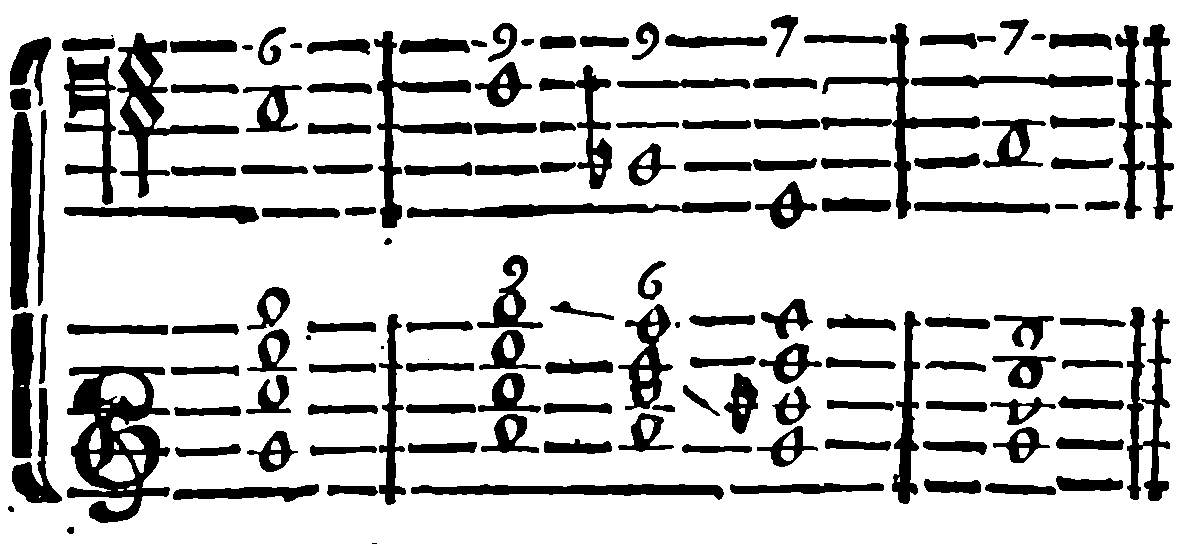
It could more suitably resolve to the sixth by making the bass ascend a third, because the foundation of the harmony would then remain unchanged. See the cue signs in the other example.
Every minor dissonance by supposition must absolutely be prepared. Thus, whenever the ninth can be prepared by a consonance of the preceding chord, provided that the bass rises a second or fourth in this case, one may use this dissonance, afterward resolving it in the manner prescribed by the example and without departing from good modulation.
The seventh, which can always accompany the ninth, must never be added unless prepared by a consonance of the preceding chord. See, however, what we say on this subject in Book II, Chapter XVII.
Observe also that minor dissonances by supposition, such as this one and the eleventh to be discussed in the next chapter, may be prepared by another ordinary dissonance, such as the seventh or diminished fifth, although the seventh is suitable only for preparing the heteroclite eleventh. This is because these latter dissonances belong to the same fundamental chord. We already observed in Chapter XII that the same note could form several successive dissonances when they came from the same fundamental chord.
Turn the page for the following example.
Example
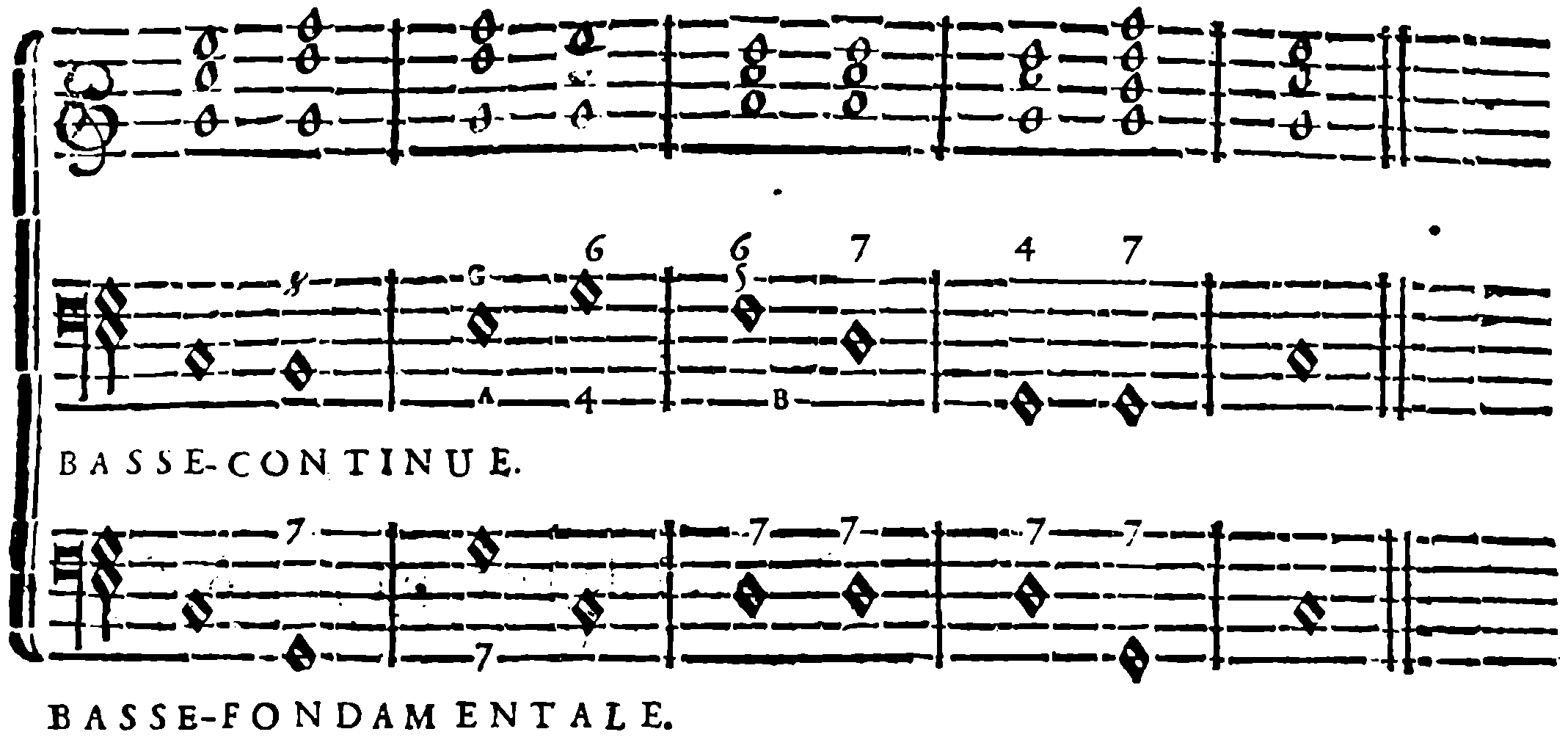
The continuo-bass notes at A bear chords derived from the fundamental chords figured on the fundamental bass; likewise the notes at B. Now, if dissonances by supposition may be heard after another dissonance, and if a dissonance must certainly be preceded and followed by a consonance, then, to preserve this last rule, the different dissonances heard successively on the same degree must not truly be different dissonances. They must all arise from an initial dissonance, the seventh, whose fundamental chord remains unchanged until these apparent dissonances end on a consonance, as the example shows and as is indeed the case.
Chapter XV shows how the heteroclite eleventh is also prepared by the diminished fifth, and so forth.