 Playable Books
Jean-Philippe Rameau · section 76 of 109
Chapter thirty-three
Read and hear this section in the playable edition →On the Augmented-Second Chord and Its Derivatives
We call the augmented-second chord and its derivatives chords by borrowing, because the tonic dominant yields its foundation to the sixth note, in minor keys only, from which this augmented-second chord and its derivatives arise. Thus:
instead of
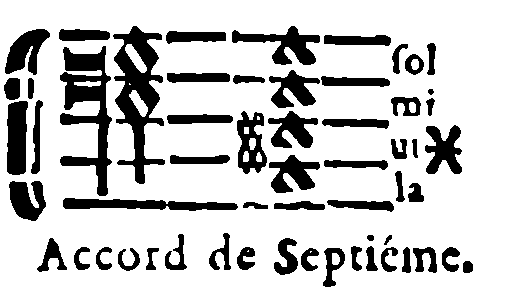
we find
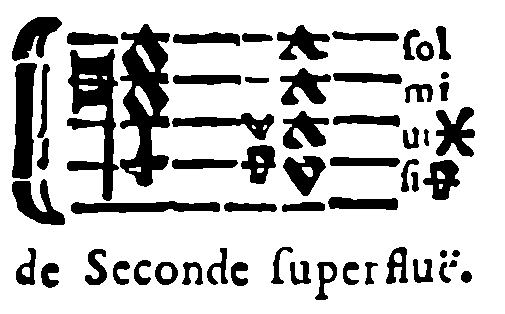
We have good reason to say that the augmented-second chord originates by borrowing from a tonic dominant’s seventh chord. The sixth note occupies the place where that tonic dominant should stand, while the sounds belonging to the dominant’s seventh chord remain entirely unaltered. Their progression, for both the major and minor dissonance, always agrees with the motion naturally prescribed to them. Moreover, although the choice between these two bass notes is free in the middle of a piece when one wishes to sound the tonic dominant’s seventh-chord tones with either of them, the ensuing harmony is no longer freely chosen. It must conform in every respect to the succession of that seventh chord. Thus the tonic’s perfect chord must follow either chord alike.
Examples
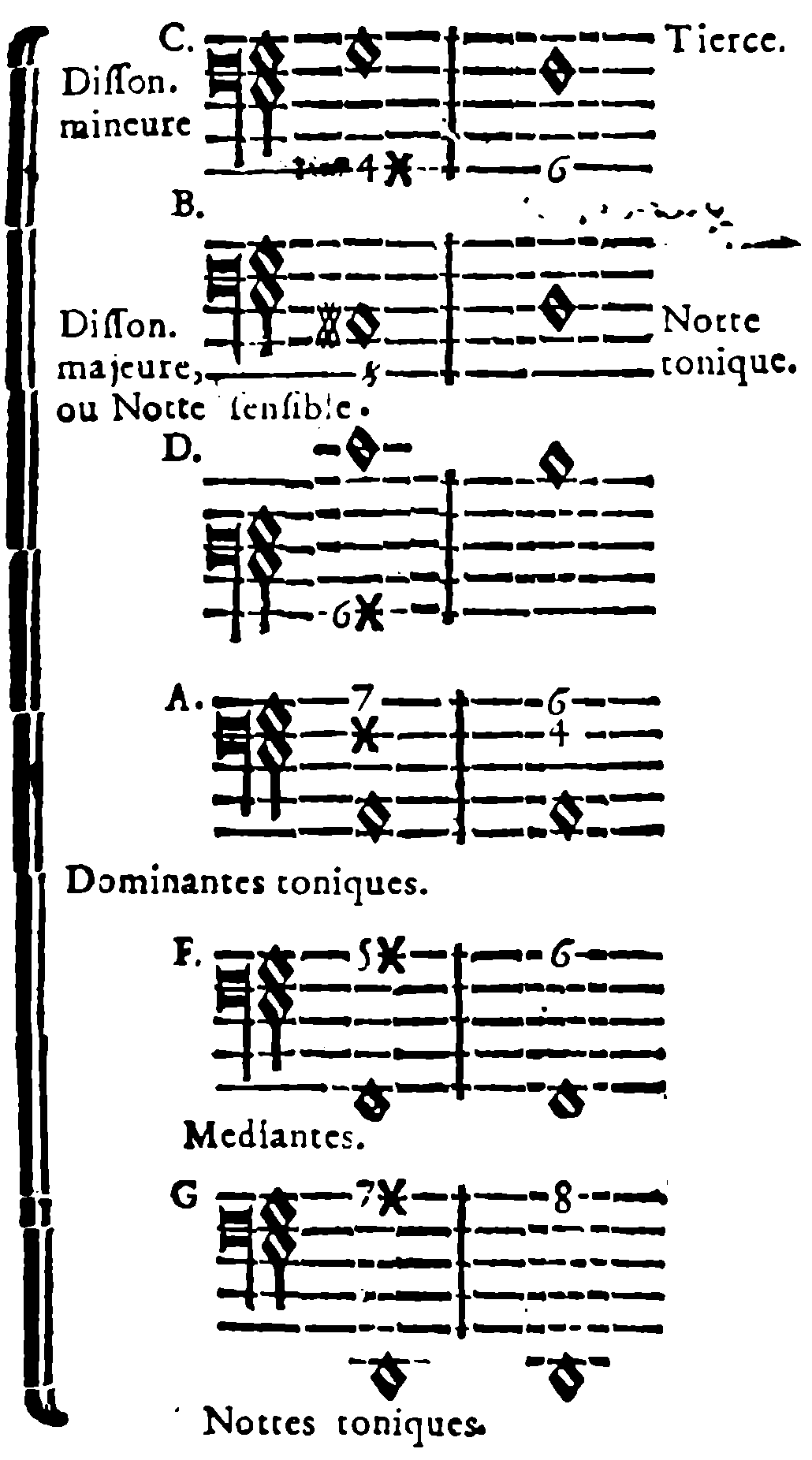
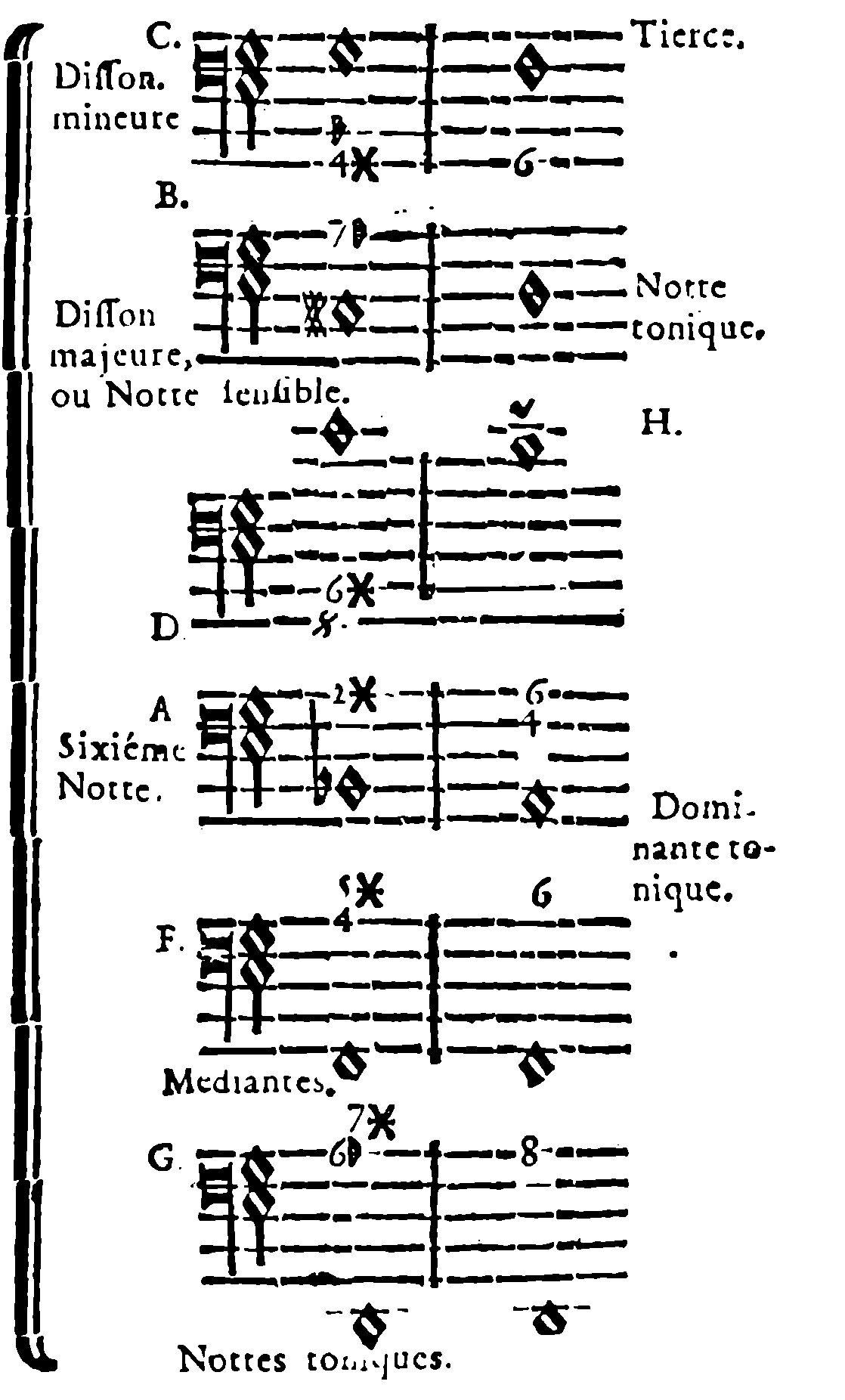
These chords by borrowing contain two major and two minor dissonances. The foreign ones arise from replacing the tonic dominant with the sixth note. We see that the minor dissonances always descend, but the foreign major one does not always ascend, as it would have to if it were the leading note. See the cue sign H, where this major dissonance may ascend, and indeed must do so when the minor dissonance C or A occurs in the bass.
Observe that the only difference between the two examples is the sixth note in place of the tonic dominant at A. The succession of dissonances in both examples remains the same, with no alteration whatever to the modulation.
Replacing the dominant with the sixth note produces this augmented-second chord and a corresponding difference in every chord derived from a tonic dominant’s seventh chord.
Where the leading note should bear the diminished-fifth chord, the resulting diminished-seventh chord comes solely from this change, adding 7♭ in place of 6, B.
Likewise, the minor third is added to the fourth note’s tritone chord in place of the second, C.
The diminished fifth is added to the second note’s small-sixth chord in place of the fourth, D.
The fourth is added to the mediant’s augmented-fifth chord in place of the third, F.
The minor sixth is added to the tonic’s augmented-seventh chord in place of the fifth, G.
To understand this difference better, take the four upper bass lines separately, letting each serve as bass in turn while the others serve as upper parts.
As for the two lower basses, the chords by supposition they bear prevent them from serving as upper parts, as we know. Each must be heard separately with the four upper parts, since they would not sound well together.
The new minor dissonance introduced by this change may descend alone, leaving the tonic dominant’s seventh chord afterward in its natural construction.
Example
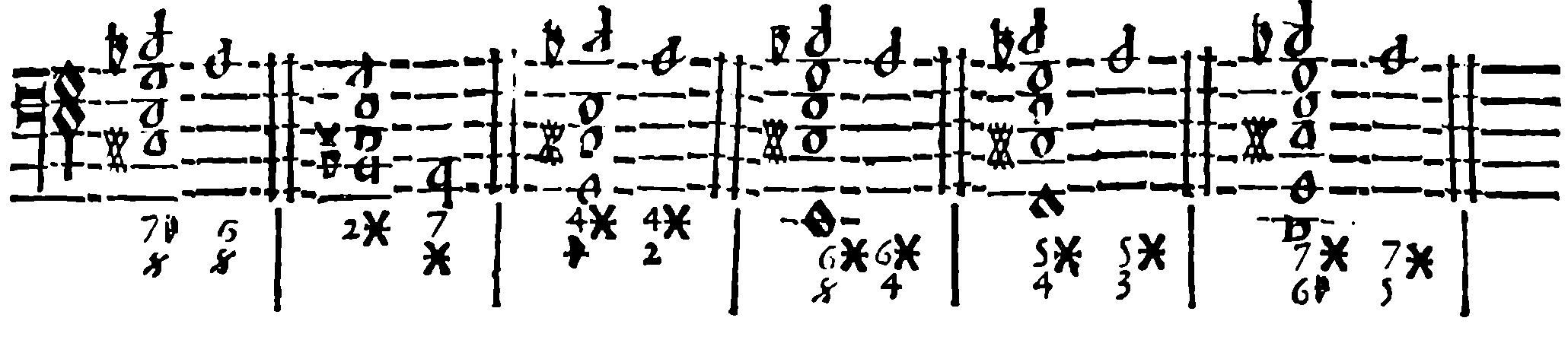
One may also make the leading note ascend alone, but only in the chords that can be inverted, not in the last two, which are by supposition. After ascending, however, it must return to its place in the tonic dominant’s seventh chord.
Example
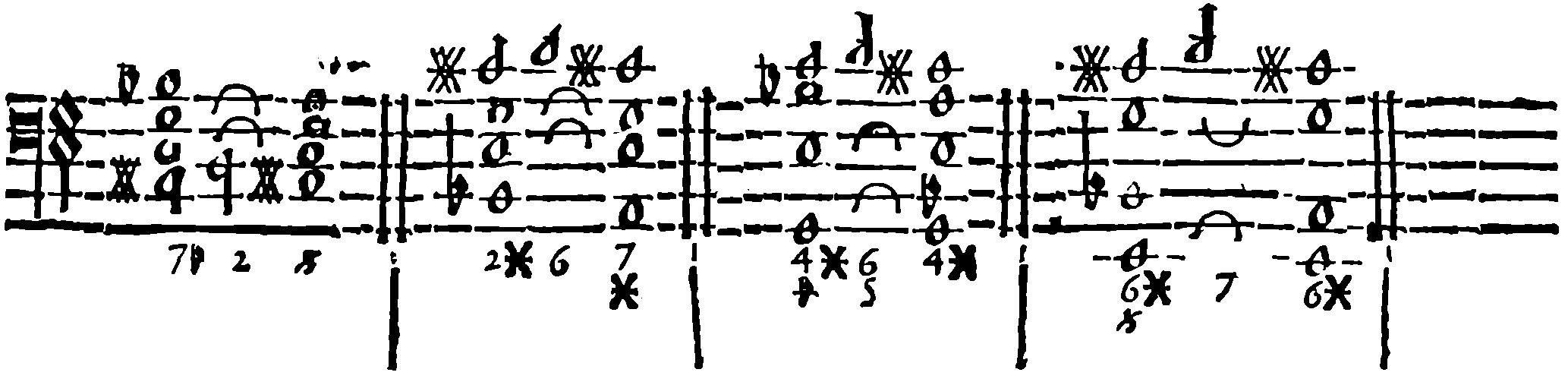
All these chords by borrowing, and the augmented-fifth chord, may be used only in minor keys, as already stated. Each has a particular bass note permanently assigned to it, as we explain more fully in Chapter XXXV. Some further licenses can be studied in Book II, Chapters XIII and XVIII.